Be selflessly selfish (as if you had a choice)

A few nights ago my wife traumatized me. She shook the foundation of my existence, which in no small part rests on a weekly filling up of our bathtub with steaming hot water, pouring a glass of red wine, and having a pleasant soak while reading the latest issue of People magazine. (How else am I going to keep up on celebrity weddings?) "Where's the People magazine?" I asked Laurel, wine in hand. "I left it at the athletic club," she told me. "I thought you'd read it." Instantly the bottom dropped out of my envisioned future. I couldn't believe…

Reality isn’t what we imagine, or remember

Most forms of religion, mysticism, spirituality, and philosophizing have a big drawback: they're wildly out of touch with reality. Of course, for those who don't care about living a truthful life, imagining an illusory world where Jesus saves, a guru enlightens, karma bites you in the butt during your next incarnation, or whatever, can be appealing -- since a believer can substitute warm and fuzzy concepts for whatever hard realities he or she wishes to deny. Those of us who are committed to experiencing life as honestly as possible have our own sources of solace, though. Since I'm a long-time…

“Story of Suzie” shows absurdity of Jesus

Thanks to one of my favorite blasphemous blogs, Pharyngula, I got to watch the new version of the Story of Suzie. I found it especially enjoyable because Christians are upset that the video depicts them as delusional. Well, to me Suzie accurately reflects the craziness of Christianity. Have a look and see if you agree.

Zen says the door is wide open (while we cling to bars)

As noted before, I keep re-reading Hubert Benoit's brilliant book about Zen, "The Supreme Doctrine." No matter how many times I ponder a page, a fresh understanding (or productive non-understanding) almost always pops into my psyche upon another perusal. This morning I re-read Benoit's chapter on The Immediate Presence of Satori. In the first few paragraphs he accurately captures the psychology of both spiritual seekers and humanity at large. My primordial demand to be a distinct being conditions all my desires and, by my desires, my hopes and my beliefs. Bearing this claim, I am the bearer of an aspiration,…

“Selfless Insight” — intriguing, yet disappointing, Zen book

I didn't enjoy neurologist James Austin's book about Zen and neuroscience as much as I thought I would. My reading of "Selfless Insight: Zen and the Meditative Transformations of Consciousness" may show, of course, that I'm neither selfless nor imbued with enlightened (or kensho'ened) insight -- both of which I plead guilty to. Regardless, I expected that Austin would provide a clearer and simpler analysis of how Zen meditation and brain science relate. He's written two other books on this subject, this being the most recent, so perhaps "Selfless Insight" is more complicated than his earlier works. I was left…

Sober or drunk? Sacred or profane?

I've rarely gotten drunk. But I love the notion of drunkenness. I don't swear a whole lot in public. But profanity springs from my lips much more freely than prayer does.

Reality just seems more, well, real when it is lived on an intoxicated blasphemous edge — whether this be conceptually philosophical or crudely physical. Neat and tidy sobriety isn't congruent with the cosmos' natural wildness, though we humans do our best to smooth rough edges and tame savage beasts.

At the end of this post I've included an excerpt from a chapter in Daniele Bolelli's terrific book, "On the Warrior's Path: Philosophy, Fighting, and Martial Arts Mythology (second edition)."

Now, if you're tempted to stop reading because your interest in martial arts is slim to nonexistent, give this post a chance.What we're talking about here is an issue that goes way beyond martial arts: is the straight and narrow a more productive path than a curving and unrestricted way?

If you read the excerpt from Bolelli's "Sacred and Profane: Combat Sports as Athletic Philosophy" chapter — and I hope that you do — be aware of your reaction to the two contrasting instructional styles he describes in such an entertaining fashion.

This likely will be an indication of what sort of spiritual, religious, moral, mystical, or philosophical teachings and practices you're most attracted to.

Admittedly, Bolelli features some extremes. But few of us are precisely balanced at a mid-point; it's natural to tilt one way or the other (for example, how many people are so perfectly bi-sexual, they're equally attracted to both sexes?).

I bought the second edition of Bolelli's book, even though I'd already read the first edition (and blogged about it in "Bruce Lee's Taoist life lessons") because two new chapters sounded intriguing to me.

I'm glad I did the Amazon deed. Bolelli is much more into martial arts than I ever was, but we share some common experiences and attitudes on both the philosophical and fighting fronts.
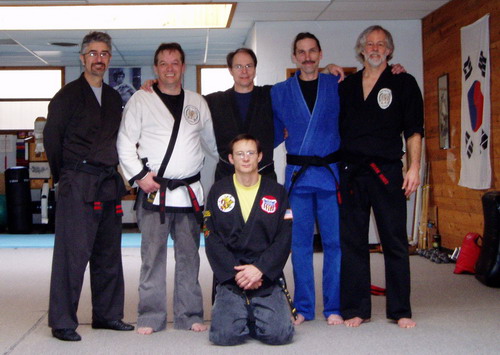
Pacific Martial Arts

I talked about this in a 2004 post where I congratulated my martial arts friend, Dave, on his black belt accomplishment. (I'm in a black gi on the right; Dave is next to me, in blue; Warren Allen, our instructor, is in the middle, in back.)

After almost nine years of traditional Shotokan karate training where everyone had to wear a plain white gi (and only females wore a t-shirt under it, which helps explain my habitual t-shirtless look), I much appreciate Warren’s hang-loose Taoist attitude toward the dojo dress code. Discipline is needed in the martial arts, but dressing exactly alike doesn’t teach anything except rigidity.

It’s interesting that my changeover from the linear, dogmatic, structured Shotokan training to the Pacific Martial Arts circular, eclectic, flowing style has pretty much paralleled a similar change in how I approach meditation and spirituality. I’ve become much less rigid in my philosophical/metaphysical beliefs during the years I’ve been trying to achieve a similar openness in my martial arts training.

My new Church of the Churchless site reflects this creedless creed mentality.

Daniele Bolelli's comparison of contrasting uptight Shotokan and hang-loose Jujitsu classes rang true to me. I trained for nine years in a traditional Shotokan dojo where we practiced the sort of rigid discipline you can read about in the extension to this post.

When I switched to the eclectic Pacific Martial Arts style, the training was just as tough and demanding — more so, in fact — but not as anal. This meshes with Bolelli's description of the Brazilian Jujitsu class he observed, a martial arts style that I learned just enough of to know how much more I had to learn about it.

Anyway, read on for an interesting take on whether sober is better than drunk, and sacred better than profane.

(If you'd rather watch than read, check out Jackie Chan's classic "Drunken Master" on Netflix; it can be watched instantly for free if you have a Netflix account; from about 1:20 to 1:27 is a generally comedy-less look at drunken-style kung fu.)

If the Bible permits it, why can’t I own a Canadian?

Here's a classic (all the way from 2002) expose of the ridiculousness of some entities that deserve to be ridiculed: the Old Testament and Dr. Laura Schlessinger. Dear Dr. Laura:Thank you for doing so much to educate people regarding God's Law. I have learned a great deal from your show, and try to share that knowledge with as many people as I can. When someone tries to defend the homosexual lifestyle, for example, I simply remind them that Leviticus 18:22 clearly states it to be an abomination. End of debate. I do need some advice from you, however, regarding some…

Lessening thinking is beneficial, but not religious

Every day, in so many ways, our brains produce lots of thoughts. Estimates vary as to the average number. When I asked Google, widely disparate answers popped up. None seemed to be based on solid scientific research. Regardless, most people -- certainly me included -- feel that much, if not most, of the thinking that goes on inside their heads is unproductive, useless, unnecessary, and even unpleasant. Yet the thought-beat goes on... boom, boom, boom, one after the other, much of the time with little rhyme or reason. Often this is called "monkey mind," since left to its own devices…

Vatican supports Parkinson’s disease “miracle,” but not a cure

To become a saint in the Catholic Church you've got to manifest at least two miracles. (Only after the person's death -- sainthood now is purely a posthumous possibility in Catholicism, though things were different in the Middle Ages.) John Paul II is halfway there, as this dead-and-gone Pope has been credited with a cure of Sister Marie Simon-Pierre's Parkinson's disease, which gets him to the beatification level. Failing to investigate many cases of sexual abuse apparently isn't a black mark for a would-be beatified. The global lay Catholic group We Are Church responded this weekend with dismay. In a…

Christian governor of Alabama practices non-brotherly love

I sure am glad that I don't live in Alabama. It'd drive me crazier than I already am if I had to listen regularly to the fundamentalist crap spouted by recently elected Governor Robert Bentley. "Anybody here today who has not accepted Jesus Christ as their savior, I'm telling you, you're not my brother and you're not my sister, and I want to be your brother." Hmmmm. So non-Christians in Alabama aren't going to be fully represented or respected  by the governor of their state? Here's a great argument for keeping religion out of politics -- the bigotry practiced by…

“The Best Spiritual Writing 2011” — a religious Rorschach test

I usually find a collection of essays to be too diffuse and disconnected for my taste. I prefer a book with a unifying theme, something that either grabs me or repels me -- but at least touches me forthrightly. However, I enjoyed "The Best Spiritual Writing 2011" more than I expected. [Note: I got this book free from the publisher, who said I could have a copy if I considered writing a review of it, which I'm doing here.] The thirty essays are well-written, some more so than others, naturally. Good writing always is pleasurable, even if I don't agree…

Klondike solitaire — a fine philosophy of life

My churchlessness has evolved to the point where playing an iPhone game app is my last sacred gesture before I meditate each morning. I go with a classic, Klondike, the Mobility Ware version of which is generically called "Solitaire" (for many people, including myself, Klondike is the beginning and end of solitaire games). It'd be a short book, but I could easily write Everything I Learned About Life Came From Playing Solitaire. Well, I might be doing that right now. Just before I meditate, I fire up my iPhone and click on the Solitaire app after reading for a while,…

Ken Wilber’s creationism is pseudo-science

I used to enjoy reading Ken Wilber's take on reality, a.k.a. Integral Theory. But eventually it dawned on me that Wilber takes a lot of liberties with facts about nature (human and otherwise), so much of his integrating involves untruths. Case in point: David Christopher Lane's short, easy-to-read pictorial essay, "Frisky Dirt: Why Ken Wilber's New Creationism is Pseudoscience." Lane persuasively argues that supposedly super-brilliant Ken Wilber actually is clueless about how evolution works. Chance plays a role, but natural selection is anything but random (that's why it's called selection, Ken). Wilber has come to sound like a creationist with…

Toward a more civil and honest discourse

President Obama's speech at yesterday's memorial service for the victims of the Tucson shooting inspired me. So I wanted to share some excerpts from his remarks which bear on any sort of discourse -- including "conversations" on this blog and elsewhere on the Internet. (Since quite a few visitors here live overseas, a brief background on the events that have shaken up the United States: last Saturday a Congresswoman, Rep. Gabrielle Giffords, was shot in the head by a young man, Jared Loughner, as she was speaking with constituents in Tucson, Arizona. Giffords survived, but six other people were killed…

Did Buddha have a stroke?

Maybe Buddha's enlightenment was caused by a lack of oxygen in his brain -- a stroke. It's a hypothesis that makes some sense. (Thanks, Mike, for sending me a link to this article.)

Reality is what works for us

What is real? This is one of the toughest questions. Ordinarily we don't pay much attention to it. We just go on with our lives. But sometimes it's necessary to ponder whether something is really there -- a human-like shadowy shape moving in the woods as we take an evening walk, say (if a serial killer is on the loose, we'll be seriously motivated to ponder that question). Philosophers are interested in this issue for other less concrete reasons. They wonder about topics such as "Realism and Truth," the title of a chapter in Philosophy in the Flesh, a thick…

Prayers are urged for a most worthy recipient

I'm not at all into praying, but will make an exception today. Someone dearly beloved to me is facing a difficult challenge. And even though I don't believe that God or any other higher power exists -- hey, there's a slight chance she/he/it does and can help my friend. Who is the University of Oregon football team that's playing for the national championship this afternoon. A simple loving, compassionate, heartfelt prayer is all that's needed. Like... May the blessed Oregon Ducks stomp the unholy crap out of the despicable Auburn Tigers, and may Auburn's Cam Newton & Nick Fairley have…

Religions (and RSSB) should come with a guarantee

If a product lets buyers down, consumer advocates -- along with plain consumers -- jump into aggrieved action. Sometimes excessively. I'm amazed that Consumer Reports, a magazine I love and have subscribed to for as long I can remember, still isn't recommending purchase of the iPhone 4 because of a minor antenna reception problem that really wasn't that big of a deal. However, it was a defect that Consumer Reports felt should have been fixed by Apple before the iPhone 4 was released. This makes me wonder: Wouldn't it be great if religions came with a guarantee that salvation, enlightenment,…

The self as illusion

For a long time I wanted to find my "true self." Then I got all enthused about calling off the search. The Buddhist notion of neither-this-nor-that fascinates me. Something else. None of the above. Think outside the box. Even more, blow the fucking box to smithereens. Searching. Finding. Real self. False self. God. Devil. Masters. Disciples. Wisdom. Ignorance. Good. Bad. Right. Wrong. More and more, I have the sense that It is something else entirely. By “It” I mean the root, the core, the kernel, the center that we’re all spinning around and never finding. Now, though, I'm beginning to…

Take a look at Best of Raptitude 2010

As noted before, I enjoy the Raptitude blog. Blogger David has listed his top 10 posts of last year, so that makes it easy to hit the 2010 Raptitude highlights. "Die on Purpose" is intriguing. Excerpt: I think it’s really helpful to forget you exist, and often. It sounds impossible, but it can be done. Here’s an exercise I do sometimes to achieve that perspective:Wherever I am, whatever location I am in, I picture the situation exactly as it would be if I wasn’t there. I just watch it like it’s a movie, and the people still in the scene…