Back in 2006 I pondered the question, Who is the guru?
By “guru,” I meant someone who is (1) alive today, and (2) considered by his/her devotees to be, if not actually God in human form, darn close to this exalted level of divinity.
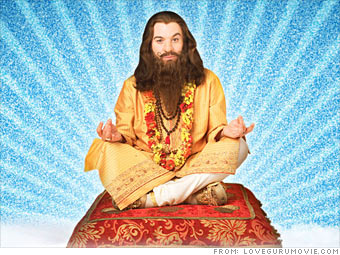
This is, obviously, a different sort of religious personage than, say, a Christian minister. Or even the Pope. It is easy to visualize them sincerely believing that they are God’s representatives on Earth, while recognizing that they are entirely human.
In some Eastern religions, though, the distinction between God and guru is minimal. Even nonexistent.
The Indian guru I was initiated by in 1971, Charan Singh, was considered to have attained a state of God-realization by his followers.
No longer believing this, my “Who is the guru?” post was an attempt to make sense of the fact that Charan Singh, along with his successor Gurinder Singh, could sit on a podium in front of tens of thousands of adoring disciples who looked upon them as not only godly, but as God.
I’ve been thinking about the four options concerning who Jesus was, according to biblical scholar Bart Ehrman: a liar, a lunatic, the Lord, or a legend. When it comes to a long-dead historical figure like Jesus, these options make sense. But what about a modern-day guru who is similarly proclaimed to be God in human form?
I was initiated by such a guru, Charan Singh Grewal. I sat at his feet, literally. I had two personal interviews with him. I heard him speak many times. I saw him worshipped by tens of thousands of devotees as a divine incarnation.
And yet, I still don’t know what to make of him. Or his successor, Gurinder Singh Dhillon. Who is the guru? A philosophically-inclined friend of mine likes to say, “There’s only one question to ask a guru who is supposedly God in human form: Are you who people claim you are?”
But given Ehrman’s four options, the answer wouldn’t be all that revealing. If the guru was a liar, you couldn’t believe what he said. Ditto if he was a lunatic. And even if he truly was the Lord, and said as much, what reason would there be to believe him? Plus, one could argue that a God-man would be so humble, you’d never hear a claim to divinity pass his lips.
With living gurus the legend option doesn’t come into play. They’re alive and kicking, not legendary. Quite a few men (and a few women) of recent vintage are considered by the faithful to be manifestations of God. For example, Meher Baba, Ramakrishna, and Lokenath.
So I muse over my recollections of Charan Singh and Gurinder Singh, trying to decide whether they’re best described as liars, lunatics, or the Lord.
I ended up preferring a fourth option, loyalist.
Is there another L-word that better fills the bill? One springs to mind: loyalist. Perhaps when a successor is appointed to fill the shoes of a highly-regarded guru, loyalty both to his predecessor and to the surrounding organization prevents the newcomer from crying out, “Hey, I’m not God! I’m just a man filling the role of a guru.”
This theory got support in a video David Lane made about Charan Singh, as described in a 2013 post, “Charan Singh was a loyal guru.”
But a essay by Michael Shermer in his Scientific American “Skeptic” column suggests another possibility. In “Lies We Tell Ourselves: How Deception Leads to Self-Deception,” Shermer says:
Trivers’s theory adds an evolutionary explanation to my own operant conditioning model to explain why psychics, mediums, cult leaders, and the like probably start off aware that a modicum of deception is involved in their craft (justified in the name of a higher cause). But as their followers positively reinforce their message, they come to believe their shtick (“maybe I really can read minds, tell the future, save humanity”).
Click on the link above to read the full piece by Shermer. I’ll also include it as a continuation to this post.
Desperate to find an L-word to add to the liar, lunatic, Lord, or loyalist possibilities, the best I could come up with after a brief look at some online thesauruses was to substitute “legerdemain” for self-deception.
It seems to fit, as rarely used as the word is.
2. trickery; deception.
3. any artful trick.
So let’s add a likely option that answers the question, “Who is the guru?” Legerdemainist. Which actually is a word.
The guru tricks himself into believing that he (or she) is God. Or God in human form, after being viewed as divine by fawning followers. This act of self-deception further bolsters his standing among devotees, as Shermer explains.
As Abraham Lincoln well advised, “You can fool some of the people all of the time and all of the people some of the time, but you cannot fool all of the people all of the time.” Unless self-deception is involved. If you believe the lie, you are less likely to give off the normal cues of lying that others might perceive: deception and deception detection create self-deception.
Interesting. Read on to peruse Shermer’s entire essay.

 No Comments