

Recently I had an essay rejected by the Spiritual Naturalist Society because the powers-that-be there, where I've become a regular contributor (for now…), didn't think that being politically active, in the sense of being involved in public policy debates, was a "spiritual" practice.
(See my post, Naturalism needs to rule public policy debates.)
This got me to thinking, again, about what that problematic word, spiritual, means. Most people, along with the dictionary, consider that it mostly refers to something supernatural, other-worldly, divine.
But how does a naturalist, someone who only considers the material world to be real, differentiate between what is spiritual and what isn't?
Back in 2008, in What does it mean to be "spiritual"?, I quoted Andre Comte-Sponville, the author of "The Little Book of Atheist Spirituality." His answer made generally good sense to me then, and still does.
Taken in its broadest sense, spirituality can be said to include virtually all aspects of human life and spiritual is more or less synonymous with "mental" or "psychic." Today, this use of the word has pretty much gone out of use, and when people talk about spirituality, they are usually referring to a rather limited part of our inner life (though it may contemplate limitlessness) – the part that involves the absolute, the infinite and the eternal. It is, in a sense, the spirit's farthermost point and its greatest amplitude.
So if "spirit" refers to mental, which tends to be my leaning, there isn't anything in human awareness or experience that isn't spiritual. And that obviously includes political activism.
Restricting "spiritual" to mean only the farthest limits of material existence, a contemplation of the vast extent (maybe eternal) of time and space, that strikes me as unduly restrictive.
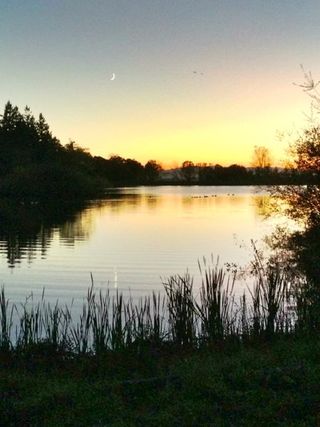
Can't I be spiritual while I'm raking leaves, writing a blog post, drinking wine, walking the dog around a nearby lake, testifying at a city council meeting, enjoying nature, or doing any number of other everyday things?
If so, what makes some of these everyday things "spiritual" and other things "unspiritual"? This was the question I posed to folks in the Spiritual Naturalist Society in some emails after my essay was rejected for publication on their web site.
Well, I'm open to other arguments.
I just haven't come across any convincing ones yet that would make me think that a naturalistic/atheist spirituality has to be restricted to only certain aspects of human experience.
Here's other blog posts I've written on this always-intriguing subject, some of which may contradict what I've said here, since I really am unsure what "spiritual" means for a materialist.
Spirituality is experienced, not proven
"Spiritual" and "Science" — two words that belong together
A secular Easter thought: "spiritual" isn't supernatural or religious
I'm churchless. And as "spiritual" as ever.
Real spirituality is realizing you aren't a soul, or self
Step out of the separate self, and you're spiritual
Discover more from Church of the Churchless
Subscribe to get the latest posts sent to your email.
My understanding was that believers are “spiritual” just as homosexuals are “gay”. Then Sam Harris decided that he’s spiritual. What’re ya gonna do?
Then say anything on spirits : spiritual, voodoo included
Better then name the “back to our origin” quest ; theologie again ?
or
no do semantics and take the thoughtless+awake state :
https://churchofthechurchless.com/2015/08/naturalism-needs-to-rule-public-policy-debates
10 seconds will do !
777
Brian,
For the record, the Society does not claim that spiritual means, “the farthest limits of material existence, a contemplation of the vast extent (maybe eternal) of time and space”. These abstract ideas are not very useful. Spirituality is precisely as you describe it in this post and in Comte-Sponville’s quote. As you say, “being politically active, in the sense of being involved in public policy debates” can definitley be a spiritual practice. In fact, refrain from social action is more difficult to justify in the spiritual life, I would think.
For more information, please see:
http://spiritualnaturalistsociety.org/naturalist-practice-the-big-picture/
http://spiritualnaturalistsociety.org/what-is-spiritual-transformation-pt-1-of-2/
http://spiritualnaturalistsociety.org/distractions-to-spiritual-practice-part-1/
Daniel Strain
Executive Director
Spiritual Naturalist Society
Thanks, Daniel. I didn’t intend to imply that the quote reflected the Spiritual Naturalist Society’s position, just mine. I’ll take a look at the links, as I hope others will.
“…anymore” ???
jordan, I used to believe there was a cosmic supernatural conscious entity that could be termed “spirit.” So whatever led to contact or union with that super-soul, so to speak, was spiritual.
https://en.wikipedia.org/wiki/Spiritualism
” So whatever led to contact or union with that super-soul, so to speak, was spiritual. –
It’s really a big trick Brian.
You are IT , . . minus thoughts c q IQ
777
I would define spiritual as that state of mind that connects us to a vastness that is beyond our everyday experience.
I think that God or Spirit is a (mostly unconscious) metaphor or analogy for those parts of our thinking and experience that *seem* to come from outside our conscious mind. I am very Jungian in this sense, but it’s also another way of saying our brains are very complex, and a unitary self-identity may not be as solid or as cohesive as it seems.
In other words, there is a *lot* going on in our minds besides what we are conscious of, and connecting or sensing that “other” in ourselves is a lot of what “spirituality” is about.
Another part of “spirituality” is about freeing us from the terrorism of our own thoughts, and letting go.
I believe all of this is 100% compatible with an athiestic approach to the world.