

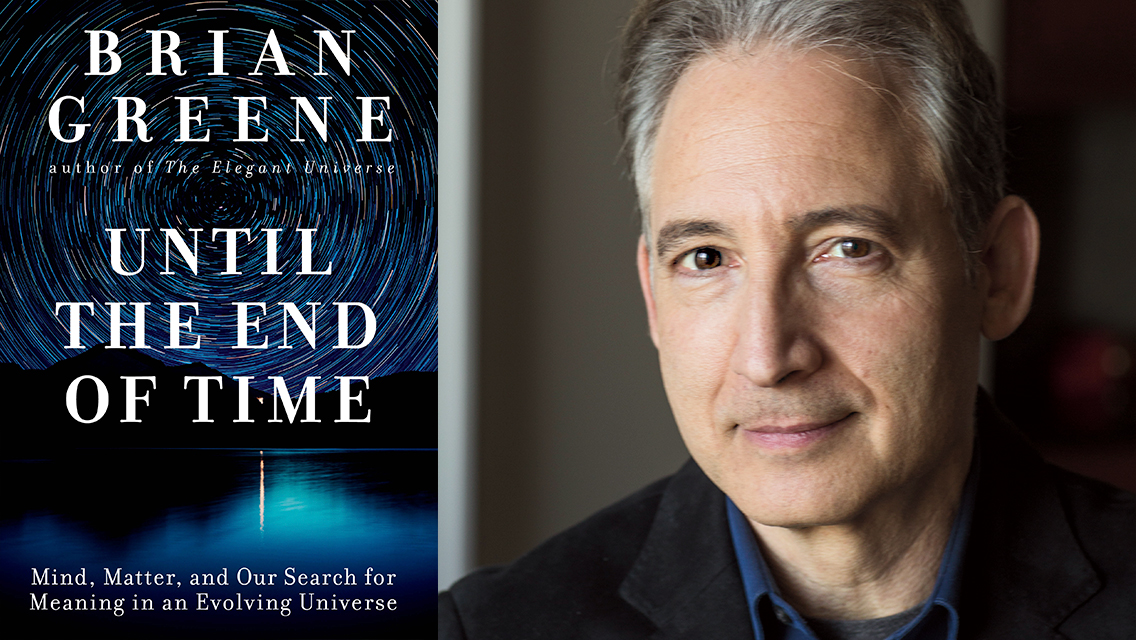
Here's an excerpt from a story in the most recent issue of TIME magazine about physicist Brian Greene and his new book, Until the End of Time. (I've ordered it, naturally.)
I get hugely more inspiration from science books like this one, because they're founded in reality, not fantasy, as religious writings are. I've been there and done that. Now, like Greene, I embrace the cold, cruel, wondrous universe.
There's a lot of satisfaction in such neat solutions to head-cracking problems. But there is an equivalent neatness to the ostensibly dispiriting conclusions Greene reaches in his books and in his research: that unhappy business of a cold universe, an insentient universe, of the individual as just a quantum contraption, behaving as a product not of choice but of probabilities and randomness.
It's where the free-will thing comes in: the universe is guided by quantum probabilities, and your "choices" are simply a part of that, the way a local breeze is part of the global weather system.
"My feeling is that the reductionist, materialist, physicalist approach to the world is the right one," Greene says. "There isn't anything else; these grand mysteries will evaporate over time."
But despite such empirical bravado, Greene says more too — and whether he likes it or not, it's not reductionist, and if it's written in a book like Until the End of Time, it could be written in the Vedas as well.
"Rather than feeling, 'Damn, there's no universal morality,' 'Damn, there's no universal consciousness,'" he says, "how wondrous is it that I am able to have this conscious experience and it's nothing more than stuff? That stuff can produce Beethoven's Ninth Symphony, that stuff can produce the Mona Lisa, that stuff can produce Romeo and Juliet? Holy smokes, that's wondrous."
The rational physicist with the deeply spiritual brother surely meant the holy as just a figure of speech — but if so, he picked an apt one.
Discover more from Church of the Churchless
Subscribe to get the latest posts sent to your email.
What’s not to love about the universe?
If you like anazing stuff, look no further. But you have to keep looking deeper and deeper as it all unfolds to see what’s really in front of you.
The more carefully you look the more you see, and the more you realize is there that you don’t see.
And if you love a mystery shrouded in the unknown, there is even more of that.
As for universal consciousness not existing, that’s a stretch. The universe exists, we are all connected. Human thought should not be the definition of thought or consciousness.
Also, any Mathematician will tell you that there is no such thing as truly random. Random is a mathematical, a statistical tool to help explain the background noise of myriad variables we haven’t fully measured yet. When you investigate in detail, you see that every event has a cause. And if you investigate far enough, you can science it down to predictable cause and effect. There is nothing loose, unconnected or random in the entire creation. The very notion violates the foundation of science.
Finally, the universe is infinitely sensitive. Nothing happens without both cause and effect, no matter how far away or tiny.
Two bodies in space separated by millions of miles with nothing detectable between them still effect each other’s movement.
Funny how scientists can instantly forget the basics of science when they venture into sweeping philosophical statements about reality. Forgive them. They are only human.
Understood rightly, Schroedinger’s Cat is science’s resignation to the fact that everything, even the scientist making their observation, is connected. Yes the creation blushes, or in Schroedinger’s case dies, when you look at it.
Greene says, “how wondrous is it that I am able to have this conscious experience and it’s nothing more than stuff?”
— Greene has it backwards. Stuff is nothing more than consciousness. There is just consciousness. That’s it. Full stop. Right here. Really. Just slam on the brakes. Just consciousness. Right here. Immediately.
it depends who reads this book.
Like a child will look different upon a flower, or a lover, a an artist, so does the biologist, the farmer etc.
They all use the denotative flower and by doing so it seems that the are discussing the same… they do not, as their personal use of the denotative is commanded by their connotative experience.
In a way he talks like an religious person, that seeks and explanation for the unexplained and what cannot explained. He too, like them, is looking for a “giver” an “creator”.
Like not all are gifted with an mathematic talent, that turns them into brilliant scientists, not all are gifted with the power to love as expressed by mystics.
In fact there is not very much difference between the two and it is unhealthy to turn it into an either this or that discussion.
https://www.youtube.com/watch?v=z0tHMFkXws4
Maybe this is nice for some..a Mooji video.
It is not a believe system no religion…
Being aware even of being aware..
The Being the Presence..
It’s a bit like vipassana..
It can be the Sadana to stay in the observing presence..
@ Understood rightly, Schroedinger’s Cat is science’s resignation to the fact
@ that everything, even the scientist making their observation, is connected.
@ Yes the creation blushes, or in Schroedinger’s case dies, when you look at it.
Yet the converse is true for the mindful “cat” in its radioactive
cage. When its thoughts go unobserved, it falls asleep and
fitfully dreams of chasing squirrels. Or, drifting into a catnap,
it daydreams of treats and showing its human who’s boss.
But, ah, remaining mindful, its observed thoughts fade away
like its cousin the Cheshire Cat. The cat purrs.
Consciousness is a doozy. ‘Ness’ is added to an adjective to become an abstract noun denoting an idea, quality, or state rather than a concrete object. For example happy becomes happiness; kind becomes kindness; selfish becomes selfishness and conscious becomes consciousness. We are conscious creatures and we can discover when, why and how we are conscious – though we cannot discover a ‘thing’ called consciousness.
Okay, perhaps there is a universal principle that accounts for everything, but I doubt whether our recently evolved thinking brains are capable of knowing ‘it’! And consciousness is such a confusing word in that it is known that various areas of the brain are responsible for the conscious experience. Better to call ‘it’ something else. I prefer ‘life’, although perhaps better is ‘Tao’.
And as for the other doozy – free will. Seeing that the I/self/mind structure is a mental construct composed purely of information, such contents can only choose (or arise as the situation demands) from its library of information, but this is not free will. There is no entity in there to exercise free will – only an ad hoc accumulation of information.
Wow, reading just the first 9 comments “my consciousness” got a lesson in biology, math, science-esce, language-ness, philosophy, zen and a trip down the rabbit hole.
Maybe what we “are” is just a part of some sleeping cat’s dream.
I assume in the minds of people like Elon Musk this is a possibility—the transference of consciousness biologically.
https://youtu.be/M8PsZki6NGU
What do you think?
On another note, I think colonizing Mars is ridiculous. It’s an insult to the planet that gave birth to the human race. Not only that, it’s stupid to say the very least. All of that money would be better spent trying to combat the man-made causes of climate change.
If we accelerate the preventable causes of earth’s destruction, we deserve to die.
Bill Bryson’s new book The Body is a great read too.
Fun facts from it: The saying that “we only use 10% of our brain” isn’t true, and no one knows where it came from.
A piece of our brain the size of a grain of sand has the memory capacity to hold all the movies ever made.
We don’t actually live in the present but perceive events 1/5th of a second after they’ve actually happened.
@ We don’t actually live in the present but perceive events 1/5th of a
@ second after they’ve actually happened.
Mystics would counter we do live in the present whereas the events
we perceive happened in the past. The events were all conceived
by the creative power of consciousness. They happened in a single
moment beyond time itself. Call it the “big bang”. Consciousness
simply replays these events which are now memories for the sake
of a roller-coaster thrill ride in duality.
A fairy tale? Perhaps, but the mystic’s claim is that it is provable
by introspection of consciousness itself through various practices
of mindfulness.
But, since super-consciousness has stepped down awareness for
thrill enhancement, the body’s 1/5 sec. processing delay seems
reasonable. Don’t take any wooden nickels from mystics without
a shred of proof.
Dungness,
That sounds true..
Interesting..
Anyway it’s good to see, feel, undergo conciously..our ‘own’ awareness..
I think..
Words are short..
“My feeling is that the reductionist, materialist, physicalist approach to the world is the right one,” Greene says. “There isn’t anything else; these grand mysteries will evaporate over time.”
“Rather than feeling, ‘Damn, there’s no universal morality,’ ‘Damn, there’s no universal consciousness,'” he says, “how wondrous is it that I am able to have this conscious experience and it’s nothing more than stuff?
Some refer to awareness as the original state. Here’s a snippet from what Nisargadatta Maharaj taught. “Awareness is primordial; it is the original state, beginningless, endless, uncaused, unsupported, without parts, without change. Consciousness is on contact, a reflection against a surface, a state of duality. There can be no consciousness without awareness, but there can be awareness without consciousness, as in deep sleep. Awareness is absolute, consciousness is relative to its content; consciousness is always of something. Consciousness is partial and changeful, awareness is total, changeless, calm and silent. And it is the common matrix of every experience.”
But then we’ve just substituted one abstract verb for another (consciousness – to awareness) and still have no evidence as to what either are. Perhaps because any originating causal agent is beyond the ability of a simple thinking organism – us. I like the fact that we cannot use it, cannot make of it a commodity, cannot make it into a mind object to enhance the ego/self.
Again, to repeat from my earlier comment – “. . . consciousness is such a confusing word in that it is known that various areas of the brain are responsible for the conscious experience. Better to call ‘it’ something else. I prefer ‘life’, although perhaps better is ‘Tao’”.
Maybe it’s better to drop this ‘universal consciousness’ concept and accept that the universe ‘just is’. Many ‘thinkers’ on this matter sensibly refer to ‘it’ as ‘This is it’; ‘the formless’; ‘What is’ and Tao. They don’t know and say it is not in our domain to know it or to stick some concept onto it.