

As soon as I saw the title of this book mentioned in a recent issue of New Scientist, I ran to my computer and ordered a copy of Existential Physics: A Scientist's Guide to Life's Biggest Questions from Amazon.
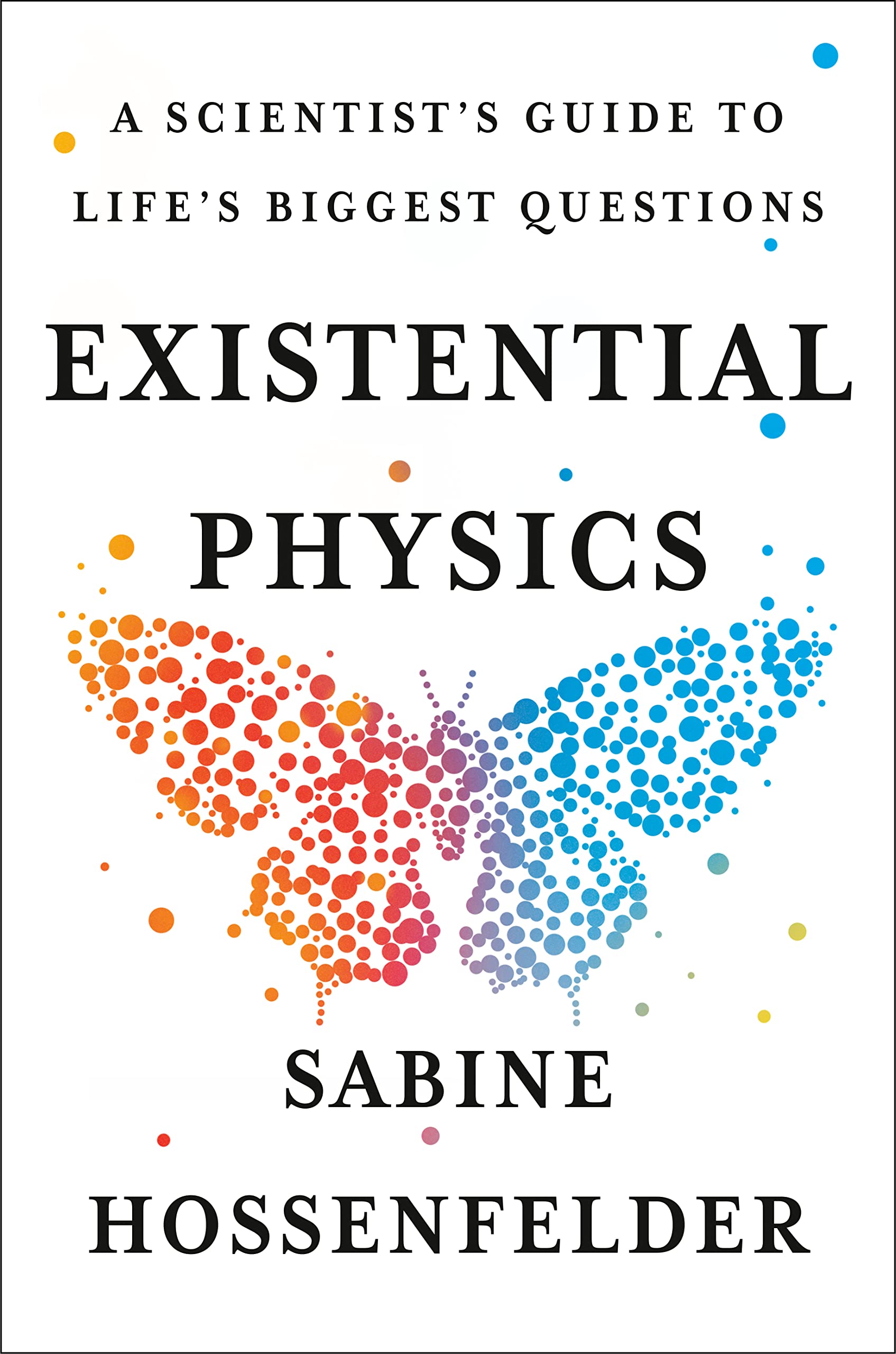
As expected, I'm enjoying the book.
I've only read the Preface and initial chapter, "Does the Past Still Exist?", but that's enough to tell me that theoretical physicist Sabine Hossenfelder is a gifted writer with a talent for explaining complex ideas so ordinary people can understand them.
She describes her approach in the Preface. I like how she views the relationship between physics and spirituality.
After all, I'm just a physicist. I'm not competent to speak about consciousness and human behavior and such. Nevertheless, the young man's question drove home to me that physicists do know some things, if not about consciousness itself, then about the physical laws that everything in the universe — including you and I and your grandmother — must respect.
Not all ideas about life and death and the origin of human existence are compatible with the foundations of physics. That's knowledge we should not hide in obscure journals using incomprehensible prose.
It's not just that this knowledge is worth sharing; keeping it to ourselves has consequences. If physicists don't step forward and explain what physics says about the human condition, others will jump at the opportunity and abuse our cryptic terminology for the promotion of pseudoscience.
It's not a coincidence that quantum entanglement and vacuum energy are go-to explanations of alternative healers, spiritual media, and snake oil sellers. Unless you have a PhD in physics, it's hard to tell our gobbledygook from any other.
However, my aim here is not merely to expose pseudoscience for what it is. I also want to convey that some spiritual ideas are perfectly compatible with modern physics, and others are, indeed, supported by it.
And why not? That physics has something to say about our connection to the universe is not so surprising. Science and religion have the same roots, and still today they tackle some of the same questions: Where do we come from? Where do we go to? How much can we know?
When it comes to these questions, physicists have learned a lot in the past century. Their progress makes clear that the limits of science are not fixed; they move as we learn more about the world. Correspondingly, some belief-based explanations that once aided sense-making and gave comfort we now know to be just wrong.
The idea, for example, that certain objects are alive because they are endowed with a special substance (Henri Bergson's "elan vital") was entirely compatible with scientific fact two hundred years ago. But it no longer is.
In the foundations of physics today, we deal with the laws of nature that operate on the most fundamental level. Here, too, the knowledge we gained in the past hundred years is now replacing old, belief-based explanations.
One of these old explanations is the idea that consciousness requires something more than the interaction of many particles, some sort of magic fairy dust, basically, that endows certain objects with special properties. Like the elan vital, this is an outdated and useless idea that explains nothing.
I'll be sharing Hossenfelder's conclusions about the big questions in future blog posts. To whet your appetite for them, here's the preview she shared in her Preface.
I will get to this [whether consciousness needs something besides particles] in chapter 4, and in chapter 6 I'll discuss the consequences this has for the existence of free will. Another idea ready for retirement is the belief that our universe is especially suited to the presence of life, the focus of chapter 7.
However, demarcating the current limits of science doesn't only destroy illusions; it also helps us recognize which beliefs are still compatible with scientific fact. Such beliefs should maybe not be called unscientific but rather ascientific as Tim Palmer (whom we'll meet later) aptly remarked: science says nothing about them.
One such belief is the origin of our universe. Not only can we not currently explain it, but also it is questionable whether we will ever be able to explain it. It may be one of the ways that science is fundamentally limited. At least that's what I currently believe.
The idea that the universe itself is conscious, I have found to my surprise, is difficult to rule out entirely (chapter 8). And the jury is still out on whether or not human behavior is predictable (chapter 9).
Discover more from Church of the Churchless
Subscribe to get the latest posts sent to your email.
“…Such beliefs should maybe not be called unscientific but rather ascientific as Tim Palmer (whom we’ll meet later) aptly remarked: science says nothing about them.
One such belief is the origin of our universe. Not only can we not currently explain it, but also it is questionable whether we will ever be able to explain it. It may be one of the ways that science is fundamentally limited. At least that’s what I currently believe.
The idea that the universe itself is conscious, I have found to my surprise, is difficult to rule out entirely (chapter 8)…”
I’m reacting here only to the portion I’ve quoted. I do realize that it could be that I’ve taken those few sentences I’ve quoted out of context, since I haven’t actually read her book. It could be she’s merely discussing the route of soft atheism, or maybe she’s merely talking about how we don’t have 100% certainties in science, ever. It could be that she doesn’t actually mean that as literally a view on whether or not the universe might be conscious. In which case I’ll be happy to retract my criticism, absolutely.
But taken by themselves those sentences do convey, by implication, exactly the kind of meaning that woo-peddlers of the Deepak Chopra variety tend to latch on to. No sane rational man will go around imagining that the universe might in fact be conscious. (Equally, though, no sane rational man will refuse to acknowledge it if the evidence one day shows that that might be so. Nor would the sane rational man have any difficulty in speculating, while clearly recongizing the speculation to be nothing more than speculation; and nor in researching the idea further if he wanted to. But to incorporate that sort of thing as a possible descriptor of reality, that is incompatible with a rational scientific worldview. No matter if it is a scientist that espouses such a view.)
Have just read this blog on ‘Existential Physics’ and look forward to reading some more extracts – or perhaps buy the book.
I like what Hossenfelder says about ‘respecting the physical laws of the universe and how physicists needs to “. . . step forward and explain what physics says about the human condition, [or] others will jump at the opportunity and abuse our cryptic terminology for the promotion of pseudoscience.” And also that she aims to point out that regarding quantum entanglement and vacuum energy, as being the go to explanations of alternative healers, spiritual media, and snake oil sellers.
She talks of outdated ideas such as old explanations that, “. . . consciousness requires something more than the interaction of many particles, some sort of magic fairy dust . . .” She also adds that to her surprise it is difficult to rule out entirely that the universe is conscious. This will make for interesting reading as she will be discussing “ . . . whether consciousness needs something besides particles . . .”
There is prevalent assumption to confuse being conscious with self-conscious. I often feel that the term for consciousness gets limited to meaning being self-conscious. Matter does react (even rocks change and ‘evolve’) according to their environment. Perhaps particles have a potentiality, perhaps a momentum toward eventually, life, mind and finally consciousness but to confer some sort of awareness or consciousness of them, is a bit of a stretch.
Also, I quite like the fact that regarding the universe she says: – “One such belief is the origin of our universe. Not only can we not currently explain it, but also it is questionable whether we will ever be able to explain it.” This is honest (a hallmark of science). I can appreciate the limitations of our human abilities, perhaps it is a characteristic of the human mind that it egotistically believes every question will eventually bow before it.