

If a religion, spiritual path, or mystical realization could promise a very good chance that you'd be able to do away with feelings of blame, regret, and pride — along with other negative or good-to-let-go-of emotions — would you want to pursue that opportunity?
I sure would.
Especially if that opportunity didn't involve believing anything that couldn't be demonstrated to be true. And since I no longer believe in God or any other supernatural entities, I'd give the opportunity bonus points if it was thoroughly secular.
That's why I've been so enthused for quite a few years about seeing through the illusion of free will, with my enthusiasm intensified recently by a book I'm reading, Paul Breer's The Spontaneous Self: Viable Alternatives to Free Will.
As noted in previous posts, Breer is fairly unique among writers on the illusion of free will in his emphasis on the benefits of seeing through the illusion, along with tips on how to do this. On the benefits front, Breer persuasively argues that without a belief in free will, blame, regret, and pride naturally fall away.
Giving up the ghost of agency exposes guilt, remorse, and sin as demons whose power to torment us rests on an error in our thinking. In light of the pain those demons continue to inflict upon us, it seems reasonable to ask why we continue to tolerate the error. In part, the answer lies in what we stand to lose by changing our thinking.
We are attached to a view of ourselves as causal agents who are not at the effect of other causes. We enjoy seeing ourselves as islands of freedom in a sea of determinism. From this perspective, every time we act out of will we perform a small miracle.
We are gods who move the world of experience and behavior without ourselves being moved. Once a god, it is hard to settle for less, hard to leave that island and join other creatures of the sea, hard to accept that we are bound by the same laws of motion, heredity, and conditioning as the rest of nature.
Giving up the illusion of agency implies rejoining the natural world, or more accurately, recognizing that, despite our dreams of divine status, we have never been parted from it.
If we give up our identity as soul-agents, we also stand to lose the satisfaction of pride and approval, which, some would argue, more than compensate for the pain of guilt and disapproval. The fear of losing credit for our accomplishments is certainly one of the reasons we have resisted attacks on free will.
Breer, though, makes clear that we gain much more than we lose by giving up the illusion of agency, of free will.
After all, while the feeling of pride we get from being praised for something we did is real, it isn't necessary to demand that people stop saying, "You did a great job." We just need to remember that the you being referred to isn't an independent entity who is responsible for freely willing their actions, but a person whose actions are the result of deterministic causes and effects.
In other words, instead of thinking "I did that," we realize "That happened here, via this person." Thus giving up a belief in free will leads to the sort of humility that is difficult to attain from years or decades of ardent meditation.
(I speak as someone who engaged in decades of ardent meditation.)
The same applies to feelings of blame, whether directed at others or at ourself, and regret. In no way am I past feelings of blame, self-blame, and regret — feelings that I've struggled with in the past and surely will continue to do so in the future.
All I'm saying is that the more I look upon the world through the lens of no-free-will, which I've been doing more strongly after I started reading Breer's book, I've been having some success with toning down feelings of blame, self-blame, and regret. Breer writes:
When we interpret blame as positional (aimed at our behavior) rather than moral (aimed at our agent) we both feel and respond differently. Being identified as the person in whom an offensive act has arisen, as opposed to the agent who has made that act happen, is less likely to make us defensive.
As persons instead of agents, we have less to defend; while our value as body/minds remains open to judgment, our worthiness as creators of experience and behavior is no longer at stake. Once relieved of the fear of being proven unworthy agents, we are unlikely to develop feelings of rage or harbor thoughts of seeking revenge against our accuser.
If our behavior needs explaining, we need only point to our genes, our previous conditioning, and certain features of our present environment. Because the behavior has arisen here, however, we will still suffer the consequences.
If those consequences are punitive, it behooves us to defend ourselves against false accusation. The choice may even arise to defend ourselves against a legitimate charge. Whatever the decision, our belief that we are positionally but not morally responsible makes it easier for us to be objective in weighing the evidence presented.
Yesterday Laurel, my wife, and I put this mirror up on a wall in our house. (Laurel likes blue, along with dog art.) I took the lead in putting it up, since I'm more familiar with our cordless drill and am more rigorous in measuring where a wall hanging should go than Laurel is.
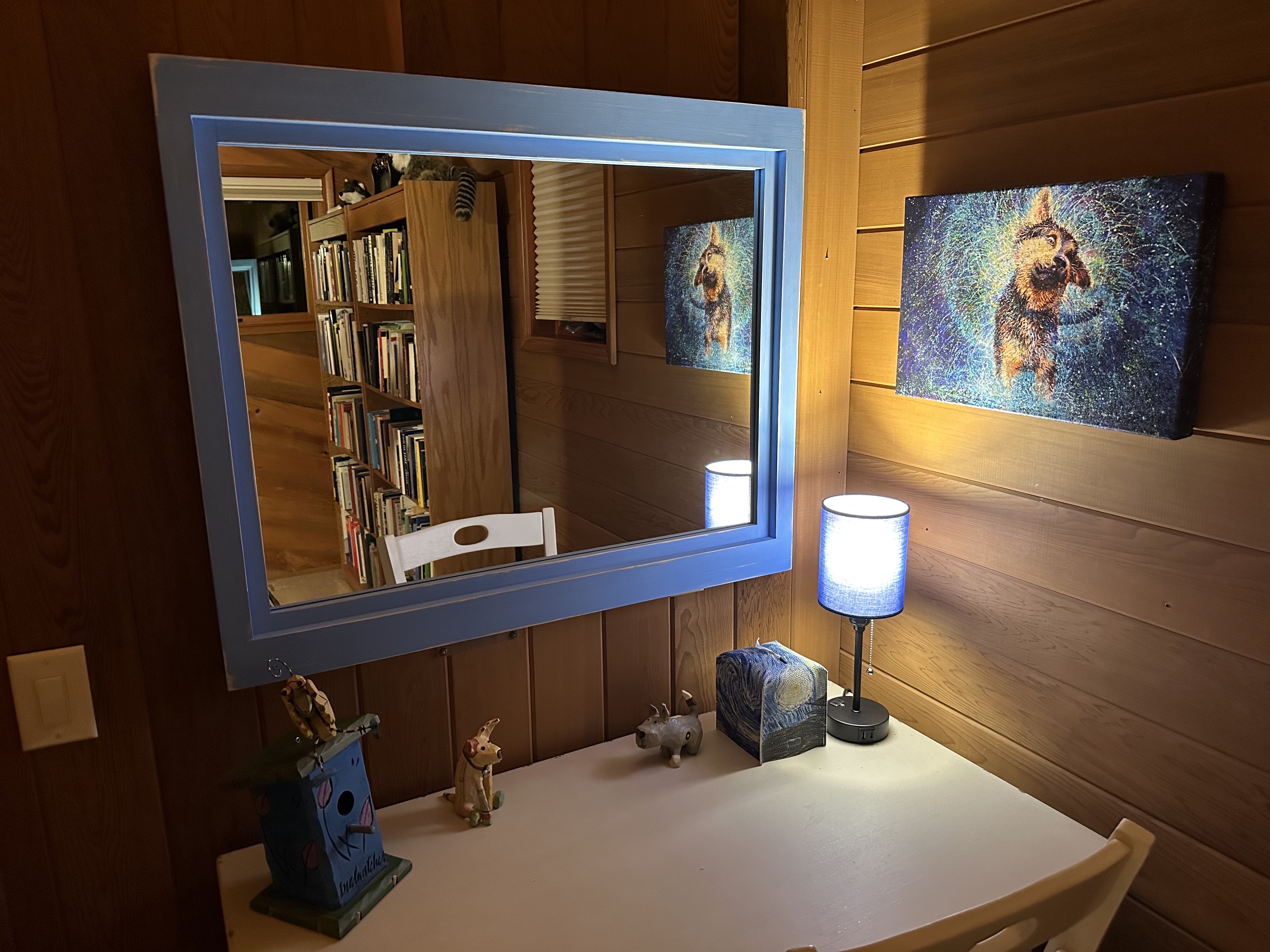
But rigorous doesn't mean error-free. This was kind of a tricky installation, since the mirror needed to cover up some earlier work on our 1973-era home that occurred before we bought it in 1990. A previous mirror, not blue, of a different shape used to cover up those patches.
So I measured. I calculated. I put pencil marks on the wood wall where the screws should go to make for a mirror perfectly centered over the desk and vertically in just the right place to cover the patches. Everything was looking good. Until…
Laurel said as we were about to place the hangers on the back of the mirror over the screws, "The screws aren't even close to the fasteners." Absolutely correct. I was guilty as charged.
Interestingly, I didn't feel more than a slight twinge of regret or self-blame. I just started to remove the screws so they could be put in the correct location. I had no idea why my measuring and marking went amiss. That really didn't matter.
As Breer said, I had to deal with the consequences of my positional responsibility for the mistake. I was the person who caused the mistake. However, I didn't feel that I was an agent who freely willed whatever caused the mistake. It just happened.
Five or ten minutes later. The mirror was solidly on the wall. Mistake corrected. Now, sure, this was a minor problem. It remains to be seen how I'll react when I make a bigger mistake and am tempted to blame myself for it.
I'm simply saying that by deeply pondering the illusion of free will, I feel a bit less bound by my tendency to blame myself when something goes wrong or praise myself when something goes right. Increasingly, I'm seeing that things just happen, and I'm the person where they happen.
Discover more from Church of the Churchless
Subscribe to get the latest posts sent to your email.
Bree talks about: – “Giving up the illusion of agency implies rejoining the natural world, or more accurately, recognizing that, despite our dreams of divine status, we have never been parted from it.” This sounds eminently sensible, not only to the question of agency but to the vast amount of abstract concepts that permeate our thinking.
It would appear that the thoughts, ideas and opinions that arise in us consist of perceptions that were laid down in our past through exposure to various experiences and influences. Other than practical matters where we draw upon past information to address a plan of action – whether that is to build a bridge, prepare a meal, or plant a shrub in the garden – all other thoughts fall into the category of subjective opinions.
It appears we spend a vast amount of time and mental energy suffused by the type of abstract thinking where thoughts and views espoused are subjective, and are peculiar to the individual who holds them. Nothing wrong with a few abstract thoughts, a bit of harmless day-dreaming is fun and relaxing, but sadly, where many abstract thoughts are believed to represent reality then the schism between what is real and natural and what is un-natural may have the effect of divorcing us, not only to the natural world but to our own natures and the reality thereof.
I don’t know what to make of this idea that a “person” is somehow different from an “agent,” Or that mistakes “just happen.”
I can understand how the environment can play a part in how I react. For example, I once heard Ajahn Amaro’s talk about how pre-monsoon weather affected all the monks’ moods. The hotter and more humid it got, everyone tended to be edgy.
I noticed this very thing when I visited Asia. I’d enter the country feeling very serene and full of benevolence, but within no time the heat and the crush of people on the city streets would play havoc with my lofty ideals of serenity. And so, I agree that environment, the time of day, diet, etc can have a marked effect on how “I” am.
No doubt environment has a large impact on the health of a society. I’m talking about cultures within a society. We can see that some cultures have demonstrably positive characteristics of strong family ties, industry, respect for education, and civil order. We have other cultures that do not share those qualities. The people of these cultures are generally responsible for most of the crimes (hurting other people). The solution to this problem isn’t to forgo punitive action because these criminals came from a problem culture/environment. Rather, the solution is to change the culture by holding each person accountable for the harm they do, and not reward them for it.
This idea of morality being an illusion is something I don’t agree with at all. Yes, self-recrimination can be overdone, but zero recrimination isn’t a healthy ideal. The Manson family is an example of why. Manson drilled his followers into believing that all social mores were a false construct.
The entire movement to empower all people is a movement to establish voice and agency personally, individually.
Not erase it.
Whatever helps you sleep at night…
Let’s brush up on the basics, shall we:
https://www.thecollector.com/jean-paul-sartre-philosophy-ideas/
“On the benefits front, Breer persuasively argues that without a belief in free will, blame, regret, and pride naturally fall away.”
Ah, I’d been waiting for you to get to this, Brian. The “strategies” part of it.
Here’s my thoughts about what I read here. While appreciative of Breer’s overall work, obviously, but I’m afraid my thoughts around what I’m seeing here are …well, kind of critical?
I’ll briefly mention what all I find just a bit off here, in the first section. And dwell at some length on my major …doubt, issue, about this business, in the subsequent section, that I’ll be grateful if you can resolve, either basis what Breer’s said elsewhere in the book, else basis your own thoughts about this.
“We surrender to a higher power when we no longer believe in free will”
“a surrendering of control to a higher power plays the key role in most conversion experiences, the specific object of that surrender being secondary. While in our culture it is God to whom we usually relinquish our power (“Not my but Thy will be done”), it could just as easily be Circumstance or Causal Necessity or Chance”
“When we give up straining either to bend the world to our will or to prevent it from taking away the things we love, we can experience what it is like to live in that world. Because our wishes are less urgent and our efforts less violent, we no longer feel pitted against the world.”