

As I said in my previous post about Sartre and how his view of freedom bugs me because I don't believe in free will, Sartre takes it for granted that because he feels like he is free to choose his actions, this is proof that free will actually exists.
This is wrong.
It goes against what is known about the human brain. So because I realize how entrenched a belief that they possess free will is in the minds of most people, including commenters on this blog, I dug out what I consider to be one of the best books debunking free will: Daniel M. Wegner's The Illusion of Conscious Will.
Below is how Wegner summarizes his position in the book's first chapter, "The Illusion." (Wegner is a Professor of Psychology at Harvard.) But all isn't completely lost for believers in free will, because Wegner also discusses in his book why free will seems to be true. Meaning, evolution has given us a sense of free will because this illusion has benefits.
In my next post I'll share the benefits that Wegner describes in a concluding chapter, "The Mind's Compass." (Preview: a compass tells us what a ship is doing, but it doesn't control the action of the ship.)
Broadly speaking, what Wegner says below has implications for more than just how we view free will. Our inability to know what the brain is doing down in the engine room, so to speak, should make us cautious about drawing strong conclusions from our conscious experience insofar as we believe that what we're conscious of reflects what is going on in the brain.
Philosophers and psychologists have spent lifetimes thinking about how to reconcile conscious will with mechanistic causation… The solution explored in this book involves recognizing that the distinction between mental and mechanical explanations is something that concerns everyone, not only philosophers and psychologists.
The tendency to view the world in both ways, each as necessary, is what has created in us two largely incompatible ways of thinking. When we apply mental explanations to our own behavior-causation mechanisms, we fall prey to the impression that our conscious will causes our actions.
The fact is, we find it enormously addictive to think of ourselves as having minds, and so we are drawn into an intuitive appreciation of our own conscious will.
Think for a minute about the nature of illusions.
Any magician will tell you that the key to creating a successful illusion is to make "magic" the easiest, most immediate way to explain what is really a mundane event. Harold Kelly (1980) described this in his analysis of the underpinnings of magic in the perception of causality.
He observed that stage magic involves a perceived causal sequence — the set of events that appears to have happened — and a real causal sequence — the set of events the magician has orchestrated behind the scenes.
Laws of nature are broken willy-nilly as people are sawed in half and birds, handkerchiefs, rabbits, and canes appear from nothing or turn into each other and back again.
The real sequence is often more complicated than the perceived sequence, but many of the real events are not perceived. The magician needs special pockets, props, and equipment, and develops wiles to misdirect audience attention from the real sequence.
In the end, the audience observes something that seems to be simple, but in fact it may have been achieved with substantial thought, preparation, and effort on the magician's part. The lovely assistant in a gossamer gown apparently floating effortlessly on her back during the levitation illusion is in fact being held up by a 600-pound pneumatic lift hidden behind a specially rigged curtain.
It is the very simplicity of the illusory sequence, the shorthand summary that hides the magician's toil, that makes the trick so compelling. The lady levitates. The illusion of conscious will occurs in much the same way.
The real causal sequence underlying human behavior involves a massively complicated set of mechanisms. Everything that psychology studies can come into play to predict and explain even the most innocuous wink of an eye.
Each of our actions is really the culmination of an intricate set of physical and mental processes, including psychological mechanisms that correspond to the traditional concepts of will, in that they involve linkages between our thoughts and our actions. This is the empirical will.
However, we don't see this. Instead, we readily accept a far easier explanation of our behavior. We intended to do it, so we did it.
The science fiction writer Arthur C. Clarke (1973) remarked that "any sufficiently advanced technology is indistinguishable from magic." Clarke was referring to the fantastic inventions we might discover in the future or in our travels to advanced civilizations. However, the insight also applies to self-perception.
When we turn our attention to our own minds, we are faced with trying to understand an unimaginably advanced technology. We can't possibly know (let alone keep track of) the tremendous number of mechanical influences on our behavior because we inhabit an extraordinarily complicated machine.
So we develop a shorthand, a belief in the causal efficacy of our conscious thoughts. We believe in the magic of our own causal agency.
The mind is a system that produces appearances for its owner. Things appear silver, for example, or they appear to have little windows, or they appear to fly, as the result of how the mind produces experience. And if the mind can make us "experience" an airplane, why couldn't it produce an experience of itself that leads us to think that it causes its own actions?
The mind creates this continuous illusion; it really doesn't know what causes its own actions. Whatever empirical will there is rumbling along in the engine room — an actual relation between thought and action — might in fact be totally inscrutable to the driver of the machine (the mind).
The mind has a self-explanation mechanism that produces a roughly continuous sense that what is in consciousness is the cause of action — the phenomenal will — whereas in fact the mind can't even know itself well enough to say what the causes of its actions are.
To quote Spinoza in The Ethics (1677), "Men are mistaken in thinking themselves free; their opinion is made up of consciousness of their own actions, and ignorant of the causes by which they are determined. Their idea of freedom, therefore, is simply their ignorance of any cause for their actions."
In the more contemporary phrasing of Marvin Minsky (1985); "None of us enjoys the thought that what we do depends on processes we do not know; we prefer to attribute our choices to volition, will, or self-control…. Perhaps it would be more honest to say, 'My decision was determined by internal forces I do not understand.'"
In 2017 I wrote a blog post about Wegner's book: "Experience of conscious will is an illusion." In that post I shared an image from the book that illustrates what is spoken of in the passages above. I'll also include my commentary on the image.
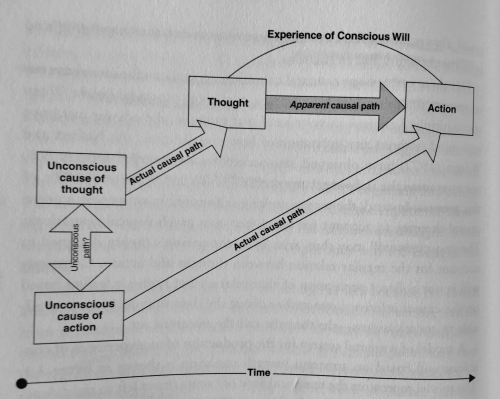
Note that there is an "actual" and "apparent" causal path leading to an action.
The actual causal path flows from an unconscious cause of the action. Meaning, the human brain is doing things below the surface of awareness that cause us to do something.
At the same time, there also is an unconscious cause of thought. This takes an actual causal path in the brain that leads to a thought.
So the brain is unconsciously causing both an action and a thought.
These two things are actually happening. However, our experience of conscious will — the feeling that our thought or intention is what causes an action to occur — is an illusion. This is shown in the "Apparent Causal Path" arrow leading from thought to action.
Here's a few passages from Wegner's book that explain what is going on here. (Wegner is a Professor of Psychology at Harvard University.)
The experience of will, then, is the way our minds portray their operations to us, not their actual operation. Because we have thoughts of what we will do, we can develop causal theories relating those thoughts to our actions on the basis of priority, consistency, and exclusivity.
We come to think of these prior thoughts as intentions, and we develop the sense that the intentions have causal force even though they are actually just previews of what we may do.
Yet in an important sense, it must be the case that something in our minds plays a causal role in making our actions occur. That something is, in the theory of apparent mental causation, a set of unconscious mental processes that cause the action. At the same time, that something is very much like the thoughts we have prior to the action.
…We must remember that this analysis suggests that the real causal mechanisms underlying behavior are never present in consciousness. Rather, the engines of causation operate without revealing themselves to us and so may be unconscious mechanisms of mind.
…The unique human convenience of conscious thoughts that preview your actions gives us the privilege of feeling we willfully cause what we do.
In fact, however, unconscious and inscrutable mechanisms create both conscious thought about action and the action, and also produce the sense of will we experience by perceiving the thought as cause of the action.
So while our thoughts may have deep, important, and unconscious causal connections to our actions, the experience of conscious will arises from a process that interprets these connections, not from the connections themselves.
This is brilliant. I'm only read about 1/4 of "The Illusion of Conscious Will," but I'm far enough into the book to have gotten a good feel for Wegner's thesis. He provides a lot of evidence to support it, both scientific and philosophical.
Naturally spiritual (using that word broadly) implications of this illusion are easy to come by. For example, it can be argued that the so-called enlightenment of Zen, Taoism, and such simply is an intuitive seeing-through of the illusion of conscious will.
Meaning, the illusion that "I" am determining what I do (and also by implication, what happens to me) is somehow experienced as the scientific falsity that it is. Of course, this is just a fact — assuming Wegner's hypothesis is correct, as it seems to be — not any sort of supernatural or mystical state of mind.
It is just our actual state of mind, seen for what it is. It'll take another blog post to explain this more fully.
Discover more from Church of the Churchless
Subscribe to get the latest posts sent to your email.
There is surely enough research and studies done over the last few decades to show how the brain is a predictive and interpretive organ. But facts are regarded only as valid as the mind that receives them and minds (in the sense of being merely vehicles of information) are awash with information that has been absorbed from other minds, much of which has been derived from centuries of belief, superstition and naive assumptions.
Also, as Wegner points out in his ‘illusionist’ illustration, the mind tends towards the easiest explanation unaware of ‘the culmination of an intricate set of physical and mental processes’. Much the same as when the brain predicts and interprets arising situations in accordance with immediate requirements.
I would think that beliefs or assumptions of free will cannot really be settled until the underlying assumption of a separate self is realised. After all, the self construct (the ‘me’) is the supposed basis from where free will emerges. It is this ‘me’, this ‘self’ that is believed exercises free will. And of course, there is a whole bunch of accepted authoritative literature and teachings that make it difficult to deal with contradictions.
But, being human and having human fears and insecurities, and also having the overwhelming sense that there is an entity called ‘me’ in charge and making the decisions is a hard feeling to dispel – in fact, it may be impossible without the realisation of seeing that there is no ‘self’ – which some believe is possible with plain, simple observation.
There are many writers and researchers that have reached the same conclusions of Wegner, and of course a whole range of Buddhist literature and practices. One contemporary writer I particularly appreciate is Jay Garfield where in his book: ‘Loosing Ourselves’ he argues that we are not selves, nor do we have selves. His premise is that we of course exist – though not as selves but as persons. Becoming persons is to see and confront the reality of us being biological, psychological and social creatures (or as I would contend, natural beings). He states that to see ourselves as persons rather than as selves allows us a richer, more nuanced understanding of who we are.
We can move our hands and arms, but not unlimited.
We can uses our sense but not unlimited.
We can use our brain but not unlimited
There are INBORN restrictions for everything we “have” and everything we “do”
Both the reach of what we have and what we can do as the restrictions are INBORN and related to natural survival.
The use of it all is not even free … the crow HAS to act as a crow and so has the tree and the human. In the midst of what is around the human has the most “grades of freedom” .. that “forced” use of that freedom can be given any name.
The drive to live and to stay alive is not even a matter of free will or choice it is also INBORN …hence … he said that it was “good” what he saw.
I do not suggest there is a creator but only that we have not made ourselves as we are and we have little understanding of what that is all about. What we can and what we do is attributing meaning and value to it all ..restricted human value and meaning.
We can never know what it is all about but only how we perceive it to be and there is no reason to think or believe that it can be objective or scientific correct and all encompassing.
What we do is describing the stained windows, windows we create ourselves.
That said there is nothing wrong with science etc, nothing at all but some humility would do weel for scientist and certainly for those that hide behind and use scientic results.
But what was Wegner thinking sending Walcott on that early?
Wegner’s The illusion of conscious will is successful in
presenting a host of empirical facts that inform us about the way we think and act
(though mostly in marginal situations). We should pay attention to these facts. But
he’s not successful in presenting a decisive challenge to the folk intuition at
the heart of philosophical conceptions of free will, that our conscious experiences of
our deliberations, planning, intentions, and actions often play an essential role in
what we do.
As someone said, If it isn’t literally true that my wanting is causally responsible for my reaching … and my believing is causally responsible for my saying … then practically everything I believe about anything is false and it’s the
end of the world.
As I wrote in my previous comment, the more aware we are, the greater our conscious awareness, the more free will we have.
Counterintuitively, the more we see what moves us, the more forces we can perceive impacting upon us, the greater our freedom from those Influences, the greater our ability to act free of their hold. The greater our free will.
Ignorance of those things defines our servitude to them. We are enslaved entirely by what we are entirely ignorant of.
The concept of free will is easily confused with choice. Spence advocates awareness, which is great, but awareness simply allows the options of responding to a situation rather than routinely reacting to it. Any such response must come from the information that the brains network already holds.
It is not possible to respond to a situation without accessing the brains information – which is what free will implies – that is acting (or thinking) outside of the brains’ store of information. All our thoughts and actions derive from our predictive and interpretive brains.
Such a thing as free will would entail some entity that operates outside the natural functions of being a human being – an entity that is free of natural laws. It would necessitate introducing a supernatural equation – which I suspect is what drives the desire to advocate the belief in free will.
HOW THE BRAIN DOES ANYTHING.
Perhaps there’s a mirroring of the biological and the esoteric.
Hi Ron
You wrote
“Any such response must come from the information that the brains network already holds.”
Accessing more information you weren’t aware of, outside of your prior experience, expands your freedom to choose outside of your past conditioning. Hence, with awareness comes choice and freedom that wasn’t available before.
Your level of freedom, your degree of freedom from past conditioning grows with your awareness and understanding of new things that don’t fit your old models. Be open to them. There is the path to free will
Expand your consciousness, expand your freedom.
The tree may not be able to change its roots but it definitely has the freedom to grow towards the sun.
[Spence: – “Accessing more information you weren’t aware of, outside of your prior experience, expands your freedom to choose outside of your past conditioning. Hence, with awareness comes choice and freedom that wasn’t available before.
Your level of freedom, your degree of freedom from past conditioning grows with your awareness and understanding of new things that don’t fit your old models. Be open to them. There is the path to free will.”]
That is so, but once new information is attained it becomes part of the conditioning and part of the brain’s armoury – which may be chosen via the brain’s natural predictive processes if a situation demands it. But, still not free will, far from it, for to have free will one needs to be endowed with a separate, autonomous entity uninfluenced by the natural workings of the brain/body.
What we call free will is simply the vast amount of information that the brain/body organism draws upon to survive via its predictive pathways, and yes, being aware or mindful of day-to-day living with its ever-arising phenomenon can expand the brain’s contents – its conscious information.
[Spence: – “Expand your consciousness, expand your freedom.”]
Yes, which is to expand the brain’s contents, its accrued information.
[Spence: – “The tree may not be able to change its roots but it definitely has the freedom to grow towards the sun.”]
Tree roots continue to grow as long as they receive nutrients – even after it has been cut down. The roots of a mature tree can spread out up to three times the width of the tree’s canopy. Together, all the tree’s physiology contributes to it being a tree. Like us, a tree is a non-dualistic being and not separate from its parts or the environment it inhabits – or subject to non-natural influences.
Hi Ron
Good comments.
You wrote
“But, still not free will, far from it, for to have free will one needs to be endowed with a separate, autonomous entity uninfluenced by the natural workings of the brain/body.”
Access to any entity, and its influence, that is separate, autonomous from our personality, our way of thinking, our habits, and uninfluenced by the natural workings of our brain/body to perpetuate this persona, is our link to freedom, relative to ourselves, and thus a higher level of free will, when we develop that connection and submit to its influence.
Access to any good writings, scientific knowledge, education or another person truly uninfluenced by us can serve that purpose.
Degrees of freedom. It happens in degrees. Like freedom from addiction, or freedom from dogma.. Once we were its prisoner, now we act with a higher, larger view and understanding. And we are moving to ever greater understanding, as the many layers of our conditioning are being washed away by that independent influence. Thus we become, relative to our past, free. And so, relative to that past, our will becomes free will.
Our freedom to act is no longer dependent upon those negative influences, no longer enslaved by it. But this is the effect of submitting to a positive independent influence.
We achieve degrees of freedom when we transcend our old selves and become new. The human brain is actually quite well engineered to support that, when we make the effort.
You see Ron, the human brain can support a very wide range of personas. One human brain supports changing personas our entire life. And quite interestingly, the brain reconfigures itself around what we attend to. It doesn’t act independently from our persona at all. And indeed our attention drives it. So if we allow our attention to be driven by habit or emotion, we are letting our past conditioning, like an echo chamber, drive how the brain works. We are giving our brains the same assignments over and over again. Assignments to continue feeding lust, anger, greed, attachment, pride. Assignments to continue making images and chemistry to perpetuate those things because we are focusing on them. The entire brain is constantly adapting to what we attend to. Our attention drives its entire value system.
So, we can, by habit, choose to attend to something else, something better, over and over again. We can lay down new conditioning around something quite independent of our past. Our choice.
That may be a good choice or a bad one. Time will tell. But we are responsible to choose well, and to learn from our choices to make other choices, new choices. Then the brain will follow, instead of lead. It always follows our attention. But we should lead our attention. A good external influence is the best way to do this. Then we are reaching out beyond our own prison cell echo chamber into the reality beyond.
Yes Spence, more or less what l said – good to see you understand that we operate on natural choice and not supernatural free will.
PS. Spence, drop the dependance on imaginary external influences and you’ll be able to embrace the reality of the natural world. The world that we come from and always and only ever have.
Hi Ron
You wrote
“you understand that we operate on natural choice and not supernatural free will.”
These are both concepts. Reality we only understand in steps of growing awareness and learning. What we know we call natural, and what we don’t know we label supernatural or non-existent. What influences us is often outside of our awareness, so labeling that as non-existent, God or illusion reflects what our awareness level is.
We don’t need those labels. Let’s just work to increase our awareness.
What we see and get to know better, naturally we label as our understanding grows.
And the first big lesson is to see how differently things look from different levels of awareness.
Leave yourself the option to label things carefully as you are exposed to them. Hence, a key rule of thumb to growing our free will is to diligently keep an open mind.
Spence: The manner in how people choose is natural; such choosing is of course dependent on one’s background and the present circumstances. It can be observed how we make choices quite naturally, not conceptual and, with no need for free will. Also, we don’t need to know anything to call it natural; the senses perceive nature as it is (or rather, as necessary for survival), that is until thought comes in and labels it mysterious, supernatural or some other mind held concept.
There is probably no ‘different levels of awareness’; awareness basically is knowledge and understanding that something is happening or exists. There is a lot of hype (and at the extreme, magical thinking) about awareness. Awareness is basically to be present in the moment – and that’s not free will or choice but more a quiet appreciation.
Also, you don’t need to label things (carefully or otherwise). In nature things just are, that is until we label them with our desires and wishes derived from how we want things to be.
Beware of keeping an ‘open mind’, sounds admirable but an open mind can be in danger of being filled with a whole host of extraneous ideas and concepts – easily done particularly as the brain constantly makes choices based on its background of hopes, wishes, fears and insecurities.
Hi Ron E.
You wrote
“There is probably no ‘different levels of awareness’;”
Decades of medical research disproved that statement long ago. There are multiple levels of conscious awareness.
You experience many of these every day, but as you may not attend to them, you may not be aware of them.
Just like any athlete or any university student, you can get better at your performance by creating the conditions to do so and engaging in practices to focus and learn. Successful students are practically professionals at learning. How to read for comprehension? How to prepare for tests? How to create an outline and then a paper from it? How to prepare and engage in uninterrupted study for lengthening periods. How to get feedback and make course corrections all along the project. These are all skills developed by focused attention to them. And learning to raise conscious awareness by practice, through various methods is a very long-standing approach. In spiritual practice we are instructed to vary our approach and try different adaptations in order to see what works best for us as we proceed. That is all under our own supervision.