

NOTE: I just checked, and it appears that the new WordPress version of my Salem Political Snark blog has gone live, thanks to the fine work by Glorywebs, the tech company that is handling the migration of my blogs to WordPress, since Typepad, my current blogging service, is shutting down on September 30. I’ve asked that Church of the Churchless be the next blog that they work on. If you want to see what this blog will look like fairly soon, check out the new and much improved Salem Political Snark. You click on the title of a post to see the whole thing, unlike how Typepad worked. Some of the content needs editing, which I’ll get to when I learn more about WordPress.
—————————————–
I enjoy watching skilled magicians do their thing. They perform tricks that seem impossible. But if I were asked to bet on how the tricks come to be — supernatural power or deceptive illusion — without hesitation I’d put my money on deceptive illusion.
Almost everybody would. So as popular as magicians are, few people believe that they actually are doing anything magical.
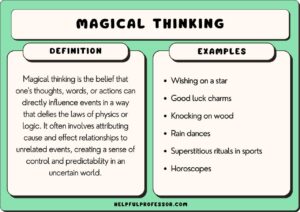
Which leaves magical thinking as a human endeavor in which it is believed that effects are achieved by causes that lie outside of the realm of science and everyday experience. In Robert Saltzman’s book, The Ten Thousand Things, which I’ve been blogging about recently, Saltzman says:
By “magical thinking” I mean the habit of attributing causes to events when one cannot possibly know that causal relations actually exist. We humans, whose minds evolved under pressure to identify threats, are voracious in our appetite for explanations, and thus prone to seeing false causality everywhere.
That is why I have been recommending investigating one’s beliefs with a view toward weeding out premature cognitive commitments. As long as one is burdened by the weight of unexamined beliefs, there is no chance at all of seeing things clearly.
The “law of karma” provides a case in point. That so-called “law” is not a law at all, but a belief based upon hearsay, not evidence. This is classic magical thinking because, beyond traditional dogma, no one has the slightest idea if some sort of “justice” is embedded in the human situation or not. Hearing and believing does not make what is heard true.
Ouch. Those words about karma don’t really hurt me now, but they would have when I was researching and writing a book I wrote many years ago for a India-based religious organization, Radha Soami Satsang Beas (RSSB), about the karmic rationale for vegetarianism.
At that time, I believed — or at least believed that I believed — in karma extending through multiple lives by means of reincarnation. So the book, Life is Fair, was a reflection of what Saltzman calls “traditional dogma.”
I had no direct personal experience of the operation of past-life karma. (This-life karma basically is just ordinary cause and effect, as when you run over a nail and get a flat tire.) But I read what every RSSB book in the English language had to say about karma, took copious notes, and organized those notes into a coherent book outline.
Of course, there’s solid research showing that a vegetarian diet is good for one’s health. I also talked about this in Life is Fair. The past-life aspect of karma, though, was decidedly magical thinking, even though I wouldn’t have characterized it that way, as I was still in my religious believing days.
When magical thinking is commonplace, embedded in a culture, it can be difficult to discern. For example, after mass shootings here in the United States (sadly, a common occurrence), “thoughts and prayers” are offered to the victims and their families. At the end of every State of the Union speech, the president typically says, “And may God bless the United States of America.”
Thoughts, prayers, and blessings have no effect beyond the minds of those people who hear or utter them unless those people also take some concrete action in physical reality, such as passing a law that bans assault-style weapons from use by ordinary citizens. So magical thinking can become a substitute for productive non-magical thinking that can actually solve problems.
Saltzman, a psychologist, writes:
Learning to distinguish between fantasy and reality is a developmental process. We can observe that process in young children. For instance, if a child is angry with a pet and the pet gets sick and dies, the child may believe that she or he caused the pet’s death, and in a child of five or six that kind of belief is expected.
For a child of ten, that thought might arise, but most likely the child would not really believe it. If an adult seriously believed such a thing, most of us would view that person as deluded, possibly psychotic.
…”Step on a crack, you break your mother’s back,” a game children play as they traverse a sidewalk, is an example of magical thinking that serves to blunt the child’s fear that something bad could happen to mom. The adult ballplayer who crosses himself before stepping into the batter’s box is playing a similar kind of game with himself, as if a hand gesture could really forestall a fastball in the noggin.
So magical thinking is a way of denying the complete insecurity of here and now — of presuming and feigning control over this present moment in which we really know anything can happen, like it or not. The denial of the obvious fact of total vulnerability to events is a chief impediment to finding the freedom and peace of mind that seem to be the heart’s desire of us all, or at least most of us.
Discover more from Church of the Churchless
Subscribe to get the latest posts sent to your email.
I’m copying in comments left on the Typepad version of this and a few other posts that I wrote after my files were downloaded from Typepad. So since the dates will all be the same, that’s the reason.
Test, checking threaded comments…
test again
test
Hi Brian,
It seems you have strong Karmic links with India, and Indians 😆
@Tej – if the company had been based in Punjab… this seems to be in Gujarat, ha
@Roshni – you’re overcomplicating things. He doesnt have any enemies in India, let alone many enemies in India. This blog is no more than a collective perspective of both the blogger and the readers in a world of free speech.
Ehh, yes, that’s a bit …not done, that linking-in-one’s-mind of Indians as potential saboteurs just because the GSD thing. I don’t think there’s any call to blanket-question a whole people’s professionalism like that! Hell by that yardstick USAisans back home would be far more suspect, given Trump. Brian would need to go look for some firm based in Iceland or someplace, maybe, if that is what one is to look out for!
(No doubt that was a throwaway remark, not meant overly seriously. But it is helpful, in my view, to be shown the biases we harbor, and it is entirely in that spirit, in the spirit of critique not criticism, and with goodwill, that I point this out, @Roshni. Bias is bias, even if it is the case that it is to some degree self-referential, as your name might indicate.)
Good to know that the Glorywebs folks have already delivered your Salem Snark blog. I don’t think I’ve visited that blog of yours, so I don’t think I can compare the one with the other though. But yes, absolutely, it does look intuitively and agreeably laid out. And the important thing is that they’ve managed to get all of the data across, which I’m sure you’ve cross-checked.
Looking forward to seeing what they do this CotC blog of ours! (Heh, I cannot but help think of it as “ours”, as opposed to merely “yours” — as do many of us who regularly visit here, as well, I’ve no doubt!)
———-
Agreed fully with what Saltzman says about magical thinking, obviously.
I notice, though, that he’s has not listed prayers, and other directly-mainstream religious halfwittery, among his examples, at least not in that table of his, and what we see in these excerpts here; and has focused, instead, on the more fringe instances of magical thinking. Religion’s kind of the elephant in the room when it comes to magical thinking, so this omission cannot have been inadvertent. (Maybe he was trying not to ruffle feathers overly much? On the other hand, maybe it is the case that these excerpts just happen not to include explicit mention of mainstream religious halfwittery, and that elsewhere he has indeed called such out?)
In any case, Brian, I note that *you* have made sure to not leave that obvious omission unaddressed, and have gone out of your way to very clearly call out “thoughts and prayers”, and such other mainstream voodoo. Very cool, that. 👍
Again, as with most of the supernatural belief systems, magical thinking is yet another domain where abstract concepts are the sad hallmark of human thinking and imagination. All to be added to thought generated ideas of Gods, Devils, karma, enlightenment, heaven, masters and the such like. Nothing like these mind-created ideas appear in the natural world. We are the only animal that has the mental misfortune to create abstract stories and believe them.
Even meditation, which through its most authentic practice is useful to help the confused human mind to realise that the cherished self is merely a thought structure and is the prime instigator in separating ourselves from the real (natural) world, is used excessively to produce mental states that we label as being holy or spiritual insights.
Saltzman ‘hits the nail on the head’ where he says: – “So magical thinking is a way of denying the complete insecurity of here and now…” Indeed, the whole gamut of non-natural beliefs and dogmas act as crutches to escape the inevitabilities of ‘what is’ or the ‘here and now’ – basically, the realities where anything can happen, even death.
Our basic instinct is to stay alive – in order to propagate our genes. In nature this means to acquire food, fend off predators and to mate. When it arises and is inevitable, the physical organism accepts death. What does not accept any threat to its survival is the ego – the elevated and exaggerated sense of a separate me or self; it believes itself to be deserving of endless continuation – hence the ubiquitous belief systems.
The biggest trick that fake ass gurus use is throwing karma at you, the store of endless sin, so you go into a powerless fear mode so. They can then control and manipulate you into their cult , and offer a false salvation. Gurinder dhillon, the RSsB cult and its entire lineage are perfect examples. The irony is that God, who they blashpomy daily , will get justice on these crooked gurus and they are the ones who will have to face their karma. Gurinders days are numbered , which is why he has gone off to early retirement, hiding in shame. It’s game over
Cool, the new format 👍
Been checking out the “threaded comments”. Yes, I see how this can be useful, when comment discussions get involved, as they sometimes used to at the old placed.
One small glitch I found. I posted some comments in quick succession, the test comments right here — and the software/system tells me to “Slow down, you’re typing much too fast” — or words to the effect. Now being told, “Slow down tiger, I can’t keep up” is kind of flattering, in other circumstances — but I doubt the system was complimenting me on my typing prowess. It’s a glitch, this, that the other place did not have.
(On the other hand it’s possible this could be a feature not a bug, a feature deliberately thrown in to prevent spamming. In which case, all good. After all, I don’t believe I’ve ever, in all these years, thrown out comments in such quick succession as I did just now, when testing the thread feature. …So yeah, whether deliberate feature or bug, I don’t suppose the “glitch” needs fixing at all, given that actual substantive comments won’t be posted so quickly ever.
Also, there doesn’t seem to be a Preview feature. At least, if there is then I couldn’t figure it out.
That’s a glitch, sure enough. Not a deal breaker, but very useful to have. Makes no difference to short simple comments like these, but will for longer more involved ones.