

As I’ve noted before, am noting now, and likely will note again, my life seems to be a reflection of the lyric in a Donavan song, “First there is a mountain, then there is no mountain, then there is.” Reportedly this was inspired by a Zen saying.
The meaning it has for me is that the first 20 years of my life were marked by a feeling that this earthly existence is the only reality we’ll ever know. Then, for 35 years, I embraced an Eastern religion (Radha Soami Satsang Beas) that taught the physical universe is the lowest realm of creation, and our true life as soul is to be lived on higher supernatural planes.
After that period, for the past 21 years I’ve returned to believing that the “mountain” of this world is the true reality for us human beings. Belief in any supernatural reality takes us farther away from truth, not closer.
Accordingly, my view of what spirituality means keeps changing. I’d say evolving, but that presumes a directionality that would be conjecture on my part, even though it does seem to me that my current naturalistic perspective is a step in the right direction — since my aim is to better understand the nature of things.
That’s why even though I like the phrase, “spiritual but not religious,” as it marks a step away from the dogma and rigidity of organized religion, increasingly I find myself attracted to writers who question the need to view ourselves as spiritual. Isn’t simply being alive good enough? Isn’t there wisdom in saying, “I’m living but not spiritual”?
After all, many people live happy, meaningful, and productive lives without paying any attention to spirituality. Their life as it is, that’s enough for them. No need to add another layer of conceptualization to it by the term “spiritual.”
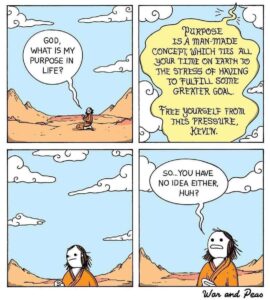
UPDATE: Just saw this in the Buddhist Humor feed that I follow on Facebook. Pretty much makes the same point.
Robert Saltzman is one of those writers. I’ve shared a couple of blog posts about his book The 21st Century Self: Belief, Illusion, and the Machinery of Meaning. After starting to read it, I switched to Saltzman’s first book, The Ten Thousand Things, which provides a better overview of how he views life. Here’s some passages from that book relating to spirituality.
I regard most of so-called “spirituality” as a collection of superstitious behaviors and baseless conjectures passed from generation to generation via indoctrination beginning in infancy — a schooling principally in magical thinking and self-deception.
The worst feature in that landscape of nonsense is the idea that the world we see with our eyes is somehow less “real” than some other “better” world, and that if we could somehow enter that “other world,” either after death, like a Christian or a Muslim, or here and now like the “self-realizers,” the pains of our life would be magically transformed into “perfection.”
Once that idea takes root, then comes the need for so-called “faith,” along with doctrines, practices, and instructions, all aimed at attainment of that perfection.
Saltzman talks about how this duality between life as it is, and life as imagined it could be, is also reflected in how the self often is viewed. Here’s some passages relating to that subject. Saltzman is a psychologist who used to do psychotherapy, so that informs how he views this duality, or split. His first book is questions and answers that appear to be posed and responded to in discussions on his web site, which explains his reference to a question.
The apparent space in which perceptions, feelings, and thoughts seem to arise could be called “knowingness,” as you refer to it, or “awareness,” but I am not sure that awareness can be so easily separated from the apparent content of awareness that changes constantly.
What if awareness and the content of awareness, which in your question you have separated, is really one and the same thing — the same process? What if any attempt to separate out thought from thinker, perception from perceiver, or feeling from feeler is doomed to succeed only in imagination?
To ask this in another way, how is the knower different from knowing or from the known? What if knower, knowing, and known are not three distinct items, but one and the same happening called by different names depending on point of view? What if knower, knowing, and known cannot be separated or distinguished from one another at all?
…When thinker is set apart from thought and thinking, fear arises inherently. Then, as an antidote to that fear, the possibility of becoming “enlightened” seems highly desirable. So setting thinker apart from thought creates fear, which feels disturbing as you said, and also creates an imagined escape from fear — the fantasy of “enlightenment.”
Splitting off thinker from thought and promoting the now separate “thinker” to a position of superiority over thoughts and feelings allows the creation of a so-called observer, which is the “entity” that is going to become “enlightened.” I say so-called observer advisedly; it does not exist except as just another thought — an habitual, repetitive thought.
Who, after all, is observing the observer? And who is observing the observer of the observer?
…There is no entity, no little “decider” in my head that stands apart from the incessant stream of perceptions, feelings, and thoughts, to be choosing anything. That imagined entity — the little decider that some people imagine is the “real me” — is not real at all, but a ghost in the machine.
Discover more from Church of the Churchless
Subscribe to get the latest posts sent to your email.
Sure. There’s no “consciousness”, only entities that are conscious. The same as there’s no running, only people (and other creatures) that are running. Consciousness is an abstraction, and does not actually exist; no more than does running.
Wait, did we just solve the hard problem right there?
———-
Saltzman’s criticism of spirituality seems spot on, depending on how he defines the term. And it seems a trifle overdone, again depending on how he defines the term.
Does he actually define the term? That might make for a good starting point to understand and assess his critique.
(For instance: If spirituality is a first-hand investigation into the nature of consciousness — into the nature of us being conscious — then that might, I suppose roughly include most “spiritual” practices, including meditation. If that investigation is based in reason, that that seems cool enough. …Again, depends what “spirituality” amounts to, exactly, in his criticism.)
(To be fair: Most de facto real-world seen-in-practice definitions of “spirituality” do indeed answer to Saltzman’s criticism. Still, might not hurt to explicitly define it first, before discussing it and critiquing it. Maybe he has indeed done that.)
———-
…I remain curious about what and how Sabine Brennan’s “manifestation” turns out to be.
In a response to someone who asked why he seems to dismiss spirituality entirely, Saltzman said:
“If you imagine that I dismiss spirituality entirely, most likely you have misunderstood my words. The word ‘spirituality’ comprises a large balliwick, and certainly there are parts of that territory which I do not dismiss, at least not entirely. I have even quoted at times sources normally considered to be part of ‘spirituality,’ although I don’t see them that way myself. If I quote, I am quoting what I consider to be wisdom, not ‘spirituality.’ And there is a difference — a vast one.”
As he says in a quote included in this post, I think Saltzman dismisses the form of spirituality that sees this world as illusory, which implies that our life in this world is illusory. As a psychologist, I don’t believe Saltzman dismisses “spiritual” practices like mindfulness that can help a person live more happily and contentedly in this very human existence.
Makes sense 👍
And heh, yes, cool cartoon.
Actually, this cartoon here, it made me think of another cartoon, just as cool, and similar-ish in some ways. Don’t remember where I saw it, might have been right here on this blog, maybe. It’s the anthropic principle joke about one puddle saying to another, “Of course God created this hole, and created it specifically for you and I, see how well and how precisely he’s tailored this hole exactly to fit us!”
So I thought I’d just paste the cartoon here. And did a quick search. Which didn’t get me the cartoon, not immediately. I could have got to it, I guess, had I looked some more. But I left off because I found something better. A short, less-than-five-minute clip featuring Douglas Adams himself, the Hitchhiker guy, the guy who came up with the puddle thing, himself discussing his puddle — how cool is that, right?! Here’s the clip, enjoy: https://www.youtube.com/watch?v=ckR7TqptGHY
Well, l can only totally agree with Saltzman’s take on this matter of spiritually – and man’s search in general. Love the cartoon.