

This morning I felt in love. With a chapter in Robert Saltzman’s book, The 21st Century Self: Belief, Illusion, and the Machinery of Meaning. I knew that I wanted to share it in a blog post tonight.
But it was a long chapter. I doubted I could type all of it into a post. So I started typing, figuring that at some point my fingers would tire, the time would grow late, and I’d have to pick and choose what to share, and what to leave out.
Yet as I got into the rhythm of Saltzman’s writing, needing to pay close attention to his words so as to not to make any errors in what he wrote, I couldn’t stop. His message resonated deeply with me. He was saying way better than I could what I’ve been feeling, but couldn’t express anywhere near so clearly.
Here’s the entirety of “The Hill, the Stone, and the Breath.” I think it’s one of the best essays of its kind I’ve ever come across. You may think it’s garbage. That’s okay. It is what it is.
We push. That’s what it amounts to. Something rises — habit, hunger, despair, momentum — and feet move, hands reach, the body carries on. No manifesto in it. No claim to purpose. It’s not even chosen. More gravity than conviction. One wakes, breathes, pisses, brews the coffee. The work resumes.
But to what end?
From most angles, human life appears as relentless motion. Toward what, exactly, differs by temperament and by epoch — salvation, success, transcendence, security, or just the relief of sleep — but the thrust is there. No one has to teach a child to want. No one instructs a dying man to long for more time. We reach. It’s what we do.
Yet, if one pauses — really pauses — the momentum falters. Clarity begins not with answers, but with doubt. Not suspicion, but seeing without adornment. The motion may continue, but something loosens. One no longer believes in the destination. Or perhaps no longer believes there is one. That’s when the questions begin to fray — not from resolution, but from lost weight.
What compels the creature who no longer believes in the path?
Some find liberation in the collapse of a false horizon. A strange kind of peace. For others, it invites despair — a hollowing. And many, maybe most, will scramble to patch the illusion. A new goal, a different meaning, some kind of service or redemption. Not necessarily from dishonesty, but from necessity. The human organism flails in open air. It needs a story to grip.
But for a few, the story doesn’t return. Or returns too faintly to restore its former power. And so, another way appears — not better, not higher, not more noble. Just what remains when the story fails to cohere.
I write from there.
Not to deliver insight, not to console or provoke. Just because writing is what happens. The fingers move. The words appear. There’s no “why” that holds. No act of will. No claim to authorship. Not even a feeling of choice. It’s like breath. It comes. Then it goes.
Still, the act is not meaningless. Meaning need not be summoned. It may arise, unsummoned, in the curve of a phrase, in the rhythm of a pause, in the tension between what is said and what is withheld. But it flickers. It doesn’t anchor. And what glimmers in one moment may vanish in the next.
To live without anchoring is not nihilism. It is not despair. But it is something close to nakedness. A stripping away of narrative, of role, of the comforts that most of us wear like skins.
People ask: If there’s no purpose, no arc, no ultimate meaning, why go on?
The question is valid. But it may be misdirected. No one asks the stream why it flows, or the tree why it reaches. It is only the human, aware of itself and therefore separate, who demands justification.
We want the motion to mean something. We want the doing to add up. And if it does not –if the parts do not form a whole — we feel betrayed. But what if there is no betrayal, because there was no promise?
The flame of inquiry, once lit, may burn through the paper it was meant to illuminate. Not every question leads to insight. Some lead only to ash. That, too, is a kind of light.
It becomes clear: there may be no summit. No answer. No final accounting. And yet the motion continues. Not because of hope, but because of the impossibility of stillness.
Hope, after all, is often a form of evasion. A way of saying: I do not want what is. So I imagine something else.
But when the imagination fails — when one no longer pretends — what remains?
Just this.
This step. This ache. This moment of contact with the texture of being.
It is not transcendent. It is not redemptive. It does not save. But it does not need to.
And here, something like dignity emerges. Not from success. Not from triumph. But from contact.
Contact with what?
With what is.
Not the world as idea. Not life as narrative. But the immediate, unframed fact of existence. The feel of the cup. The sound of breath. The sting of memory. The weight of the stone.
Yes, the stone.
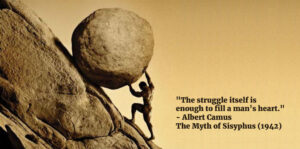
The philosopher Albert Camus wrote of Sisyphus, condemned to roll a rock uphill forever, only to watch it fall again. A stupid punishment, perhaps. Or a mirror.
Camus invited us to imagine Sisyphus happy. Not because the task is meaningful. But because he sees, and no longer resists.
This is not mysticism. It is not a triumph of will. It is the dry clarity of one who no longer lies.
What remains is the bare act. The push. The return. He sees it for what it is — and does not invent more. That’s what Camus called happiness. Not elation. Accuracy.
But this seeing — this dry clarity — is not a prize. It isn’t bestowed for merit or granted for suffering. It arrives, or it doesn’t. And even when it does, it doesn’t stay. It’s not a ribbon pinned to the chest. It’s a break in the cloud cover. The light comes through. The terrain is visible. Then, slowly or suddenly, the fog returns.
Still, once the light has come, the fog is never quite the same. The stories lose their grip. The metaphors grow thin. One no longer needs to be fooled.
This shift is subtle. Not renunciation. Not stoicism. Not rebellion. It’s revolt — but not the kind that marches or declares. A quiet retreat. No banners. No slogans. Just: no more lies.
Most of what we call culture — religious, philosophical, psychological — is an elaborate system for metabolizing contradiction. We want to live forever, but we die. We want to be known, but we remain opaque. We want love to last, but it often doesn’t.
These are not errors to be corrected. They are the structure of the thing. And the structures built to hide the truth, however ornate, eventually buckle. Some buckle early. Others hold on. But when the pretexts crumble, the absurd comes into view — not as theory, not as concept, but as the shape of the world. Incoherence, seen clearly, is no longer incoherence. It is what is.
What then?
Some collapse. Some run back into belief. Some mask the terror with therapy-speak, spiritual bypass, clever frameworks that say nothing but offer the illusion of movement.
But a few — just a few — stay.
Not heroically. Not dramatically. Just long enough to see that the absence of meaning need not be catastrophic.
Sisyphus, in Camus’ telling, is not redeemed. He is not granted mercy. The gods do not relent. But he becomes aware. And that awareness does something, not to the task, but to the framer.
The labor remains. The futility remains. But the hope is gone.
And with the death of hope comes the birth of something else: a different kind of participation. Not resigned. Not noble. Just bare.
And so the stone is rolled. Again. And again.
The repetition is not transcendence. It is not sacred. It is just what happens when one stops pretending that something else will.
There are days when the stone feels heavier. When the silence bites instead of soothes. When even the hill itself seems to mock. That too is part of the rhythm.
This is not mastery. There are no masters here. No teachings that dry and rot in the sun. No system that does not eventually eat itself.
What survives?
The breath. The step. The feel of the world, raw and unspoken.
That is what it means to be awake — not to understand, not to transcend, but to no longer require the story.
To no longer require anything but what is already here.
And what, then, is this “what is already here”?
It’s not a static answer. It shifts. One moment it’s the scent of morning air, the clink of a spoon in the sink. The next, it’s the memory, uninvited and tender, of someone gone. Then it’s back to the slope: the body moving, the stone rolling, the useless effort resuming as if it means something, though it doesn’t.
And yet — this is the riddle — somehow it does. Not as justification. But as immediacy. The contact itself becomes sufficient. Not for a story. Not for a legacy. Not for a god. Just for itself.
That’s a hard sell. It doesn’t preach well. It doesnt’ motivate. It doesn’t convert. And so we surround it with distractions — goals, roles, metaphysics, belief systems with bells and robes and sacraments. But underneath all of it, this moment continues. This step. This breath. This tangle of perception and response.
Living without overlays is not a discipline. It’s not something to be achieved. It’s what happens when the overlays no longer grip.
Most people never get there. Most don’t want to. They want the story. Even a painful one. Even a tragic one. Anything but the silence.
Because the silence — real silence — isn’t emptiness. It’s fullness without interpretation. And that is unbearable to the part of us that needs to know.
But Sisyphus does not know. He is not reconciled. He is not enlightened. He just works.
Camus asks us to imagine him happy. But “happy” is the wrong word. Too glossy. Too bright. Better to say: unguarded. Unresisting. No longer bargaining.
That is rare.
Those who touch the rawness reach quickly for metaphor. “It’s all sacred.” “Everything happens for a reason.” “There is a hidden order.”
Maybe. Maybe not. What’s clear is the reflex — the unwillingness to let go of the frame.
But suppose the frame is allowed to drop. Suppose the world is seen not as a symbol but as a surface. As contact, not code. Then what?
Often grief. For the years spent searching. For the love poured into empty containers. For the part of oneself that still wanted the story to be true.
But beyond that, or beside it, something else flickers. Something so small it cannot be named. Not peace. Not joy. Just presence, with no need to fix or transform.
And when it passes — as it will — one continues.
The stone doesn’t care what you believe. The hill doesn’t ask for vows. There is no narrative reward. There is only repetition. And in that repetition, a kind of fidelity emerges.
Not to a doctrine. Not to a dream. To the moment.
This is not surrender. It is not defeat. It is not even acceptance, in the usual sense. It is what remains when resistance fails.
Not passivity. Not indifference. Contact.
This breath.
This motion.
This falling light.
And so the task continues — not because it leads somewhere, but because it is what remains when illusion has nothing left to give.
What began in striving ends, perhaps, in rhythm. What began as hope ends, perhaps, in attention.
Not the attention of the seeker, but the attention of the animal — present, uncalculated, alert without object.
And in that attention, the hill loses its threat. The stone becomes just weight. The body just moves.
No music swelling, no applause. Just the footstep. Just the wind.
Just this.
To live this way — to meet the day without premise — is not serenity. It is not some quiet ecstasy. It is more like standing barefoot on a cold floor: vivid, inescapable, without cushion.
And yet, in time, the cold no longer feels like punishment. It is simply the temperature of contact.
That’s all this is: contact. With pain, with joy, with tedium, with hunger, with light, with darkness. Without a story to hold it or a frame to bless it. Just this, arising. Just this, passing.
Not neutral. Not numb. But unadorned.
And here, strangely, a tenderness appears — not sentiment, not softness, but a kind of raw fidelity to what is. The skin thinned by exposure. A life lived without anesthesia.
Most of what passes for awakening is just a repackaged dream: the idea that one can become immune to sorrow, that one can stand above the fray, wrapped in insight like a cloak. But this is not above. It is not beyond. It is within — and not as refuge, but as full implication.
No veil. No gate. No second act.
Just the rhythm of repetition, stripped of aspiration. The hill, the weight, the breath.
This is not philosophy. It’s anatomy.
What the myth of Sisyphus shows is not despair, not courage, not even absurdity — it shows fidelity to the real. He knows the terms. He does not argue. He does not pray. He rolls the stone, and the question fades.
Not sanctity in the old sense. Not righteousness. Something far less noble: the refusal to dissemble.
This refusal is not ideological. It makes no claim. It offers no lesson. It cannot be sold. It doesn’t preach or convert. It simply persists.
And that persistence is its own form of grace — not given, not earned, not distributed. Just present, when the overlays fall.
People ask: how should one live?
But there is no should. There is only this: to rise, to touch what is near, to speak what is true enough to tend to what is falling apart without pretending it can be saved.
This is not bleak. Bleakness requires a contrast, a lost ideal. But there is no ideal here. No heaven deferred, no justice postponed, no meaning misplaced.
There is only this — this slope, this moment, this strange and fleeting capacity to know that one is alive.
And when it fades — when the vision dims, when the old hunger returns — nothing is lost. Because nothing was held.
And so, one begins again. The stone is waiting. The hill inclines.
No climax. No salvation. No end.
Just the clear air, the grit underfoot, the lift of the shoulders.
And if anything can be called freedom, perhaps it is this: not the freedom to choose another path, but the freedom from needing one.
To walk not because one believes, not because one seeks, but because one is — and nothing else.
This, then, is the reply. Not an answer, but a reply: the weight is real, the task is endless, the self is uncertain — and still, we begin.
Each morning. Each breath. Each falling stone.
Not as martyrs. Not as fools.
But awake.
Discover more from Church of the Churchless
Subscribe to get the latest posts sent to your email.
Beautiful, thank you for sharing!
When you decide to exit the maze of glittering innuendo and wishful thinking maybe you should become a boxer and save everybody else the trouble. But that’s the foolishness of being a so-called atheist. They don’t exist either. I don’t believe in atheists. So they don’t exist. It’s a dichotomy something must exist for it not to be believed in . Fools gold for all . How smug and cool you must feel to believe that you are so much smarter than anyone else. Dead men don’t wear plaid either!
I agree, one of the best essays I have read – definitely not garbage. It is all here.
Incidentally, I have just been reading Joan Tollifson’s latest postings. While I’m in total agreement with the chapter from Robert Saltzman’s book, Tollifson outlines the kind of pitfalls people like me – and perhaps others – can fall into while accepting ‘just this’, or ‘present moment’. From what I’ve read of Robert Saltzman he understands this well and lives what he talks about rather than accepting it merely intellectually. I include the piece from Joan (below) as it serves as an apt reminder for me.
Joan Tollifson, Oct. 15th 2025. “The potential pitfall in pointing to “being here now” as a kind of practice is that it can become a new self-improvement project for the imaginary “me,” in which we are continuously monitoring and judging ourselves and trying really hard to “be here now” all the time, as if total mindfulness in every moment forever after is our goal, which of course is unattainable. All such result-oriented efforting tends to reinforce the very problem it has the potential to illuminate and dissolve.”
“The potential pitfall in pointing out that there is only here-now-being, regardless of how it shows up, is that this can be taken on as merely an intellectual understanding that we believe is true, a concept, and that conceptual belief can all too easily harden into a comforting, self-protective, fundamentalist dogma that can be used to avoid feeling the suffering in life, or as a duplicitous way to avoid taking any kind of responsibility for mistakes or hurtful actions.”
The problem is that it’s just pretty words. It’s a philosophy that no one believes in, and no one is practicing. It’s an idol that people worship. They worshiped the Sant Mat literature because of the way the words made them feel, and later they worship neo-Buddhist ND boilerplate for the same reason — the way that it makes them feel.
But it remains true that they can’t actually live and practice the ND philosophy that so titillates them. The proof of that is their relentless obsession with local, national, and global politics, issues, personalities, the past, and the future. They spend most of their waking hours so focused on “becoming.” What then happened to their philosophy of “being”? They shove it aside, because they never really believed in it. As I said, the ND Being philosophy is just pretty words, just rhetoric, just an idol of consolation. It’s not real. And that’s because it’s not a philosophy that can’t be practically lived (unless you’re another Ramana Maharshi).
Genuine Zen Masters like Suzuki Roshi understood that true Zen isn’t just about “being awake”—Zen is about integrating compassion and mindfulness into all activities. Real Zen is about caring for everything and trying to help everyone. It’s not about wandering through life as an ambitionless bubble of awareness because nothing is worth doing and nothing has any meaning. That’s the definition of nihilism.
Yes, it’s beautiful, this chapter. Sheer poetry. Thanks for taking the trouble to type it all out!
I found it particularly poignant, given it speaks to the very issue I’d raised here a while back, and that we’d discussed. The issue I’ve grappled with for years now. The issue I kind of sort of found a resolution to, with an “It is what it is” shrug.
———-
While I found this chapter moving, poignant: but the trouble with poetry is this: although beautiful, but it often enough only conjures up the illusion of understanding, of wisdom; without actually the substance of it.
Sure, the stream flows, and babbles as well. Sure, the tree reaches. But that is most definitely, most emphatically, not equivalent to Sisyphus toiling at his endless task, or Atlas laboring under his endless burden.
Two very, very different things. Completely different. The stream may well arrive at happiness, as may the tree. And so may Sisyphus and Atlas as well, certainly: but not in their externally imposed tasks, never. That is beyond the bounds of what is reasonable, to one that has felt in their bones what Saltzman’s poetry-in-prose alludes to.
———-
Not garbage. No one with the least bit of discernment can possibly think that! Exactly the opposite.
And yet, it is poetry carrying only the illusion of meaning, in so far as the final resolution to the fundamental existential “problem” that I see as being alluded to.
Which is not to say Saltzman himself is lacking in that understanding. At least not necessarily.
Unfortunately, Saltzman himself is not here with us. If he were, I’d ask him to tell us plainly:
On attaining to “clarity”, why would not Sisyphus drop his absurd load, and his absurd unnatural externally imposed task? On awakening, why would not Atlas shrug?
———-
(I strongly suspect that the answer, the only answer that actually speaks from the depth of understanding, is that they would. Sisyphus would no longer fuck around endlessly with the rock. Atlas would indeed shrug. After all, one attained to the “dry clarity of one who no longer lies”, would no longer be in thrall to another’s will, not even of gods, no matter how powerful. And after all, the exemplar and standard-bearer of no-self, the Buddha himself, did not ever return to rolling up the hill his hot-courtesans-and-loving-wife-sweetened rock, he did not ever again hold aloft his kingly load.)
Saltzman isn’t here. But if elsewhere in his book throws clear light on this, then I’ll be grateful if you’d spell it out, Brian.
TLDR:
The stream’s flowing ~/~ Sisyphus’s asinine endless task
The tree’s reaching ~/~ Atlas’s endless burden
Which is not to say that Sisyphus, and Atlas as well, cannot flow like the stream, or reach like the tree. They can. But that flowing and reaching cannot possibly incorporate externally imposed and unnatural convoluted tasks. Camus seems to have got the final part of the message completely wrong, as far as this nuance; as does Saltzman as well, in blindly echoing him. It is the Buddha, whose message in this case was his own actions and his own life, who got that one right.
I’m somewhat pessimistic that writers like Saltzman will not be seriously listened to, or worse, not understood. Instead l fear that people will turn to fundamental belief systems – either religious ones or adherence to autocratic leaders. All in the search for personal security and self preservation – all fuelled by the belief that we are separate beings.
I also fear that the environment and natural world will suffer more as climate change and dwindling food sources may reek havoc on the planet.
“We want the motion to mean something. We want the doing to add up. And if it does not –if the parts do not form a whole — we feel betrayed. But what if there is no betrayal, because there was no promise?”
Everything does add up to something. Everything does come from something.
If the author just accepted this much, things would have been great, because his understanding was wrong before. And it is wrong now, but at least he recognizes the wrong of the past understanding.
But he must somehow make all that he thought before wrong. And worse, make others wrong, blame the wrong thinking on others. That separates us from reality, rather than gets us closer to it. Because reality is indeed a whole. Just not the self-flattering story we liked and bought. Nor the one we like today and buy every day.
What happened didn’t happen in a vacuum. We just didn’t understand it then, we didn’t want to believe we were wrong, and we still don’t understand it now and still can’t accept how tiny we really are, how wrong we are, how incapable human thought is of understanding. At best we accept a photocopy. And believe it or not, that photocopy is based on reality. It is only a photocopy because that is the only way our brain can digest and make sense of it.
Human understanding ain’t gonna do it for us. Until we give that up, we have no hope of capturing the immense incredible, awesomeness of this moment.
But we can understand. So that becomes the mission. To deconstruct first, as we feed ourselves whatever of reality we can accept without conditions.
And then realize that what we thought a long time ago was true wasn’t false. We are false. And we didn’t understand that truth.
So long as we think we don’t lie, that we’ve accomplished something by giving it all up, by making it all wrong, we are still lying. Only now we have a different lie. And the biggest victim is ourselves, because we are lying to ourselves. Give that up, and you can actually feel real liberation. Otherwise it’s just the same lie. It would be more honest accepting the lie we like and always wanted to like. For then the activity of mind is put aside so that we can actually perceive the moment without needed a story we can accept, nor claim there is no story. There is a story here. Cause and effect is real. But not one of our invention, even our interpretation.
If we replaced the old lie of our misunderstanding of the story, with the deeper lie there is no story, both are lies.
The mechanism of human mind that extrapolates, that rebuilds before we ever see it, to our tastes, to our fears, to our desires perfectly, that is the liar we must deal with first and foremost. It is doing its best to adhere to the rules we created for it, in twisting and reinterpreting for our consumption the sweets we like. And creating poisons we fear where no poison exists.
So it is quite presumptuous to claim we are not lying to ourselves now. We have just replaced an old lie we don’t like anymore, with another one we do, even one we fear.
And the proof of this is in the proclamation “I’m no longer lying!” Wow, that’s pretty ignorant.