

Yesterday I wrote a post for my HinesSight blog about how an American ice skater fared in what was expected to be a gold medal performance. Here’s some excerpts from “Ilia Malinin lost an Olympic ice skating medal, but he won the heart of people who also have screwed-up big time.”
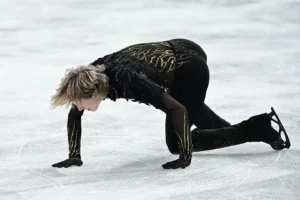
For me the most tragic moment in this year’s Winter Olympics was Ilia Malinin, a hugely talented American figure skater, snatching defeat from the jaws of victory when he bungled a seemingly certain gold medal by falling twice in a performance where Malinin was so far ahead of his competition, all he needed to do was skate a clean program and the medal was his.
As his stood on the ice, unable to comprehend what had befallen him, there was still a lot of cheering from the audience. They recognized his brilliance, and how uncharacteristic his deeply flawed skating was on this particular night. You can watch his performance in this NBC Sports You Tube video.
…If I could speak with Malinin, I’d tell him, “Ilia, so many of us have been there and done that — just what you did, just not on such a worldwide stage; we’ve screwed up something big-time that ordinarily we could have handled just fine; but nerves, tension, trying too hard, or whatever resulted in disturbing disappointment rather than celebratory triumph.”
Life is uncertain. Life is unpredictable. Life is painful. Life throws us a curveball that we swing and miss at instead of the fastball that we planned to hit out of the park.
My own athletic squandered opportunity is far removed from Malinin’s. Still, it bothered me a lot at the time. Heck, it still does, even though I was in high school when it happened, some 60 years ago.
I then described how my high school tennis team failed to earn a league championship because I was defeated by a player who I easily handled in the first set, but then my nerves got the better of me and I fell apart in the next two sets.
This gets at the subject of self-control that Alan Watts talks about in an essay called “Zen and control” in his book, This is It.
Now it is of great interest that we cannot effectively think about self-control without making a separation between the controller and the controlled, even when — as the word “self-control” implies — the two are one and the same. This lies behind the widespread conception of man as a double or divided being composed of a higher self and a lower, of reason and instinct, mind and body, spirit and matter, voluntary and involuntary, angel and animal.
So conceived, man is never actually self-controlling. It is rather that one part of his being controls another, so that what is required of the controlling part is that it exert its fullest effort and otherwise be freely and uninhibitedly itself. And the conception is all very well — until it fails.
Then who or what is to blame? Was the lower, controlled self too strong, or was the higher, controlling self too weak? If the former, man as the controller cannot be blamed. If the latter, something must be done to correct the weakness.
But this means, in other words, that the higher, controlling self must control itself — or else we must posit a still higher self available to step in and control the controller. Yet this can go on forever.
After Malinin made some uncharacteristic errors in the first part of his ice skating performance, he tried to get back on track, doing what he had shown he was clearly capable of in a string of marvelous competitions prior to the Olympics. However, his attempt at self-control failed, just as mine did when I tried to get back to playing tennis the way I did when I easily won that first set against an inferior opponent.
As Watts pointed out, the problem with self-control as normally conceived is that it presumes a distinction between a part of us that is doing the controlling (like the mind), and a part of us that is being controlled (like the body). Problem is, and this is clear to anyone who has played sports or watches sports, often the harder someone tries to control their body with their mind, the worse their performance is — because a skillful athletic performance requires a relaxed singleness, not a tense duality.
(The same applies, perhaps to even a greater extent, when we try to control one part of our mind with another part of our mind.)
I enjoy watching Oregon State baseball games when they make it into the postseason, which usually is the case. Say a reliever comes into a game with the bases loaded, just one out, and the game tied in the bottom of the ninth inning. Any run scored loses the game for the relief pitcher’s team. Almost inevitably, if the pitcher starts consciously aiming the ball in an attempt to exert control, rather than pitching in their usual relaxed natural fashion, the batter will either earn a walk or get a hit.
Game over. But when a relief pitcher is on the mound showing relaxed confidence, usually good things happen for him. I wrote about this sort of thing in a couple of posts (see here and here) about a terrific book by Edward Slingerland, Trying Not to Try: The Art and Science of Spontaneity.
Has this ever happened to you?
You’re going to bed a bit early because you have an important meeting in the morning and need to be well rested. Reclining your head on the pillow, you say to yourself “I need to get to sleep, so I’ll make sure I’m relaxed.”
An hour later, you’re still awake, even though usually you fall asleep in just a few minutes. It’s dawning on you that trying to sleep is keeping you from sleeping.
So now you try not to try to fall asleep. Which, of course, is still trying. That doesn’t work either. Eventually you do get to sleep. But it isn’t from trying. Nor is it from not-trying. It’s from just doing what comes naturally: falling asleep.
I’m re-reading Edward Slingerland’s marvelous book about the Chinese notion of wu-wei, which Slingerland says is best translated as “effortless action” or “spontaneous action.” Trying Not to Try: The Art and Science of Spontaneity is one of my favorite books about spirituality (using that word in a non-supernatural sense) now that I’ve given up religiosity.
…There’s a lot more to Slingerland’s book, of course. Here’s some passages I liked in two chapters I read this morning.
The ridiculousness of splitting ourselves into parts.
Colloquially, we often speak of ourselves as if we were split in two: “I couldn’t make myself get out of bed in the morning.” “I had to force myself to be calm.” “I had to hold my tongue.” Although we use such phrases all the time, if you think about them they’re a bit weird.
Who is the self who doesn’t want to get out of bed, and what is its relationship to me? Does my tongue really have a will of its own, and how do I go about holding it? (And who am I if not my tongue?) Since there is always only one “me” involved, this split-self talk is clearly metaphorical rather than literal.
We are one being with two functional systems.
So although talk of “mind” and “body” is technically inaccurate, it does capture an important functional difference between two systems: a slow, cold conscious mind and a fast, hot unconscious set of bodily instincts, hunches, and skills. “We” tend to identify with the cold, slow system because it is the seat of our conscious awareness and our sense of self.
Beneath this conscious self, though, is another self — much bigger and more powerful — that we have no direct access to. It is this deeper, more evolutionarily ancient part of us that knows how to spit and move our legs around. It’s also the part that we are struggling with when we try to resist that tiramisu or drag ourselves out of bed for an important meeting.
The goal of wu-wei.
The goal of wu-wei is to get these two selves working together smoothly and effectively. For a person in wu-wei, the mind is embodied and the body is mindful; the two systems — hot and cold, fast and slow — are completely integrated. The result is an intelligent spontaneity that is perfectly calibrated to the environment.
…For the early Chinese, being in wu-wei is not just about how one feels internally, or to what extent one’s conscious brain is in charge. It is, at the end of the day, about being properly attuned in the cosmos. And this too has important implications for contemporary life.
Discover more from Church of the Churchless
Subscribe to get the latest posts sent to your email.
Jiddu Krishnamurti pointed out this fallacy that we all take part in – the fallacy of splitting ourselves into separate parts, just as Alan Watts here talks of the erroneous concept: “… of man as a double or divided being composed of a higher self and a lower…” And Slingerland addresses – “The ridiculousness of splitting ourselves into parts.”
Robert Saltzman also puts it well: “When we look deeply into it, ‘myself’, which so many of us simply assume exists as a fixed presence, is not like that at all. ‘Myself’ arises freshly in each moment as the instantaneous, transient gathering of the perceptions, feelings, and thoughts of that moment. Those perceptions, feelings, thoughts are not happening to me, nor are they mine. That flow of perceptions, feelings and thoughts is me.”
With all my faults and failings.
We do this unconsciously – postulate a separate, autonomous self (or soul, or spirit) and then fear and worry that this self needs saving and freeing from other ancient mind-constructed inventions such as various hells, sin, karma, etc. And just in case we feel this self is base and beyond redemption, we imagine another, higher self that can help us out.
To get us out of this mess, or rather, out of our fears, desires and insecurities, we feel the need to employ the services of someone who we believe has the wherewithal to ‘set us on the right path’ of liberation or enlightenment.
@ Ron
Yet .. I want to believe that MR. Saltzman sees himselve still as separate from the donkeys HE loves so much and that HE is taken the pictures, what he loves to do.
” there’s no success like failure and failure is no success at all ” Bob Dylan
We want many things. But what our body, mind and soul really need is often quite different.
The duality shows itself in desire, misaligned. No amount of trying to relax or let go, only in order to grab tighter, will solve any problem.
Alignment requires that we submit to something better, natural that aligns us. Love of something greater than ourselves can do it. Love of God can do it, if we leave ourselves, small i, at the door.
Then, victory is assured. Just not the victory our little i imagined.
You Welcome here