

I got excited when I heard about Shigehiro Oishi's book, Life in Three Dimensions: How Curiosity, Exploration, and Experience Make a Fuller, Better Life. I can't remember how I learned about the book. I just recall ordering it from Amazon almost instantly.
Though I just got the book, and have only been able to read a couple of chapters so far, my excitement at learning about a third dimension to life in addition to happiness and meaning seems to show that I'm prone to psychological richness.
This chart included in a Psychology Today article, "How to Live a Psychologically Rich Life," summarizes the difference between happiness, meaning, and psychological richness. I think Oishi is definitely on to something. This schema rings true to me, though naturally it is overly simplistic, being a very general summary of the three approaches to life.
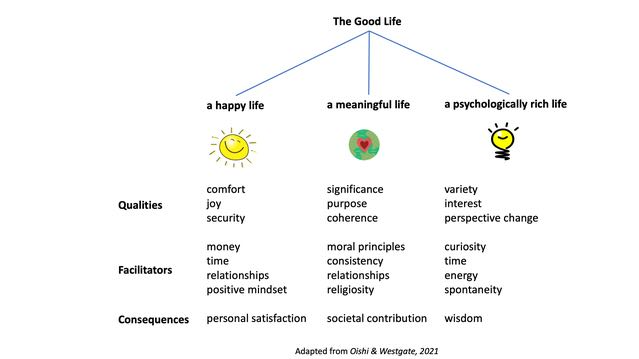
In a You Tube video I'll share below, someone encapsulates happiness as "Wow what fun," meaning as "I'm so proud," and psychological richness as "What a ride." These could be deathbed thoughts, I guess. I would enjoy mine being What a ride, because this encompasses my joys and sorrows, my successes and failures, my pleasures and pains, and all the other ups and downs I've experienced on this roller coaster of life, and continue to experience every day.
I recall something that a massage therapist told me while she was giving me a massage: "I make more mistakes than my sister because I try more things." That's psychological richness!
Here's how Oishi describes psychological richness in his book's introductory chapter.
Psychological richness is different from happiness and meaning in the sense that it is not about an overall feeling of where life is going or what the point of your life is, but about an experience, or more precisely the accumulation of experiences over time.
In the same way that material richness can be quantified by money — the more money you have, the richer you are materially — psychological richness can be quantified by experiences. The more interesting experiences and stories you have, the more psychologically rich you are.
Just as you can accumulate wealth and become materially rich, you can accumulate experiences and become psychologically rich.
…A psychologically rich life is not for everyone. It suits the curious more than the content. The comfort and security of a happy or meaningful life provide a safety net that a psychologically rich life, with all its unknowns, often lacks.
Yet the paradox of happiness and meaning is that the complacency they foster can make for an incomplete life with major regrets, doubts, and unanswered questions. Thankfully, our lives are not zero-sum games in which we must choose a single path to a good life; some people lead happy, meaningful, and psychologically rich lives.
Therefore, anyone can benefit from the lessons of psychological richness research. By reminding ourselves that what counts is not just the destination but also the journey, we learn to find value in seeking new experiences and new knowledge, hopefully leading to a life without regrets, or at least fewer regrets.
Here's the You Tube video. It includes an advertisement for the sponsor of the video. If you want to have the experience of the advertisement, watch it, as I did. Or you can avoid it by skipping ahead.
Discover more from Church of the Churchless
Subscribe to get the latest posts sent to your email.
What does it take to satisfy the mind? It’s endless. Once you obtain one thing, it tires of it and seeks another.
All happiness, joy, peace, IMHO comes from balance.
And balance is all relative to an internal fulcrum, wherever that may be relative to where we are.
Even getting there is a matter of alignment. How do you align yourself?
Find the center within yourself. Let it lift you and in the process align you.
It’s much simpler than mind would have you believe.
The hub of a wheel is much simpler than the myriad spokes.that actually have their source in the hub.
Here’s a topic for introspection and self-analysis.
Perhaps it may help some readers gain some extra self-awareness.
It is this:
Gloating and essentially bragging about how ‘happy’, ‘comfortable’, ‘meaningful’ and ‘psychologically rich’ YOUR life is, WHILE simultaneously completely disregarding a particularly cruel and gleefully sadistic ONGOING genocide that your country is complicit in and which YOU personally voted to continue, may be indicative of an unrecognised, immoral mental condition. Especially so, after you initially misrepresented the final phase of that ongoing, decades-long genocide against an entrapped, defenceless, beleaguered people as a ‘religious WAR’.
I suggest this behaviour described above may be indicative of something not being recognised.
I quite like the tone of Shigehiro Oishi’s book: – Life in Three Dimensions: How Curiosity, Exploration, and Experience Make a Fuller, Better Life where he summarizes the difference between happiness, meaning, and psychological richness.
He talks of a materially rich and a meaningful life as being a safety net while a psychological rich life involves experiences and curiosity. Well, I don’t know about how others feel about their lives but I feel that there is no need to ‘seek out new experiences’ as every moment of life (be it a welcome experience or not) is a life of richness – whether it is psychological, material or meaningful richness.
I guess it all comes down to how we are conditioned to see, feel and interpret our lives. Material richness (or sufficiency) is understandable and such security abounds in nature as well as us. And, we invest things with meaning (which is not inherent in the thing or action but whether they make us feel good about them) giving us a sense of worth or justification – nothing wrong with that, it’s just another of the unconscious habits we indulge in.
Psychological richness, being the accumulation of experiences and the result of curiosity sounds quite valid and relevant to the human condition. Although I would say that it doesn’t necessarily mean that one should go off bungee jumping or swimming with sharks; perhaps a simple inquiry (or curiosity) about how we arrive at our particular way of thinking and looking at life is more than pertinent.
Sounds like he’s just trying to rationalize all the people he’s slept with like Sheena did.
Makes sense, sure. Except, I guess I’d take both of those two right-hand columns as one single head, and call the whole thing “meaning”. Not sure anything new is being suggested here. …On the other hand, absolutely, it does help to be clearer about what we’re talking about, by analyzing these components separately. To that extent, sure.
Heh, this recalls to me that blessing, “May you live in interesting times” —- which is actually anything but! …More seriously, I’d consider this a kind of curve, with more of it needed initially, but the need for new input lessening as one goes along, particularly if the going along is accompanied with maturity and understanding and wisdom. And in any case I suppose it’s an individual thing, and whatever works for one is fine.
All of this makes sense if it’s seen not so much as prescription as simply, on one hand, a general analytical tool in order to better understand our life choices, and on the other hand an invitation for greater introspection and self-understanding and for calibrating one’s life basis one’s inner drives and predilections.
———-
Heh, learned a new word, eudaimonic. Cool!
eudaimonic. That’s a good one. I’m sure that there’s nothing new under the Sun though. So so much of Life occurs just fine without reading anything more into it.