

I'm continuing to enjoy Robert Sapolsky's book Determined: A Science of Life Without Free Will, which I first wrote about a few days ago. The book is getting a lot of publicity, way more than any other book on this subject so far as I can tell.
Before I share what I said about the illusion of free will on my HinesSight blog yesterday, here's more from Sapolsky — quotes from the end of his chapter "Where Does Intent Come From?"
In the first chapter, I wrote about what is needed to prove free will, and this chapter has added details to that demand: show me that the thing a neuron just did in someone's brain was unaffected by any of these preceding factors — by the goings-on in the eighty billion neurons surrounding it, by any of the infinite number of combinations of hormone levels percolated that morning, by any of the countless types of childhoods and fetal environments were experienced, by any of the two to the four millionth power different genomes that neuron contains, multiplied by the nearly as large range of epigenetic orchestrations possible. Et cetera. All out of your control.
…Why did that moment just occur? "Because of what came before it." Then why did that moment just occur? "Because of what came before that," forever isn't absurd and is, instead, how the universe works. The absurdity amid this seamlessness is to think that we have free will and that it exists because at some point, the state of the world (or of the frontal cortex or neuron or molecule of serotonin…) that "came before that" happened out of thin air.
In order to prove there's free will, you have to show that some behavior just happened out of thin air in the sense of considering all these biological precursors. It may be possible to sidestep that with some subtle philosophical arguments, but you can't with anything known to science.
And here's what I said in my HinesSight post yesterday, I don't believe in free will. Here's why. I left out a quotation from Sapolsky's book that I included in my first post about it.
Today the monthly Salon discussion group that my wife and I are part of spent quite a bit of time talking about free will.
This is one of my favorite subjects, for after pondering quite a few books about free will, or the lack thereof, I'm highly confident that free will is an illusion.
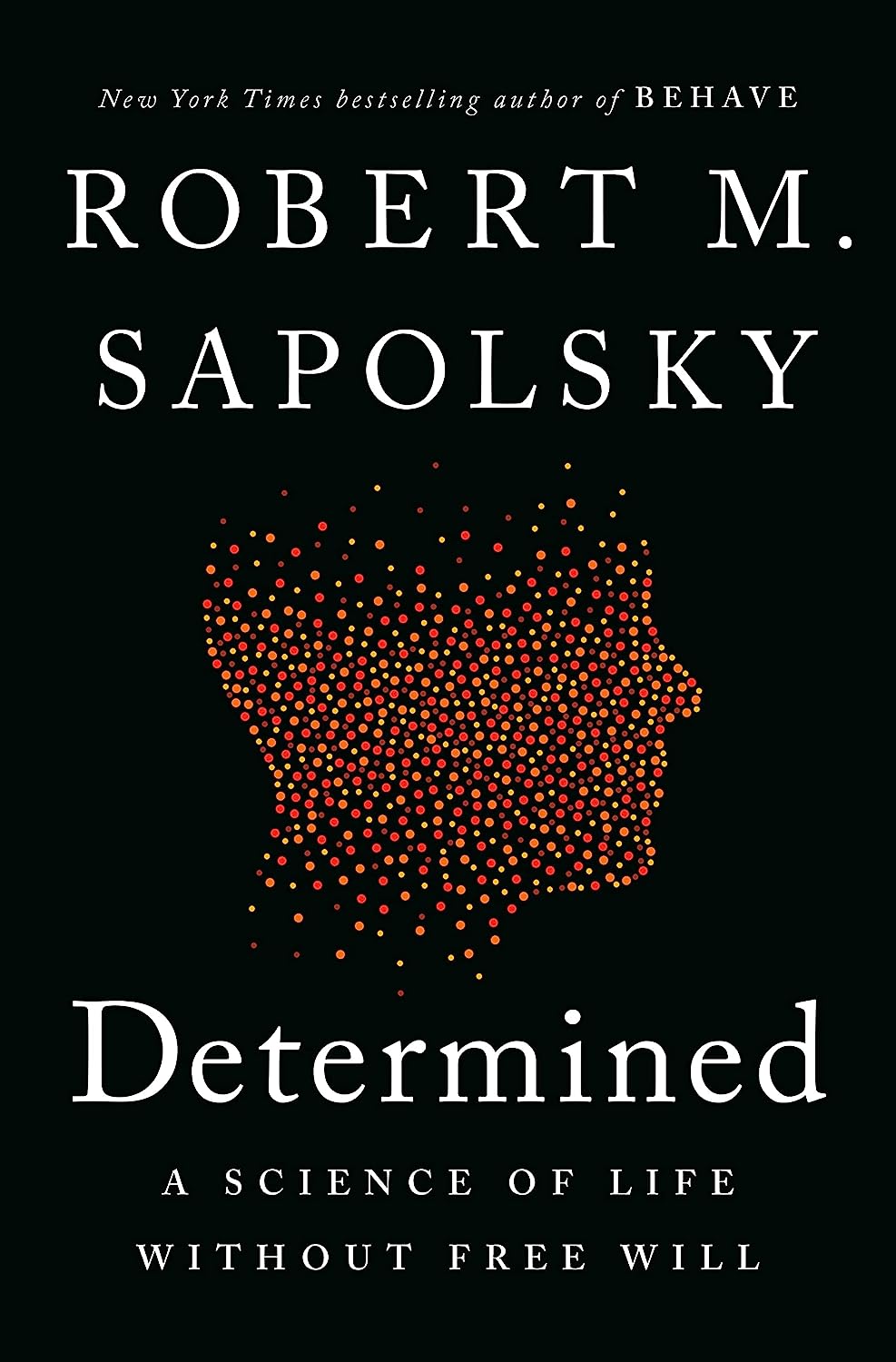
I can't recall exactly how our group started conversing about it, but for sure I spurred our conversation by saying that I've started reading Robert M. Sapolsky's terrific book, Determined: A Science of Life Without Free Will.
To give you a feel for his general view of free will, here's an eight-minute interview featuring Sapolsky, a Stanford University professor of biology, of neurology and neurological sciences, and of neurosurgery.
I was worried that my passion for this subject wouldn't be shared by other members of the discussion group. I was wrong. We had a really interesting discussion of free will in which some people agreed with me that we don't possess it, and others presented reasons why they think we do.
Since I'm writing this blog post, not them, I'm going to focus on briefly relating some of my arguments for why free will doesn't exist. These aren't original, obviously. They flow from the books I've read by people arguing that free will is an illusion.
(1) Humans are part of the natural world. We are animals. Animals with powerful brains, to be sure, but animals. If a grizzly bear attacks someone, we don't consider that the bear had the free will to do otherwise. We just say, it was doing what bears do. So what makes us think that we stand apart from the natural world by possessing some sort of free will magic in our brain?
(2) The core argument against free will is simple. Everything about us, and the rest of the world, is determined. That's why Sapolsky's book has that title, Determined. Sure, we make choices. So do bears. And sea slugs. Those choices, those intentions, don't spring out of nowhere. They arise out of the goings-on in our brain, which is amazingly complex, yet still determined by causes and effects that range from a few seconds ago, to the moment of our birth, and even beyond given cultural and genetic influences on us.
(3) Recall something you've done that you regret. That's easy for me. Probably is for you also. We all have regrets. Often, or usually, that regret is made more painful by believing that we could have acted differently. But consider this. If every atom in your brain and outside world were in exactly the same condition as it was when you acted the first time, you'd do exactly what you did again. No doubt about it. Free will assumes that we have a choice to act differently. That can't be true if nothing has changed from when we acted initially.
(4) But as Sapolsky says in the video above, change does happen. All the time. Life and our world as a whole is nothing but change. People change. Animals change. Rocks change. Plants change. Free will, since it doesn't exist, can't change anything. Yet circumstances change. Every thought we have, every feeling we have, every action we take, all that changes us. So there's no fatalism involved in giving up a belief in free will. In fact, not believing in free will opens us to the reality that change can occur for countless reasons. Life is a never-ending series of surprises caused by determinism.
(5) Believing in free will fosters judgmentalism. We see someone in an unfortunate situation and think, "It's their fault." Giving up a belief in free will leads to a realization that, as strange as this may sound, no one is deserving of praise or blame. They're just doing what was determined that they do. So are we. Everybody is. Sure, society is justified in imprisoning dangerous people. But not to punish them. To protect others. And to change the prisoner for the better, if this is possible.
(6) There's no reason to think that people would go wild and crazy if they didn't believe in free will. Animals don't believe in free will, yet a wolf pack, herd of deer, school of fish, or flock of birds do just fine without such a belief. Us human animals have a strong sense of community and social cohesion. We generally want to get along with our fellow humans, notwithstanding our political, religious, and other sorts of divisions. Morality flows from a much deeper source than free will. It is embedded in our being thanks to evolution.
This morning I emailed a link to my HinesSight post to the members of our discussion group. After sharing the link, I added some personal observations.
Discover more from Church of the Churchless
Subscribe to get the latest posts sent to your email.
In the opinion piece of the Los Angeles Times (Oct. 22, 2023) John Martin Fischer a professor of philosophy at UC Riverside writes “Some scientists (referring here to Sapolsky’s book) say we don’t have free will. As a philosopher I say, of course we do.”
He makes the usual assumptions such as: “Consider, as a simple example, my decision to sit down at my computer to write these sentences. Yes, my past and the laws of nature may have crucially led me here. But I did so also because of deliberation. I weighed the pros for writing against the cons and chose to do it. It wasn’t like a sneeze [involuntary]; it was a process that involved reasoning. Determinism helps explain why I started typing, but it does not in itself rule out my free will.”
He goes on to talk about moral responsibility, how some people deserve blame and resent-ment, much as others deserve praise and gratitude and that determinism means letting immor-al people off the hook and conversely not praising good actions.
He does not seem to realise or accept that our choices and deliberations carry the same weight and responsibility as the concept of free will (see Brian’s point 2 on choices and point 6 on morality). Also, Fisher does not mention the core belief of free will – something that has the notional capacity or ability to choose between different possible courses of action unimpeded. Traditionally, ‘unimpeded’ has religious connotations and is synonymous with having a soul or spirit that is uninfluenced by the flesh (nature).
What is this endless lament about will all about??
Who has the power to make appear what he wills>
Who is able to sleep at will?
Who is able to change his mood at will?
Who is able to change the fow of thoughts at will?
Who is able to change the weather at will?
Who is able to bypass the laws of nature?
who is able to bypass his past
who is able to by pass his character
Who is able to by pass his conditioning?
Who is able to change anything that was not created by himself?
Who is able to create at will?
The words appear before me, and I do not know how they came
The mood appeared before me and I did no from where and how
I can make coffee, lift the cup and drink the coffee, but i do not know how the “I” does that
Would any body live his life the way he does as he had will to change, himself and the world he lives in?
Would the poor Gazan people waiting to be killed and injured stay in Gaza if they had free will?
Would they not teleport themselves at will to an luxurious Disney Kibbutz?
What will for heavens sake.?!
What is it that people that go on to discuss it are after for themselves and others?
What is that they want?
Life is a mistery
what FREEDOM of use?!
Watched the video. Kind of …obvious? Same old, same old? …But then I suppose that’s only because we’ve already covered this ground, many times, on here. In general terms, it’s interesting enough, sure.
At the end of the short video, up pops the full 1½ hour interview, thanks to YT algo. I haven’t watched it yet, but I’ve bookmarked it for later on, when I’m free. Here’s the link for the full thing: https://www.youtube.com/watch?v=DtmwtjOoSYU
Not to beat to death my main objection to this sort of thinking, that I’ve articulated more than once, but I can’t help pointing out, in one more comment here, that we seem to conflating free will with agency. …That there’s no free will is very easily deduced directly, top-down, from a materialist paradigm; and in as much as science has, so far, revealed to us a materialistic universe, therefore, absent evidence to the contrary, we can take it that there’s no free will. That’s easily understood, beginning to end, in one single sentence. We probably don’t need an entire book to argue that obvious, commonsense position. (To be clear, I’m AGREEING, as I always have, that there’s no free will.) …Agency, however? That’s a different thing altogether, and it makes no sense to conflate that with free will. …I suppose, let me explain more clearly what I mean:
There was that example, that metaphor, in a previous post, quoting Breer I think (or was it someone else?), of a boat floating in the river or the sea. Some guy in a boat has come and rammed your boat, and you’re furious with the guy. But then you see that the boat is simply floating there, and the winds pulled it to your boat, or maybe a jammed gear on that empty boat did. You no longer have any call to get upset or angry or whatever. …Well, here’s what I thought of when I read that thing then, except I didn’t spell it out at that time. Instead of simply a dumb boat, think of a highly evolved AI-driven self-driving boat. …Let me further spell that out:
We already have these ChatGPT thingies, where the developers of the AI can themselves not figure out exactly how and why it does some of the things it does. That is, in principle they know why. Also, at least at this point in time, if they were to throw all their resources at one particular answer from ChatGPT, then no doubt they’d be able to find out, in practice as well, exactly how and why. But in actuality, given resource constraints, why ChatGPT gives certain specific answers, is something that is de facto something even the developers can’t figure out, really. Or so I remember hearing one of them say, I forget who exactly, Sam Altman maybe, or whoever it was.
So, think of a far more advanced AI system, maybe twenty or thirty years hence. Made all the more inscrutable (to us humans) by the fact that no doubt by that time AI will have started improving itself, “evolving” that is to say. (That has so far not happened. While AI “learns”, but so far tweaks in the programming parameters are fed in by the developers and programmers. But it’s surely only a matter of time, and not too much time at that, before self-correcting AI is unleashed, and the exponential leaps in complexity that that implies.)
Well, such a boat, powered by an incredibly sophisticated AI, floating on the river, can indeed be judged. Should these boats not have any of these rules hardwired into them, then certainly, one that necessarily avoids all damage to other boats, can be thought of as more “virtuous” than another boat that only cares about getting from point A to point B, and the “collateral damage” be damned. Much like us humans, such boats can indeed be “judged” to be either saintly, or normal-human-good, or amoral, or normal-human-bad, or completely psychotic and evil. Absolutely we can judge such programs, such boats, as such, why not.
And that would be an example of agency, but not of free will. There’d be no free will on those boats, for exactly the reasons Sapolsky argues. Or the top-down obvious reasoning directly from materialism that I invoked (and have presented before this, as well). Nevertheless, as opposed to simply a mechanical boat, an sophisticated-AI-powered boat would indeed be possessed of agency, by virtue of the sheer complexity of it.
Which, it seems to me, is exactly how it is with us humans. We don’t have free will, most emphatically (and entirely obviously). But we are, indeed, possessed of agency.
(And of course, it does make sense to “praise” a morally superior AI-enabled boat, and a morally superior human being; and to “blame” an evil and malignant AI-boat or human being. That is, while it is great not to ever get angry or agitated, sure; and in any case it makes sense to temper our instinct for vengeance, if only in consideration for what that does to us; but it does make sense to admire and prefer — yes, and “praise” — a morally ‘better’ AI-boat or human over a morally inferior one.)
…This conflation of free will with agency, that seems to be repeated time and time again without getting to the root of the issue of this conflation, it …bugs me, I must say. Either I’m completely mistaken about how I’ve reasoned this out, and have argued this out (which is quite possible, I’m not for a minute suggesting I’m inerrantly correct on this, except I don’t quite see where exactly I err in my reasoning); or else this entire thesis is …not quite coherent.
Not too keen on the term ‘determinism’ as it smacks of everything being preordained and that doesn’t’ sit well. Although the reality is, that as we are all programmed through the influences of the cultures and societies we are born into. In that sense, our ensuing thoughts and actions are predetermined. ‘Agency’ does seem better as the term refers to the ‘feeling’ of control – not the control as exhibited by an external agency as in the free will school of thought. But again, with agency, we, our thoughts and actions are the result of our particular backgrounds.
Both have merit. Determinism states that where people have to make a certain decision, they could not have decided or acted otherwise than they actually did. That feels a bit constricting, suggesting that there was only one course of action that the person automatically chooses, whereas in fact, a persons’ choices are boundless and reflect the myriad variables derived from a lifetime’s assemblage of experiences and information.
Agency on the other hand, (in the psychological sense) is to feel that we are in charge and in control of our own lives with the ability to act autonomously and freely. And yes, this feels true but again reflects the result of the baggage of a person’s past with all that that entails. It seems that we cannot escape the influence that our backgrounds have over our present and future thoughts and actions.
As far as ethics and responsibility is concerned, we comprise variable innate natural sensibilities and coupled with our man-made cultural and societal rules and laws, we theoretically, have the basis to make judgements and ethical decisions which benefit ourselves and societies can ideally make.
The problem with these arguments is the use of the echo chamber to bolster them: People who already believe entirely in these things. Repeating ten opinions is not the same as ten independent sources of intellectual thought.
As pointed out repeatedly earlier, we have relative free will and the universe has a level of in-determinism right along with determinism.
Here is the argument proof:
1. Provided education and encouragement, people have new choices available to them that were not there before, and the influence of other people, hence they can now do what they could not do before. They have greater free will provided externally by their environment, and internally as the result of education and positive influence. Many, many people take advantage of this opportunity and make new choices that further expand their freedom. Others do not. In both cases they have greater free will than they had before. They have, even in a mostly determinate world, relative free will. Give a prisoner good education, options and encouragement, over time the old habits may be replaced with new habits, new choices that person didn’t have available or knowledge of before. And the result is freedom to do what they could not do before.
So there is relative free will in terms of the influence of information and the encouragement of others in our social network. Those two causal factors greatly influence how well we use our potential.
To claim there is no free will is to defend the practice of slavery. Many white slave owners argued that slaves could not possibly achieve what whites achieved because they didn’t have the capacity. They looked at their slaves and saw them acting like slaves, and concluded, this is all they can do. This was a self-serving and self-fulfilling prophecy, a hateful way of thinking, because slaves were never given the same advantages as others, and did not have the same breadth of education nor choices. However, even so, many slaves self-educated and wrote and spoke brilliantly on the error of whites who made this judgement.
1.b. We have potential within each of us that we are not fully aware of. Therefore for anyone to claim “He could do nothing else” is not the same as claiming “He can do nothing else.” The potential within each of us can be awakened through education, influence, new experiences. And then we find we are capable of much more than we might have thought. And we have more choices when we make decisions about what to do next.
What 1 and 1b effectively do is to reduce the utility of arguments of determinism to their rightful purpose: Understanding and encouragement, rather than to judgement and dismissal of those of different views.
Since determinism has been used to excuse racism, and free will has been used to encourage personal growth and development, and investment in rehabilitation, education and providing better environments for others, I question the utility of attempting to prove a strict determinism, since basing that on observation is perpetuating all the evils of the status quo.
Since each of us, under the right conditions, can learn, change and grow, and our decision-making is a great part of that, it can’t be said that we have zero free will, since we now act with much greater free will relative to what we had before.
A free person living in a stable nation has much more free will than a prisoner.
2. We can’t claim the universe is 100% deterministic because we don’t understand or know all of it. It seems, logically, that everything has a cause. We are taught this in spirituality and to a degree in science. But science is not as conclusive simply because it doesn’t claim to understand the whole of creation, nor even half of it.
In fact, in every scientific experiment that works to prove the effect of an independent variable, the changes noted are compared to a level of statistically-generated variability based on “chance” or “Random variation”…This is the variation in the environment that cannot yet be explained. In order to prove determinism for a specific variable, a level of in-determinism must first be established. Therefore, in every experiment there is both determinism and a background of in-determinism. Without that background, no effect in the real world can be proven. You need both.
That in-determinism is not acknowledged by the authors cited in the post simply reflects their ignorance of how science actually is conducted. Science lives in the unknown and painstakingly brings parts of the unknown into the known. But determinism presumes all is known. That is false.
To prove a fully deterministic universe requires a closed universe. There is not adequate evidence to conclude this. Since a level of in-determinism must be established to conduct any scientific inquiry, every experiment that establishes background variation in fact provides evidence of that in-determinism (the unkown, what is yet to be measured).
2.b. A popular theory that uses this is Chaos theory. Chaos theory demonstrates that even in an entirely deterministic universe, unpredictable events can and do take place. This is because we cannot measure all variables adequately, and those background variables over time can lead to entirely unpredictable events. Therefore, since prediction accuracy drops away significantly over time, because we don’t understand all the variables nor how they interact, there is relatively limited determinism, in terms of it’s practical use, and quite a bit of in-determinism in terms of the reality of events.
3. Complex systems. Even assuming determinism, complex systems often produce events that cannot be predicted from prediction based upon their independent variables. Because they cannot be predicted, they fail the single principle proof of determinism, and its use.
The human brain is a complex system, therefore it will continue to generate novel, unpredictable ideas, and actions, and thus open for its user untold options, all with a little creative thought, which on its own naturally arises in many people.
Belief in God is one of those wild-card mechanisms of thought and heart that can and has yielded incredible changes for good in people oppressed and without any visible support or asylum.
Therefore the argument for determinism, which cannot be proven in absolute terms, because of the unknown, and which, even if it were true, cannot accurately predict how each individual person may react and interact, is relatively useless. But when applied to individuals is entirely defeatist.
The entire theory of evolution, which is well-proven, rests on a foundation of random, ie; not entirely understood nor predictable, variation. The universe introduces new in-determinant wild-cards into genetics all the time. The very theory of evolution rests in part on the basis of in-determinism. Therefore, the universe cannot be strictly determinate if Evolution is real, which we know it is.
Meanwhile, as education and good environment result in change and growth of personal free will, the utility of the concept of relative free will is much more practical and useful.
4. In a fully deterministic universe no one is responsible for their actions and no change or improvement is possible. This is the greatest argument against strictly deterministic thinking. People can and do take responsibility, and when they do not and society or family, or conscience reminds them, they can and do make course corrections. Therefore the possibility of exercising that free will is of principle importance.
So, in short, no excuses. But lots of help and encouragement.
Hi Brian:
You wrote:
“Could this help explain why my father, by all accounts from what I’ve been able to learn, was an egotistical selfish asshole? Maybe? Probably?
“Regardless I felt more compassion for my father this morning than I ever have, because viewing him as the product of deterministic forces put him in a different light than how I’ve tended to see him: ”
He worked very hard and did the very best he could, and accepted what he was incapable, emotionally, of doing.
He could have done nothing else. Nor you.
But had you understood and accepted him on the spot, when you saw him, and asked to spend more time with him, you may have opened a door to a different man…and there would have been in that moment two different men interacting.
Understanding naturally results in compassion. And meditation, Zen or otherwise, as well as a belief that we are truly all brothers and sisters (certainly genetically, and possibly spiritually, children of One “father”) raises our compassion and understanding.
And that increases our own free will. And exercising that, we help others expand theirs.
To those touting “agency,” whatever that is, as a replacement for free will, this reminds me of Sapolsky’s observation that philosophy may be able to come up with (spurious) arguments in favor of free will, this has no bearing on scientific reality. Agency strikes me as simply another way of arguing for “compatibilism,” the weird notion that while free will is an illusion, we nonetheless possess the capacity to make choices if not physically constrained (as in prison) so somehow choosing is compatible with free will.
This sophism is just a way to avoid the plain fact that free will means, obviously, that our will is free — unconstrained by all the influences Sapolsky describes in his book: prior decisions, other prior experiences, genetics, childhood and prenatal history, cultural influences, and so on. A positive review of Sapolsky’s book in Psychology Today speaks about this subject of choice:
https://www.psychologytoday.com/us/blog/this-is-america/202310/an-attack-on-free-will
—————————–
Free will, Robert Sapolsky (professor of biology and neurology at Stanford University, recipient of a MacArthur Foundation Genius Grant, and the author, among other books, of Behave: The Biology of Humans at Our Best and Worst) reminds us, is usually defined as the ability of the brain to spontaneously generate and consider alternative options, select one, and decide whether to act on it.
Sapolsky considers this claim akin to believing that human beings possess a non-biological essence “bespangled with fairy dust.”
In Determined, Sapolsky maintains that all beliefs, values, and behavior (“the way you became you”) result from the complex, uniquely individualized interactions of genes, brain chemistry, fetal, infant, and childhood nurture, and the social and cultural environment, over which human beings have no control. Thus, while we can will what they choose (open a door, pull a trigger), we cannot choose what we choose. And just as it makes no sense to blame a tornado for destroying your house, no one deserves to be treated better or worse than anyone else.