

There’s plenty of reasons not to believe in free will. The most important and basic reason is that free will is an illusion. Robert Sapolsky made strong arguments for this in his book, Determined.
I wrote quite a few posts about this wonderful book. A summary of his arguments in Sapolsky’s own words can be found here. But once we accept the reality that free will doesn’t exist, a question arises: What does this mean for how we live?
In one sense, not much. For the illusion of free will is so strong, even Sapolsky admits that almost always, he feels like he is freely choosing his thoughts and actions, even though he’s convinced that the feeling doesn’t match reality. Here’s a comic strip example that shows how difficult it is to accept that free will is a fantasy.
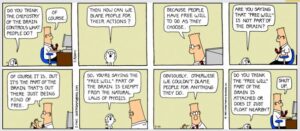
There’s one area, though, where giving up a belief in free will can have an immediate beneficial effect on us. I talked about this in my previous post, Regret seems useless to me, especially if there’s no free will. It also relates to the comic strip above, where Dogbert asks, “Then how can we blame people for their actions?”
That “we” applies to us blaming ourself for our actions. Whenever we feel guilty about something we’ve done, said, or thought, that feeling of guilt is founded on an incorrect assumption: we could have done, said, or thought otherwise, but didn’t.
This, of course, is the foundation of most legal systems, as noted in A justice system not based on a belief in free will would be much better, and Sitting in the jury box, I deny free will.
While it is going to take a while for the legal system in the United States and other countries to catch up to neuroscientific reality, the good news is that within our own mind, we can render a conclusive verdict of Not Guilty! to all of the “crimes” we feel we’ve committed that actually we’re innocent of.
The harm our actions caused to ourself or to others. Not Guilty! The distress our ill-considered speech created in people who heard our words. Not Guilty! The things we could have done to make life better for ourself or others, but failed to do. Not Guilty! The shameful thoughts that course through our mind which we’d be hugely embarrassed about revealing to others. Not Guilty!
When I have a memory of something I’ve done that I regret, I now am able to stop that thought from making me feel bad by telling myself, “Not Guilty! You’re innocent of the accusations you’ve been making against yourself.”
This is a big relief.
And it comes from making my non-belief in free will more than just a concept. Instead, a foundation for forgiveness. Understand: this doesn’t mean that I’m not interested in learning from my mistakes. I simply want that learning to occur from a place of forgiveness rather than a place of guilt or shame.
Whatever I’ve done — the good, the bad, the neutral, everything — not only were all of those actions determined by factors other than free will, there isn’t even a “me” inside my head who did them.
In a recent comment on this blog, someone shared a substack post by Robert Saltzman, a psychologist who has written books that debunk both the notion of free will and the assumption that a “self” exists who could do anything, freely or not. Here’s a passage from the post.
READER: So, Robert. I am reading “The 21st Century Self” and have some questions. First, what is the most essential idea you would like me to extract from your book?
ROBERT: The central point is stark: the self you take as bedrock is not a thing but a recursive event. What arises in experience—sensation, thought, memory—is immediately claimed as “mine.” That claim then generates the sense of a claimer, a subject. The “I” is nothing but that loop.
AI matters because it shows this mechanism without the human consolations. It speaks fluently, answers with authority, and yet there is no one there. That lack of anyone “behind the voice” makes visible what has always been the case with human selves: presence mistaken for substance, claim mistaken for claimant.
If you retain only one idea from the book, it is this: the self is not an entity you must liberate, improve, or protect. It is a performance of claiming, sustained only by repetition.
Discover more from Church of the Churchless
Subscribe to get the latest posts sent to your email.
The ‘self’, or rather the concept of a self, drops away when realised it is just thought and memory: an identity forged from our personal history, a history that comprises our accumulated experiences. It is from this accumulation of information that the idea of a ‘self’ is distilled.
Regret and guilt arise as thought transforms into emotion. Realising that the whole process of thinking turned action, is derived from a brain that automatically regurgitates the information it is programmed with, there is no one, no self that can be held responsible.
But, as social creatures who have to live and cooperate together, the situations that potentially give rise to regret and guilt, could be realised without the ensuing blaming carried by emotions and registered as new information to maybe change future actions.
Without the dominance of a separate self-promoting self, that puts its own self-interests always first, society would be able to operate intelligently within its agreed rules and laws without the accompanying anti-social baggage of self-interested parties – as is the case with self-important, ego-driven people in power today!
In all events we move forward naturally by first accepting them. They happened, and they do not require any attributions at all to exist. Certainly none from any armchair Quarterback.
But what will our next step be? For that we must use our discrimination. We must assess and accept our own condition of strengths and weaknesses, in order to proceed successfully towards any objective, even the objective of being kind and doing no harm.
It’s not enough to say we meant to do something different.
It is incumbent upon us to choose how and what we will do next. And to take responsibility for what we choose to do.
Taking a lesson from the past, now we look before acting, now we listen before speaking.
We are learning creatures. All history shows that people can and do grow, in the right environment, and are corrupted in the wrong environment. Who decides what is right or wrong? You and I must do this for ourselves. And we are equipped to do so.
And when we compare notes, we may learn a little better way to understand right and wrong, good and bad. And so our understanding not only can change over time, it naturally does. And we have a role to play in helping that along. And in acting differently as a result.
So yes, you can feel guilty if something you did hurt others. And you should feel guilty IF that motivates you to be honest, to accept responsibility for those actions, and to get help to assure you act differently moving forward. That’s all on you. Do the best you can! 😊
Love isn’t for cowards. Neither is life.
All the sciences of neurology, biology and psychology have learned that human beings and all creatures, even insects act to avoid pain and to seek pleasure. And all the hard sciences teach us that every action has its effect, no matter how small.
Anything human beings do to disrupt this natural system by which we learn and survive, and function within a culture, is unnatural. Feeling good is great, but may inadvertently reinforce harmful behavior. Feeling bad may hurt, but may lead us to becoming better human beings. No one should take any of that away. Just accept. There is no forgiveness without responsibility, no redemption without change. Mercy doesn’t exist in an environment where there is no judgement. They are all part of the system. And judgement is not personal at all. It is the acknowledgment that some actions where helpful, and others destructive. Reality is what it is.
To avoid pain of any kind, to avoid responsibility leads to actions that harm without consequence nor conscience. The people we see in public life that make decisions that harm millions of others are masters at not taking personal responsibility. Their actions harm others they don’t care about, but also, inevitably, harms themselves, since we are all part of the same system, and what we do the littlest part we are doing to ourselves. When we understand we are all connected, and responsible, we learn by necessity to live together, and to adapt to each other, to acknowledge our strengths and build on them, and acknowledge our weaknesses and work to overcome them. What we do inevitably affects us and the entire syste. All reality teaches us that every action has its affect. Let’s take responsibility for that, and save the planet, each other, and ourselves.
I’m not so easily said or quickly done for the ones who trespassed against us.