

If, like me, you’re fascinated by the phenomenon of consciousness, have your own favorite notion about what consciousness is and isn’t, yet are open to exploring other theories of consciousness, you’re going to find the Landscape of Consciousness web site a treasure trove of information and insights.
I learned about it from an article by Robert Lawrence Kuhn in the October 25, 2025 issue of New Scientist, “Landscape of consciousness.” The online article is titled “What 350 different theories of consciousness reveal about reality.” Here’s a PDF file of the article.
What 350 different theories of consciousness reveal about reality | New Scientist
This is how it starts off:
Consciousness is the ultimate question of existence. Nothing is more essential than our experience. Yet we have no consensus, and perhaps no clue, about what it actually is.
The trouble, in part, is that experts usually become invested in one theory, blinding themselves to alternative explanations that could aid progress. Instead, I embrace the diversity of consciousness theories across science, philosophy and religion – so long as they are built on clear arguments. In this way, over many years, I have charted more than 350 theories (and counting) onto a “landscape” of consciousness, which I will help you to explore.
From materialism, where only physical states are real, to idealism, where only mental states are real – and everything in between – it will become apparent, as we wander through these heady fields, how much is at stake. That’s because whichever theory of consciousness you favour determines many of your core beliefs about the world, such as your opinions on the nature of free will, the possibility of life after death and whether artificial intelligence can attain consciousness.
Mapping this landscape, I marvel not only at the sheer number of possible theories, but also at the astonishingly divergent scales and places where the magic of consciousness could make its home. Often, neuroscientists assume that experience emerges, somehow, from neurons firing in the brain, but there are many alternative theories – some of which have consciousness as fundamental, and some which have physical reality as an illusion. At the micro-extreme, does consciousness arise when quantum wavefunctions collapse into concrete reality? Or, on the grandest scales, is the cosmos itself conscious in some sense?
Of course, we have to remember that the more than 350 theories of consciousness range from almost completely unbelievable to yeah, that makes sense, so it could be correct. Also of course, depending on your point of view, what’s considered completely unbelievable and what’s viewed as much more likely to be correct is going to vary from person to person.
To whet your appetite for the Full Meal Deal on the Landscape of Consciousness web site, here’s screenshots from the New Scientist article that provide a taste of what Kuhn and his collaborations have produced — which truly is a gift to the world, or at least those of us deeply interested in consciousness.
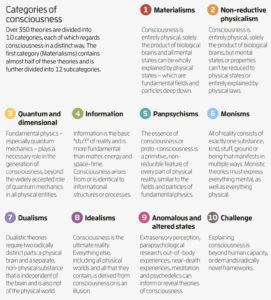
Currently I’m definitely an adherent of the Materialisms category, which comprises about half of the 350 or so theories. It just seems most likely to me that consciousness arises from goings-on in the physical brain, so is subject to the same laws of nature as everything else is. However, in my religious believing days I was a big fan of Dualisms, because I liked the idea that when my body dies, my non-material consciousness, or soul, lives on.
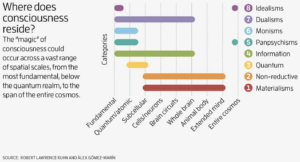
This figure is a bit difficult for me to understand. For example, I don’t really grasp why Panpsychisms don’t reside in the entire cosmos, since the first figure says that Panpsychisms hold that consciousness is a primitive feature of every part of physical reality. I guess the reason is that all that’s needed for this to occur is Panpsychisms (being primitive) to reside on the Fundamental and Quantum/atomic scales.
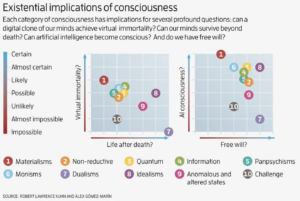
This figure is easier for me to grasp. If you want the prospect of life after death, embrace Dualisms. If you believe death is the end of life, Materialism supports that contention. Free will is most compatible with Dualisms and Idealisms. Materialistic theories of consciousness are least friendly to free will.
Head to the Landscape of Consciousness web site for a real philosophical Magical Mystery Tour. I just got around to doing that today, having read the New Scientist article a few weeks ago without checking out the site.
It’s amazing. The Map is a good place to start. Each entry there is a link, with more information just a click away. Here’s the Overview of philosophical materialism:
Materialism is the claim that consciousness is entirely physical, solely the product of biological brains, and all mental states can be fully “reduced” to, or wholly explained by, physical states—which, at their deepest levels, are the fields and particles of fundamental physics. In short, materialism, in its many forms and flavors, gives a completely physicalist account of phenomenal consciousness.
The Buddhism entry starts with:
Consciousness in Buddhism is sufficiently distinct, with its concepts of emptiness and illusion, that it could command a prime category of its own on the Landscape, yet it also fits decently in idealism, appropriately after Hinduism.
This is a taste of the Indian entry:
Theories of consciousness that developed in the ancient Indian subcontinent, based on the Vedic scriptures, focus on the relationship between individual human consciousness and cosmic consciousness. Roughly, there were two major views: each individual human consciousness is a “piece,” as it were, of the cosmic consciousness, or each individual human consciousness, in some mystical sense, is the entirety of the cosmic consciousness, even though there are innumerable instantiations of the same thing.
Lastly, the introduction to the Christian entry:
Almost all Christian denominations feature an immortal soul as essential doctrine, and it is conventional wisdom that the immortal soul is supported by passages in the New Testament. Yet there are opposing views; for example, Peter van Inwagen’s “Christian materialism.”
Discover more from Church of the Churchless
Subscribe to get the latest posts sent to your email.
With regard to this question of consciousness, I suppose I fall into the category of materialism, although I do not like the term, much preferring naturalism. Naturalism means that everything arises from natural causes and properties, can be observed, tested and verified. Non-natural, as in supernatural/spiritual/religious explanations, have no supporting evidence and cannot be tested and verified.
It is more than likely that the sensation of being conscious evolved from simple organisms that developed an awareness between ‘me’ and ‘not me’ in order to find food and to not being food. As this awareness grew, it gradually developed from the awareness of a sense of me and other (other creatures, food and the environment) into the self-awareness of higher creatures – the ability to perceive yourself, thoughts, emotions and behaviours.
I take the view (at the moment) that maybe there is no such thing as consciousness (no centre that is consciousness) in that one can be conscious, or rather, aware of internal thoughts and external objects, but with no actual ‘thing’ as consciousness. Much as there is no such thing as happiness yet there is a state of being happy. Experiencing being conscious may be the entire organism just sensing, sensing via the physical body and interpreted in the brain, where thought assumes a self that has consciousness.
Again, it all may come down to the fact that we assume a self, a self that is autonomous, which also creates the idea that it exhibits consciousness. In this scenario, self and consciousness are mind-created phenomena that exist only as thought constructs, not as realities.
Hahaha .. by accident I found this on the internet:
In the end, words are birds, and experience is the tree they roost in.
The power of inner truth is rooted in the tree; birds come and go.
Talk is cheap, but integrity is mighty.
[Comment on 6th line of Hex. 61 of I Ching]
What does the internet have to do with consciousness? There’s a word for that type of consciousness. Nerd
Wow! No, make that a double wow! This is …com-plete-ly awesome!
So far I’ve only gone through your post, and browsed, only very quickly and cursorily I’m afraid, through the linked PDF and the CloserToTruth website: but you’ve right, Brian, this is, indeed, fully a treasure trove! That one could spend hour after glorious hour just exploring!
Was curious about the guy, this Robert Lawrence Kuhn. Afraid I haven’t heard of him—or at least, I’ve no recollection of ever having come across him—and thought to look him up a bit. This interview I chanced on serves as a great introduction to who he is and what he’s about, exactly. It’s about an hour long, but you can just listen to the audio while multi-tasking, which is what I did. Link: https://www.youtube.com/watch?v=txJ4aUj-_EA&t=1548s
———-
Agreed, the second chart does seem confusing to me as well. Apart from pansychism, that you point out, take Monism: the fundamental level one gets; but why should consciousness, basis monism, reside also at the quantum level, and if at the quantum level then why not at the other levels as well?
And the third chart, it’s interesting! Mapping out ideas like free will and life after death in terms of how likely these are across categories. Didn’t actually sit down and suss out, yet, what each actually indicates, maybe later.
———-
Completely fascinating! “Gift to the world”, indeed, and I say that sans any hint of irony.
Thanks much for introducing us to this site and this schema, Brian. I look forward to checking out more of this. I mean, there’s a whole world here we can get lost in, studying this whole thing.
———-
I did have one point of criticism, as well, I’m afraid. Not about small details, but actually about one aspect Kuhn’s basic approach to this whole question, as it appeared to me. But let me hold my tongue on that, until I’ve explored a bit more than the tiny fraction I’ve seen so far of what all’s on offer here.
https://closertotruth.com/contributors/
Remarkable .. to say the least going through that page, seeing their faces and reading their qualifications, their expertise
Years agp I heard a professor define “intelligence” is THAT what can be measured with an IQ test.
In that line one could say that TRUTH and CONSCIOUNESS is what these scolars have to say about based on what they can measure.
Something like the use of an car by any driver is defined by the number of revolutions the engine makes per minute in relation to the horsepower the enigine can produce.
Finished watching that interview, finally. This one: https://www.youtube.com/watch?v=7SodXrXFAsc
(I’d posted about this interview in the thread immediately following this one. I’m posting this comment here, because this seemed more suitable, given that neither thread is current now.)
Like I said before, this is a great interview. Scratch the one I’d mentioned earlier in this thread, and watch this one instead, for an overview of Kuhn and his work.
Not that I agree about everything the interviewer is suggesting, or that Kuhn says in response. But overall, a brilliant interview, as far as both interviewer, and interviewee as well.
Anyone interested in consciousness will probably be fascinated with Kuhn’s work. And anyone interested in Kuhn’s work, and not already closely familiar with it, will probably find this interview a very interesting listen.
———-
———-
The thing about Kuhn is, while he’s a neuroscientist and all, but his lifework, his especial contribution to the field of consciousness studies, is his two-decades-long TV show, Closer to Truth.
In every episode, he talks to some people, usually three or four per episode, and talks to them about their ideas and views about consciousness. The people he talks to are top notch, and at the top of their respective fields. Scientists usually. Some philosophers as well. As well as religious types.
I’ve watched four episodes of his show. They make for fascinating viewing. The interview I linked, plus these four episodes of his show, give one a reasonable idea of the man’s overall work. …That said, each individual episode is fun to watch, and I’m looking forward to watching more of them.
Here’s the links to the four that I watched (they’re available free-to-watch on YT):
1. What is Consciousness? Ep. 1302. Link: https://youtu.be/s47EuhlgH4U?si=TWnlNJml3oWBy3Mp
2. Is Consciousness an Illusion? Ep. 1002. Link: https://youtu.be/2aPmC_zQ8bI?si=0vKQBZtGB2UWSe3v
3. Do Persons Survive Death? Ep. 712. Link: https://youtu.be/Q_60kr1pdm0?si=rkYJiMrsU-7MrCb-
4. Is Theism Coherent? Ep. 713. Link: https://youtu.be/XYgL0Exj8is?si=HVCxBolDJjYreBmM
———-
———-
I mentioned earlier a specific point of critique, that had jumped up at me when I first came across Kuhn’s Landscape taxonomy/website here. I’d been loath to go to town over it basis my very scant exposure to his work. …Well, while my familiarity with his work remains scant, given the sheer volume of his output: but still, I believe I’ve seen enough that I can put forward that critique here now, even if tentatively. (While emphasizing again my appreciation of his work overall, which I continue to think is completely fantastic, very much a “gift to the world” like Brian puts it in his main post. But I believe my critique also is probably important in terms of how we might, ideally, look on this whole thing—-albeit, as ever, I’m open to substantive critique myself, in case there’s something I’ve myself got wrong in terms of how I’m looking at this.)
I’ll post it later when I’ve time, in a separate comment here, the critique I mean to say.
Meantime, all of you who find yourselves drawn to Kuhn’s work, there’s enough fodder in that interview I linked, and the four episodes of his show I linked to—-and, of course, in his fantastic website itself and that fascinating taxonomy in Brian’s main article. (Thanks again, Brian, for introducing us to Kuhn’s work!)