

Reality. It’s everything that exists. Simple enough. Seemingly.
But the reality is that reality is fiendishly difficult to define, figure out, get a handle on, tie down. Philosophers have debated the nature of reality for thousands of years. Humans, surely, for much longer. And modern science, even with all of its accomplishments, continues to struggle with what reality is, and isn’t.
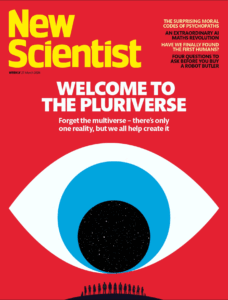
So when the most recent issue of New Scientist arrived today, I took a look at the cover and knew that I’d have to read the Welcome to the Pluriverse article right away, because the subtitle, Forget the multiverse — there’s only one reality, but we all help create it, was enticing.
I like the idea of just one reality. Of course, the multiverse certainly could be part of one reality. After all, the very notion of multiple realities doesn’t make sense to me, though I readily admit that this is just my intuition. For one thing, how would we know of another reality if we’re products of this reality? Which gets back to the basic question, what does “reality” really mean?
Leaving that question aside — it’s way beyond my philosophical pay grade — I don’t see how reality could just be sitting out there (and also in here, since reality is everything that exists), accessible to human perception and thought like a piece of toast on a plate.
What about non-human perception and thought? Sure seems that an intelligent entity with senses and a consciousness far different from ours would look upon reality differently also. Then who decides which view of reality is most real? A third intelligent entity with senses and a consciousness far different from each of the others?
That doesn’t make sense, since it would lead to an infinite regress of reality deciders. More likely, it seems to me, is that a single reality is a shape-shifter, looking differently when different forms of consciousness gaze upon it. Meaning, one reality, many ways of appearing.
Which is, roughly speaking, in the ballpark of what Jo Marchant writes about in the Welcome to the Pluriverse article. Parts are easy to understand. Parts aren’t. Here’s a PDF link if you want to read the article.
Forget the multiverse. In the pluriverse, we create reality together | New Scientist
Marchant starts off in a comprehensible fashion.
What is now? The nature of the ever-changing present moment has always fascinated me, because there is a paradox at its heart. From a personal perspective, the present is everything: it is the only time we can ever act or choose; the only thing we can ever experience or know. What did you have for breakfast? Where do you hope to go tomorrow? Even our memories and plans are forged in the present; we can only experience them now.
And yet, the conventional view of physics is that now, as we usually think of it, doesn’t actually exist at all. In Albert Einstein’s theory of relativity, all time points are equal: any event can be already done or yet to occur, from different points of view. There is no cosmic unfolding through which reality comes to be.
This raises a problem for us as thinking, feeling humans. If now is an illusion, then we cannot intervene in that moment to affect the future, because all events and times already exist. There is no gateway through which our in-the-moment thoughts or desires can reach out and change anything. By getting rid of now from the universe, we have lost a key part of ourselves.
In writing my book, In Search of Now, I wanted to know if there is another way. Can we reconcile scientific evidence with a cosmos that includes us and the choices we make? The answer, I found, was yes. But only if we are prepared to radically rethink what reality is and who we are. “The world is such that you cannot separate yourself from it,” says Michel Bitbol, a philosopher of physics at the École Normale Superieure in Paris.
She then dives into some pretty esoteric theories of quantum physics, which I won’t attempt to describe. So read the article. Here’s an excerpt that gives a feel for what the pluriverse notion is all about.
But if there were no solid landscape beyond, then it might change the meaning of predictive coding entirely. Fuchs’s big innovation is to say there is no transcendent truth; nothing exists from a “God’s eye” perspective, regardless of the individual ways we look. Rather than treating our personal worlds as hallucinations or models of the physical world, what if our experiences are components of a different kind of reality, with causative powers of their own? Whereas Wheeler saw a universe made of information, Fuchs talks in terms of actions and outcomes. “If you don’t take the action, you have a different universe than if you do take an action,” says Fuchs. “And if you do take an action, it depends on which kind of action you take.”
This is the pluriverse, a dynamic tapestry of interacting perspectives that Fuchs describes as “a living community of nows”. Rather than consisting of pre-existing, standalone things, this pluriverse is made up of patterns of experiences, continually brought into being through choices and actions. It includes all the features of our personal worlds that influence what we perceive and how we act: not just the atoms and fields of physics, but every illogical belief and unrepeatable experience, from clicking particle detectors and monsters under the bed to crunching autumn leaves.
Bitbol says that QBism offers a fascinating “twist” on reality. Einstein’s general theory of relativity describes reality as a four-dimensional block universe: a static brick of space-time within which any occurrence can be in the past or future relative to another, but there is no global unfolding or change. Instead of this monolithic block, the pluriverse is like a jazz improvisation, or wild forest, or jubilant crowd: an unruly, ever-evolving joint project with no master plan and the freedom to forge its own future. “It’s continual creation,” says Fuchs. “Nature is being hammered out as we speak.”
This vision is part of a group of quantum interpretations in which what exists depends on our perspective. “QBism takes the most radical possible way of implementing that”, with no logical reason why we should agree on anything, says Matthew Leifer, a physicist who specialises in quantum foundations at Chapman University in Irvine, California. Although Leifer sees QBism as unnecessarily extreme, he accepts that “it’s a coherent and consistent place to be”.
Intriguingly, QBism has a lot in common with a revolutionary philosophy of mind called enactivism, which argues that living things – whales, plants, bacteria, even humans – are deeply entwined with the worlds they perceive. For an enactivist, there are no pre-existing environments on one side, or standalone organisms on the other. Instead, both emerge through the dynamic process of perception itself. Here, the internal models described by predictive processing are better thought of as recipes for taking action. All of this leads enactivists, too, towards the conclusion that our perceptions aren’t representations or hallucinations, but inseparable from reality itself – as are the perceptions of all living things. Ezequiel Di Paolo, a cognitive scientist and enactivist philosopher at Ikerbasque, the Basque Foundation for Science in Bilbao, Spain, describes existence as “an ever-changing moment of creation”, in which we are all carving out both ourselves and our worlds.
Well, all I can say is… maybe. Interesting ideas. Speculative, yet possible. That’s how we progress in our understanding of reality. Be willing to consider far-out ideas, because sticking with what we know doesn’t lead to progress. I’ve ordered Jo Marchant’s book, In Search of Now, because it will shed light on the notion of the plurivese.
I liked this portion of the Amazon listing:
What do you hope readers take away from In Search of Now?
I hope it’ll give you a deeper appreciation of the wonder and mystery of each moment. You’ll come away with a rich understanding of how you perceive your world; and how your Now is shaped by your mind and body, as well as intertwined with your future and past. You’ll learn to see your life not just in terms of ticking ‘clock time’ but as the ‘lived time’ we actually experience. This evolving tapestry of sensations can’t be chopped into smaller pieces – it is woven over timescales from microseconds to lifetimes and beyond. Say you recognise a friend in a crowd, play a note on the piano, or step out on stage. When we think in clock time, we narrow each moment of our lives to a number. Research shows that the more precisely we try to chase and measure time, the more rushed and stressed we become: the less time we feel we have. But lived time is different: a quality, not a number. It expands when we focus on it; immerses us and connects us with the world.
You’ll also come away, I hope, with a greater sense of agency and freedom in every moment. We’re often told that physics proves we’re just passengers in a universe made of particles, with nothing we can do to influence their paths. Our conscious experience is described as a distortion or hallucination: a fallible readout of reality rather than a driving force. This fate sounds inescapable – how can we argue with physics? But at the end of this search for Now, I share a different vision: a cosmos more like improvised jazz. You’ll meet respected scientists from all fields who are becoming convinced that reality is made not of bouncing particles but connections and interactions, and that our in-the-moment experiences and choices matter hugely for what comes next. As one physicist put it to me: “Nature isn’t finished yet. It’s being hammered out as we speak.” We’re all coming together to shape each moment, and we can never know for sure what’s going to happen until it does.
Discover more from Church of the Churchless
Subscribe to get the latest posts sent to your email.
Hmm
I sense way too much flesh eating and meat eating amongst the scientific community. I don’t even like a doctor who’s not a vegetarian because they don’t know much if they’re not a vegetarian by now.
Well Ronald .. meat eating and all its ins and outs is relatie to the climate zone people have to live in..
Humans without tools, can only survive in a climate where the whole year there are enough fruits, seeds and nuts to consume and and an “stray” insect.
In colder climates there is just not enough vegetable food to keep them alive.
What could a poor vegan inuit survive?
Well if you have to live off of buffalo like my favorite race in all of the world ,the American Indian, did way back when then at least they used every single part of the animal but these days just about everyone can be a vegetarian or at least relegate to fish and foul. Sure there have been cannibalistic episodes in history for people stuck in the snow but we aren’t them.
Ronald, in my book all religious do’s and don’ts with regard to meat are all relate to the living circumstances and the consequences of eating meat.
As the average person is not easily to take an advice from another human being, hiding the same advice behind a divine command , will do the tric.
Meat consumption has nothing to do with God .. he or she or whatever doesn’t care at all what humans do.
It has always been humans that have demanded for themselves to speak in the name of god ..but that same god never told the humans to listen to those that speak in his name without his knowledge and consent.
I don’t have anything to do with God either. It doesn’t have to do with God to be wrong. If you want to know how covid started there you have it. That and a myriad of other diseases.
@ Spence
https://satlokashram.org/history/
There is says:
In 2006, Saint Rampal Ji Maharaj publicly objected to certain illogical and shameful parts of Satyarth Prakash. Satyarth Prakash is the central book for Arya Samaj which is claimed to be a summary of all the four Vedas, namely Atharvaveda, Yajurveda, Rigveda and Samveda, but the content of this book has no relation with the true and authentic knowledge of Vedas. Saint Rampal Ji pointed out these mistakes and published them in newspapers and books so that the devotee community themselves decide what is right and what is wrong.
You see what is interesting here to notice is that This guru publicly declared the teachings of Hindisme as incorrect and he did not do so only with that brach of religious teaching but also with other forms.
In short, He declares to have to only and ultimate understanding of the spiritual teachings, that are the foundation of all major spiritual pracrises ..base upo the discourse of Kabir in the anmurag ssagar with his disciple about the way how Kaal ensnares the souls in false panths
In imation of their guru, his followers are very active on the internet in blaming and shaming other religious ppracticing as being tools of the devil; to let them go astray.
@ Spence
HAve another cup of coffee and compare what is going on in India with the beginning of the reformation in europe and how violence that developed in the decades after 1517 until this very day.
In this country we still have the remnants of that hatred in the form of division of society on ALL levels between RC and protestants, and what is kept alive in its more violent form in Northern Ireland.
“I hope it’ll give you a deeper appreciation of the wonder and mystery of each moment.”
This already illustrates the problem.
There is only one moment. Before and next are merely conceptual. They don’t exist. The proof that the past exists are only a bunch of fossils physically and in memory that logically seem related sequentially and therefore causally.
But for time to exist we must go along with a lot of such assumptions. Because Now is all that exists. The connection between now and any other point of time is in memory, and how we interpret the fossils around and within us, that are only as they appear now.
When science can prove the past exists dynamically, just like now, and can be subjected to testing, just like now, then they can prove a past.
And in a similar way, a future.
Until then the past and future is as much a creation of mind as the future.
This is why meditation is so wonderful. Consider the possibility that you can raise consciousness to a place beyond time. Outside of time when you withdraw from matter and space.
Time, space and matter are part and parcel of one another. Beyond these, or outside of these there is no time. Perhaps one moment is indeed the same as another and they all exist in an everlasting moment. Since every moment is a near identical version of reality, reality is indeed a multiverse of such realities. Like a hologram. You can pick how and where and when to view from.
Or, returning here from meditation, you go to that one dimensional point of view assigned by the weight of such precedent moments (karma), experiencing the next snapshot along a fixed pace. But all snapshots already exist, past present and future.
The problem of time evaporates if you consider the entire creation was made in one moment, including all points of time and progressions. The multiverse.
We live our lives in a single dimension point of time and space. Limited moving through this string of one dimensional points in a series of snapshots in sequence, when all the parts were actually stamped out at once, and that once actually never ended.
A nice Read
https://grok.com/c/14760607-d986-4ad9-b059-2a2054244c89?rid=3e5eb837-3051-4e33-94f5-a0430ee60255