

I’ve been a fan of “strange loop” ever since I read Douglas Hofstadter’s book, I Am a Strange Loop. Which I’ve written at least five blog posts about. I’ve come across another mention of strange loop in The Blind Spot: Why Science Cannot Ignore Human Experience by Adam Frank, Marcelo Gleiser, and Evan Thompson.
While Hofstadter’s conception is pretty darn complicated, so not amenable to a brief description, The Blind Spot describes it well in a single paragraph. Life-world means “the world we’re able to perceive, investigate, and act in.”
You may want to say that the universe — the whole cosmos or all of nature — subsumes the life-world, so the strange loop pertains only to us and our life-world, not to us and the universe altogether. But quarantining the strange loop this way doesn’t work. It’s true that our life-world is a minuscule part of an immensely vaster cosmos. The cosmos contains our life-world.
But it’s also true that the life-world contains the universe. What we mean is that the universe is always disclosed to us from within the life-world. The life-world sets the horizon within which anything is observable, measurable, and thinkable. So the life-world and the universe themselves are caught up in a strange loop.
Makes sense. As does the premise of the entire book.
Our blind spot basically is a habitual forgetting that everything we know about the world, whether we’re a newborn baby or a Nobel prize-winning physicist, arises through direct personal experience, conscious awareness.
While it may seem that science offers us an objective perspective on reality, that perspective necessarily is dependent on the direct personal experience of scientists who conduct experiments, make observations, deduce mathematical truths. Unlike our individual direct experience, science transforms the direct experience of lots of scientists into accepted findings — laws of nature and the like.
Learning about those findings, or any accumulation of human knowledge, we generally lose sight of the fact that as universal and objective the knowledge may appear to be, it necessarily originated in direct personal experience.
Thus arises the strange loop.
The cosmos has brought humans, Homo sapiens, into being. We humans then bring the cosmos into being, in the sense that the only way we can know anything about the cosmos is through conscious awareness, personal experience. This means that the cosmos and us are intertwined in an inextricable strange loop.
No us, no cosmos. No cosmos, no us. True, the cosmos existed before us, and it will exist after us. However, without conscious awareness of some sort, the cosmos ceases to exist. I’m tempted to add “for all practical purposes,” but I can’t conceive of any impractical purposes where the cosmos could exist without conscious awareness.
I pursued this notion in considerable detail in a 2007 post, “Consider a cosmos with no consciousness.” My basic point reflected the central thesis of The Blind Spot: when I try to envision a cosmos with no consciousness, I picture galaxies, stars, planets, and such with no one able to perceive all that. But that picturing is only possible via my conscious awareness. Which is the thing I’m trying to picture a cosmos without.
In that post I quoted a noted physicist, Andrei Linde:
“The universe and the observer exist as a pair,” Linde says. “You can say that the universe is there only when there is an observer who can say, Yes, I see the universe there. These small words— it looks like it was here— for practical purposes it may not matter much, but for me as a human being, I do not know any sense in which I could claim that the universe is here in the absence of observers.
“We are together, the universe and us. The moment you say that the universe exists without any observers, I cannot make any sense out of that. I cannot imagine a consistent theory of everything that ignores consciousness. A recording device cannot play the role of an observer, because who will read what is written on this recording device?
“In order for us to see that something happens, and say to one another that something happens, you need to have a universe, you need to have a recording device, and you need to have us. It’s not enough for the information to be stored somewhere, completely inaccessible to anybody. It’s necessary for somebody to look at it. You need an observer who looks at the universe. In the absence of observers, our universe is dead.”
And that is what the strange loop is all about. The universe gives us life, and we enliven the universe.
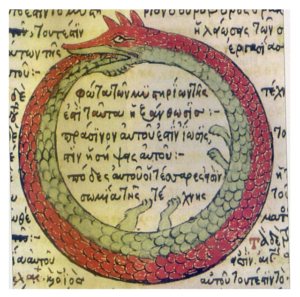
We’re Ouroboros.
Discover more from Church of the Churchless
Subscribe to get the latest posts sent to your email.
Each of us chooses what to believe, we do get some choices, though they are heavily weighted towards our own tastes, and the portion of reality we live in: the conditioning specific to our time, culture and geography. So we exist in a social hologram where each person carries a slightly or largely different version of reality.
Language and science do a nice job of getting to something closer to objective reality. There are degrees of objectivity.
And there is the reality our brain recreates moment by moment, picking and choosing for us.
Hence the practice of meditation, like scientific inquiry using a new instrument of observation, we mine those dormant capacities built into the brain to raise conscious awareness, and offer us new information we didn’t have before: information about how we filter, our conditioning, and new information from insight, and finally, direct perception.
These are all levels of objectivity. If, in a corollary to Einstein, we could imagine riding on a beam of light and sound to emerge outside this universe, what might we see? Just as Einstein, we might actually glimpse reality from an even more objective view. To move outside the loop, to the One whole, we might then see that there isn’t actually a loop at all, that both observer and observed are part of the same holographic reality where ever moment of time and space, and perception, contains an infinite number of reflections of all the others, including our perceived versions.
“… everything we know about the world, whether we’re a newborn baby or a Nobel prize-winning physicist, arises through direct personal experience, conscious awareness.” And: “No us, no cosmos. No cosmos, no us. True, the cosmos existed before us, and it will exist after us. However, without conscious awareness of some sort, the cosmos ceases to exist.”
Yes, it makes sense that without an observer there can be no observed, but just in case the ‘non-duality’, only ‘consciousness exists’ community misconstrue the statement: – “However, without conscious awareness of some sort, the cosmos ceases to exist.” This only applies to an individual subject observing an object. Naturally, for any individual, the world can exist only as long as that individual is alive, conscious, and sensing. On death, everything naturally disappears, shuts down. But the world, the universe still exists – but not for the dead individual. The world existed before any individual ‘me’ consciously observed it, and it will exist when the individual ‘me’ is gone. The individuals still alive will continue to experience the ‘life-world’, the universe.
The statement that when we die the universe dies, that, I would say, describes our own vanity and misunderstanding. If all conscious life forms were to cease to be, the universe would still be there, still evolving and perhaps producing new and different life forms. Linde complicates the issue when he says: “The moment you say that the universe exists without any observers, I cannot make any sense out of that. I cannot imagine a consistent theory of everything that ignores consciousness.”
I think the confusion always lies in the word “consciousness”. As I commented in a post here some years ago: “A certain prejudice arises in our minds when we alter the sense of the noun conscious to add the adjective ‘ness’ thereby giving the impression that there is a thing, an entity, a substance that we call conscious ‘ness’.”
We are conscious and aware, as is every other creature. It makes sense to me – and what we know of evolution – that the phenomenon of being a conscious organism emerged along with the complexity of life over millions of years. But what is true is that – without ‘me’, no conscious (personal) experience of the life-world exists.
We can only see from our own perspective. Outside that perspective we hold beliefs. Where was our consciousness before this birth? Where did it go when we slept? Where will it go after we die? These are outside our own conscious awareness, so we substitute beliefs, generally based on what we perceive or are taught. Unfortunately, these are conjectures, however well argued or with whatever arguments we muster. The human mind is a perceiving element, and when it goes beyond its core functions into conjecture, it usually errs. The whole point of science is to create testable hypotheses, and to conduct experiments. That is because we are generally wrong about most everything outside our perceptual field, and many things within it. But with a very careful approach, we can learn about things outside that perceptual field, and even more about what is in that field. This includes the illusory and highly plastic memories, and imagination.
We have learned a lot about the brain and its relationship to consciousness thereby. But is consciousness strictly the child of the brain? Or the opposite. Science is uniquely limited to adding real factual information from the scope of what it can currently measure. What is outside its ability to measure is unknown. Is it necessary to conjecture about life before this physical state? Or life after? Or even where we go in deep meditation? All we have is the experience, where science has yet to measure.
So, without the physical brain, we have no means to determine where and what consciousness might be.
We do know, from physics, that the physical world is not what it appears to be. We understand that we are all living in a quantum field of energies that take various forms of matter, space and time. We know that what can be seen or felt or perceived or measured at one level may appear entirely different from another.
What does that mean? It means that when a body is born and when it dies the atoms are not born and die. We are made of materials that have been around since the big bang. Even the ideas of birth and death, which reflect very real physical biological events, are meaningless on a quantum scale. And so that brings up the question of where consciousness rises. Does it exist only in the biological organism? Or does that organism merely house it temporarily?
Science cannot say. And so no scientific statement can be made about that, at this time.
The rest is left up to belief. But why try to coopt science in defense of claims about soul, consciousness or God? It cannot address those issues. There we have behind the scenes another system of belief, a religion, be it atheism or theology, attempting to take what has been established as a more objective means of knowing, and manipulating it to support conclusions it cannot.
A natural system of thought, an honest atheism based in science and rational thinking, would not go beyond the experience we have right now, and only, perhaps in some form of meditation, to attenuate, to improve, our ability to see, hear, understand the reality around us more objectively. That would naturally lead to a rejection of any such claims about soul, death and god. Not a rejection to say they are wrong: a rejection of any attempt to claim science can comment on these. That would be false.
>>>What does that mean? It means that when a body is born and when it dies the atoms are not born and die. We are made of materials that have been around since the big bang. Even the ideas of birth and death, which reflect very real physical biological events, are meaningless on a quantum scale. And so that brings up the question of where consciousness rises. Does it exist only in the biological organism? Or does that organism merely house it temporarily? >>>>>
That question was put by me to my Guru Ishwar Puri.He answered consciousness exists because it is in itself Source.Anybody can draw from source. Be it material or life. They both come from the same source.
That was confirmed by me on a trip that source was ME.
it is so audacious that nobody could imagine it.But ME imagined it that it was indeed the Truth all along.
The Anti-theist wants to say “I have no evidence of that, therefore it doesn’t exist.” That is actually not a logical argument. It is the argument evolution has produced of a brain that must attend to what it can measure and manipulate.
Science proves all the time that things no one ever knew about, like the crystaline structure of DNA, like Xrays, like SpaceTime, like cells and molecules, actually exists.
Until life itself can be reproduced entirely from non-biological sources, from no life, in a controlled lab, science can only conjecture on what life really is, though it knows much about how it manifests in biology, and how to manipulate it genetically and biochemically. Still, so far, science cannot actually create life.
Same for all elements that cannot be reproduced in a lab, including consciousness.
So, why conjecture? What need is there to believe in death, or life after or before it?
We have enough to keep us busy exploring the life we have, giving those moments value in things that we can actually pursue, and do. If one practice can improve our ability to see clearly, to act without harm, to be more sensitive to the reality around us, physically, intellectually, socially and psychologically, and to be the best possible students, and to be inspired to innovate solutions to humanity’s woes, that one practice would be spiritual meditation, I humbly conjecture.
To circumnavigate our fears and anxieties, our desperate sense of being alone and vulnerable, all that is needed is to embrace our naturalness to see that we are not separate, isolated creatures but interdependent with the totality of the natural world.
Until then, we will continue to conjure up weird and wonderful ideas and beliefs that effectively keep us in a state of self-isolation and at variance with life – and making mysteries out of the naturalness of awareness, consciousness, mind, self etc.,
It ain’t no mystery man this dude in India got away with stealing a billion dollars and blaming on his dead wife and threatened nephew. If that ain’t mainstream magic I don’t know what it is. The Blue Meanies are beating the curve right now. I know that there are assholes in the world but I don’t want to be one. There’s no argument to be had. It doesn’t mean that much to me to mean anything to you. Trying to explain heaven to someone living in hell is like chewing on metal. At least be happy! Your next step to enlightenment might have been my last.
Sort of extreme idealism in the Ramana Maharshi — Zen vein. But it’s not empirically true. Scientifically, the cosmos existed for 13.8 billion years before any known consciousness. Stars formed, galaxies evolved, Earth existed and so on, with no observers. We have physical evidence such as cosmic microwave background, fossil records, and geology that strongly supports a mind-independent reality.
The strange loop theory doesn’t explain consciousness. That’s not my opinion; it’s how most of the scientific and philosophical community feels about it.
Well, our AI overlords have a different take on Sant64, and I quote from them in their deep machine intelligence: The great irony of cosmology is that it confidently narrates a universe that supposedly existed long before anyone was around to witness it, while quietly depending, at every step, on the very consciousness it treats as an afterthought. If one begins from a consciousness-first principle, then every claim about the origin of the universe—even when dressed in the imposing language of objective astrophysics—is already grounded in awareness. Every equation, every telescope image, every inference about the first microseconds after the Big Bang appears only as an event within consciousness.
To declare that the universe is empirically real is itself an act of awareness. To insist that consciousness emerged billions of years after the cosmos is likewise an act of consciousness. The argument therefore undermines itself: it attempts to demote the one condition that makes the argument possible in the first place.
This does not prove that the physical universe is unreal. It reveals something subtler. There is no universe for us, no history, no empirical fact, no scientific theory, apart from awareness. The entire edifice of objective history is inseparable from the subjective condition that discloses it. The cosmos may well have existed before human beings, but the claim that it did exists only as a present fact of consciousness. Every attempt to escape this circle merely completes it.