How could a guru who knows he is a fake be a “good person?”

Here's a mildly-edited email from someone who asked me some provocative questions about Charan Singh, a Radha Soami Satsang Beas guru who I was initiated by in 1971, after which I followed his teachings for about 35 years.  This person apparently sent me an email, rather than posting the message as a blog post comment, because he thought I might be offended by what he said about Charan Singh.  Since I'm not -- and in fact enjoyed the message a lot -- I'm sharing it here. Following the message, I share my response to the questions about Charan Singh. Dear…

A Sant Mat follower returns to Jesus (and wants to hear from others who have done this)

Here's a message I got from someone who tried to follow both Sant Mat and Christianity. After developing doubts about the Science of Spirituality branch of Sant Mat (led by guru Rajinder Singh), she returned to her faith in Jesus. Below the woman says, "If anyone has any information about Science of the Soul that is not commonly known or discussed, I would be interested in hearing their stories. Especially from those that have chosen to leave the path for Christianity." Even if this doesn't describe you, the woman is interested in comments -- whether positive or negative -- from…

Tough talk about Rajinder Singh from a disillusioned ex-disciple

Recently I got an email from someone who was initiated by an Indian Sant Mat guru, Rajinder Singh, and now realizes that this supposed divine being isn't really what he claims to be. This person gave me permission to share the message, which I've done below with some mild editing in line with the person's wish to remain anonymous. I'm always pleased to hear about someone's disillusioned experience with a religion or religious teacher. This is a wonderful thing, waking up from an illusion.  Feel free to share your thoughts about what this person says in a comment, as my…

My response to someone’s mystical experience of “heaven”

Once in a while someone emails me a description of a marvelous mystical experience they've had. Usually the person is a devotee of the organization I belonged to for about 35 years -- Radha Soami Satsang Beas (RSSB). RSSB is led by a guru who is considered to be God in human form, in much the same way as Jesus is viewed by Christians. Except, the guru is alive. Once initiated by the guru, supposedly he places his "radiant form" within the disciple's consciousness.  Then the radiant form leads the mind/soul of the disciple through various higher stages of reality…

Alan Watts talks about the source of spiritual authority

Over on my "Let's add a new L-word to 'Who is the guru?' possibilities" post, William left a comment today: Hi BrianI was listening to a talk on the topic of What is a Guru? by Alan Watts. You may well find it interesting. Here's the link that will bring you to the pertinent part of that talk. https://youtu.be/sAq2NY0Tjf8?t=1m54s Since I enjoy reading Watts' books, saw him speak in person back in the 1960's, and like his audio recordings, I watched about half of the You Tube video today. Here's the link William sent, which starts at about the two minute…

DMT, a natural psychedelic chemical, could produce “spiritual” experiences

Someone sent me an email with a link to an article whose title was so intriguing, I was eager to read the piece: "The psychedelic drug that could explain our belief in life after death." DMT (Dimethyltryptamine) is the most powerful hallucinogenic drug around. The class A psychedelic is so potent that under the 1971 UN Convention on Psychotropic Substances its manufacture is strictly for scientific research and medical use and any international trade is very closely monitored. But it also naturally occurs in the human body. Now a Senior Psychologist at Greenwich University, Dr. David Luke, is trying to undercover a link…

Let’s add a new L-word to “Who is the guru?” possibilities

Back in 2006 I pondered the question, Who is the guru?

By “guru,” I meant someone who is (1) alive today, and (2) considered by his/her devotees to be, if not actually God in human form, darn close to this exalted level of divinity.
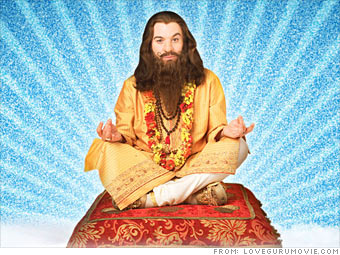
Guru

This is, obviously, a different sort of religious personage than, say, a Christian minister. Or even the Pope. It is easy to visualize them sincerely believing that they are God’s representatives on Earth, while recognizing that they are entirely human.

In some Eastern religions, though, the distinction between God and guru is minimal. Even nonexistent.

The Indian guru I was initiated by in 1971, Charan Singh, was considered to have attained a state of God-realization by his followers.

No longer believing this, my “Who is the guru?” post was an attempt to make sense of the fact that Charan Singh, along with his successor Gurinder Singh, could sit on a podium in front of tens of thousands of adoring disciples who looked upon them as not only godly, but as God.

I’ve been thinking about the four options concerning who Jesus was, according to biblical scholar Bart Ehrman: a liar, a lunatic, the Lord, or a legend. When it comes to a long-dead historical figure like Jesus, these options make sense. But what about a modern-day guru who is similarly proclaimed to be God in human form?

I was initiated by such a guru, Charan Singh Grewal. I sat at his feet, literally. I had two personal interviews with him. I heard him speak many times. I saw him worshipped by tens of thousands of devotees as a divine incarnation.

And yet, I still don’t know what to make of him. Or his successor, Gurinder Singh Dhillon. Who is the guru? A philosophically-inclined friend of mine likes to say, “There’s only one question to ask a guru who is supposedly God in human form: Are you who people claim you are?”

But given Ehrman’s four options, the answer wouldn’t be all that revealing. If the guru was a liar, you couldn’t believe what he said. Ditto if he was a lunatic. And even if he truly was the Lord, and said as much, what reason would there be to believe him? Plus, one could argue that a God-man would be so humble, you’d never hear a claim to divinity pass his lips.

With living gurus the legend option doesn’t come into play. They’re alive and kicking, not legendary. Quite a few men (and a few women) of recent vintage are considered by the faithful to be manifestations of God. For example, Meher BabaRamakrishna, and Lokenath.

So I muse over my recollections of Charan Singh and Gurinder Singh, trying to decide whether they’re best described as liars, lunatics, or the Lord.

I ended up preferring a fourth option, loyalist.

Is there another L-word that better fills the bill? One springs to mind: loyalist. Perhaps when a successor is appointed to fill the shoes of a highly-regarded guru, loyalty both to his predecessor and to the surrounding organization prevents the newcomer from crying out, “Hey, I’m not God! I’m just a man filling the role of a guru.”

This theory got support in a video David Lane made about Charan Singh, as described in a 2013 post, “Charan Singh was a loyal guru.”

But a essay by Michael Shermer in his Scientific American “Skeptic” column suggests another possibility. In “Lies We Tell Ourselves: How Deception Leads to Self-Deception,” Shermer says:

Trivers’s theory adds an evolutionary explanation to my own operant conditioning model to explain why psychics, mediums, cult leaders, and the like probably start off aware that a modicum of deception is involved in their craft (justified in the name of a higher cause). But as their followers positively reinforce their message, they come to believe their shtick (“maybe I really can read minds, tell the future, save humanity”).

Click on the link above to read the full piece by Shermer. I’ll also include it as a continuation to this post.

Desperate to find an L-word to add to the liar, lunatic, Lord, or loyalist possibilities, the best I could come up with after a brief look at some online thesauruses was to substitute “legerdemain” for self-deception.

It seems to fit, as rarely used as the word is.

1. sleight of hand.
2. trickery; deception.
3. any artful trick.

So let’s add a likely option that answers the question, “Who is the guru?” Legerdemainist. Which actually is a word.

The guru tricks himself into believing that he (or she) is God. Or God in human form, after being viewed as divine by fawning followers. This act of self-deception further bolsters his standing among devotees, as Shermer explains.

As Abraham Lincoln well advised, “You can fool some of the people all of the time and all of the people some of the time, but you cannot fool all of the people all of the time.” Unless self-deception is involved. If you believe the lie, you are less likely to give off the normal cues of lying that others might perceive: deception and deception detection create self-deception.

Interesting. Read on to peruse Shermer’s entire essay.

Modern mystics, why should anyone believe your “vision”?

After more than ten years of blogging on this here Church of the Churchless -- 2,410,012 page views; 2,036 posts; 29,750 comments -- I'm still asking this question. Why should the claims of "modern mystics," who claim to have personally experienced God, spirit, heaven, or some other manifestation of divinity, be taken more seriously than the countless similar claims that have been made by innumerable others throughout recorded history? I keep on asking this question in various ways, both in blog posts and replies to comments, because it seems to me that those alive today who would have us believe…

What is meant by a “fake” guru?

A few days ago I wrote a blog post called "Kumare: truthful movie about a fake guru." Here I want to do some additional pondering about what it means to be fake.  This is a subject of more than theoretical interest to me. Back in my college years, 1969-70, I studied yoga and meditation with a long-haired, charismatic teacher who looked a lot like the movie's Kumare (even though my teacher was Greek, and Vikram Ghandi, who became "Kumare," is Indian.) My weird story of how I switched from the first guru to another guru can be found here. l…

Kumare: truthful movie about a fake guru

"How do you know I'm not a fake? Maybe I just have the gift of gab." There's a guru in India whom I'm familiar with, Gurinder Singh, who used to frequently say this. Maybe he still does. At the time I was associated with the organization Gurinder Singh leads, his disciples would look upon those statements as a sign of some sort of humility/ Zen'ish koan/ anti-mystical mystic utterance. Which, interestingly, is almost exactly what students who flocked to a genuinely fake guru, Kumare, a.k.a. New Jersey-born Vikram Ghandi, felt when at every yoga class he taught he told them…

Spiritual sages were clueless about how the brain works

Almost every religious prophet, mystic guru, spiritual sage, revered master, elevated yogi, or other supposed knower of what lies beyond everyday appearances shares a common denominator:  They were essentially clueless about the human brain with which they made their pronouncements about divine reality.  So they had no idea about how the knower of their purported knowledge works. I'd realized this before, but the factiness of this fact hadn't really hit me until I started reading Patricia Smith Churchland's "Brain-Wise: Studies in Neurophilosophy."  In the Introduction, Churchland reminds us how neuroscience has only come into its own very recently. By contrast,…

Charan Singh was a loyal guru

It's a reasonable theory: that a guru who supposedly is "god in human form" isn't a liar, lunatic, the Lord, or a legend. He or she is a loyalist, someone who carries out the role of a divine person because he or she is loyal to the person/organization who elevated them to their gurudom. This was what I argued in "Who is the guru?" Is there another L-word that better fills the bill? One springs to mind: loyalist. Perhaps when a successor is appointed to fill the shoes of a highly-regarded guru, loyalty both to his predecessor and to the…

OPB’s “Rajneeshpuram” reminds me of Oregon’s guru weirdness

From 1981 to 1985 Oregon, where I live, was graced (if that's the right term) by the arrival of an Indian guru, Bhagwan Shree Rajneesh, whose followers founded a community in central Oregon: Rajneeshpuram. Last night my wife and I watched a recording of Oregon Public Broadcasting's hour long documentary of how the Rajnesshees rose and fell, "Rajneeshpuram." The full program can be watched online. I recommend it to anyone interested in the goods and bads of cults. That clearly is what Rajneeshpuram was, a cult. However, it's unclear to what extent the guru, who later changed his name to…

Mystical experiences. What’s the big deal with them?

Mystical experiences were on my mind today, after someone left a comment on a blog post inquiring about whether I'd gone inside while meditating or heard sacred sounds.   I replied. But then I thought, "What's the big deal with supposed mystical experiences?" Most religions, forms of spirituality, and philosophical systems don't pay much attention to them. Most Christians or Buddhists aren't out to see fantastical scenes of the astral plane, or bliss out on a supernatural light and sound show. Their goals are to become better people; to learn what reality is all about; to be of service to humanity;…

Mystical experiences prove nothing

Whatever I say in this post -- and as a blogger I never know what that is until I say it -- it won't be anywhere near as good as what David Chapman has said in his "Are Mystical Experiences Metaphysical Evidence?" So the best thing you could do is stop reading what I've written, and read Chapman now. The second best thing would be to click on the links I've given after you peruse this post. But if you've ever believed that a mystical experience means something beyond the obvious, that someone has had some sort of experience, I…

Mysticism is as real as fundamentalist religion

Yesterday David Lane left this comment on a recent blog post: Yes, good point you make here about the epistemology of "knowing" in fundamentalist religion versus mysticism. Here is a link to something I wrote that dovetails with your point: https://sites.google.com/site/msacmagazinesparttwo/home/POLITICSOFMYSTICISM.pdf?attredirects=0&d=1 Because I always enjoy what David has to say, I clicked away and found an interesting six page PDF-file essay, "The Politics of Mysticism." Download Politics of Mysticism Here's some excerpts -- the formatting is a bit screwed up, since I copied text from the PDF file. No big deal, since you really should read the whole thing. Perhaps…

“The Beginning of Infinity” — inspiring science

I don't know whether physicist David Deutsch's optimism expressed in his new book, "The 'Beginning of Infinity," is justified. I'm only about a quarter of the way through it, so maybe his later chapters imply more of a downer that what I've read so far. His basic thesis, though, is both inspiring and believable. There are no limits to knowledge. Human life -- individual or collective -- is a never-ending journey on the path to more. Whenever there has been progress, there have been influential thinkers who denied that it was genuine, that it was desirable, or even that the…

India’s “godmen” face questions about their wealth

Interesting story in the Washington Post about how spirituality has become a lucrative profession for Indian gurus and yogis.  For centuries, their image was as barefoot ascetics who spent their lives in solitary Himalayan meditation. But now India’s gurus, “miracle workers” and spiritual leaders, often collectively known as “godmen,” have become savvy, powerful figures who control vast philanthropic and business empires, dabble in politics and manipulate the media. There's no mention of Gurinder Singh Dhillon, guru of Radha Soami Satsang Beas. But he's another good example of the trend toward making lots of money while preaching detachment from material pursuits.…

Physicists are becoming mystics (sort of)

Unseen dimensions of reality. Trillion year cycles of cosmic birth and rebirth. Laws of nature utterly unlike ours. Mysterious connections between the physical universe and other realms. These sound like the airy-fairy notions of mystics who have been smoking something stronger than tobacco in their hookas. But they're all serious hypotheses of modern physics. Their cosmological implications are described by noted physicist Brian Greene, author of "The Hidden Reality," in a Hovering Universes in Nearby Dimensions chapter I read this morning before meditating. Inspirational stuff for my churchless non-soul. Having written (plug alert!) a book about mysticism and the new…