What does “going inside” in meditation really mean?

I'm a long-time daily meditator. I did the closed-eyes introspecting thing almost every morning for over forty years. During that time my practice was focused on "going inside." Inside what? Good question, one which I never gave much thought to during my true-believing spiritual phase. The guru I followed used those words going inside a lot, so I assumed they meant something. Now it seems to me that reality doesn't have an inside and an outside. I've given up the goal of concentrating on the interior of my cranium, which many meditators believe leads to an experience of wholly other-worldly…

What, I’m not the center of the universe??!!

Copernicus may have demoted us humans from an objectively real position at the center of the cosmos, but most people continue to believe that everything revolves around them. Why else would we get so upset when life doesn't give us what we feel we deserve, even though much of the time what doesn't come to me benefits someone else? (Like the guy who darts ahead of my car and takes a choice parking space that I'd been lusting after.) The crazy thing is, being the center of the universe really isn't much fun. It's exhausting trying to keep reality revolving…

Letting go — the essence of Zen

Ah, I love the title of this blog post. It sounds so assured, so confident, so Zen-master'ish. Yet I'm not sure if what I wrote is accurate. No big deal. Because if Zen actually isn't about letting go, we can let go of that notion. And if it is about letting go, then I've hit the Zen nail on the head. As should be obvious, I'm a big admirer of Zen who doesn't want to put in any serious work toward satori, enlightenment, or whatever it is Zen students aspire to. This makes me a Zen dilettante -- proudly so,…

If everything is perfect as it is, so is feeling it isn’t

I learned about Vincent Horn, "Buddhist Geek," via one of those marvelous Twitter tweets from someone you follow for a reason long forgotten. Yet you're happy you do, because now and then they share a link that clues you in to a interesting perspective. Such as Horn's "The Place of Practice: Integrating Perspectives and Clinging to Nothing." He addresses a question that has often come to my mind as I've pondered non-dual philosophies which claim that everything is absolutely as it should be, just as it is. (Obviously there's a lot more to nondualism. But if things aren't two --…

Thinking and meditation go hand in hand

For a long time I thought that I shouldn't think during my meditation time. I'd been taught to either (1) repeat a mantra, thereby keeping thoughts away, or (2) rest in a thoughtless state where the meditator gazes into inner darkness and listens to inner silence, waiting for divine light/sound to appear. Now, though, I've expanded my meditative horizons, questioning assumptions that I used to accept, well, unquestioningly. Such as, whether it's really desirable to stop thinking while meditating. Here's my pithy current answer: no. But it's up to the meditator. That's my answer, nobody else's. I think (there I…

Religious obedience: pros and (mostly) cons

When it comes to the subject of obedience, South Park's Eric Cartman pops naturally into my mind. I'm a big fan of his classic Respect my authoritah! (authority, pronounced au-thor-i-TAH) For quite a while I used that line a lot with my wife and dog, until I realized that it wasn't having any effect. Still, it worked for Cartman in the scene below. And religions are able to get people to believe it. (Click on the video to start it playing.) ChickenloverTags: SOUTHPARKmore...   In a synchronistic moment this morning, shortly after I finished reading the Just Following Orders chapter…

Be your own sunlight, not a religious reflection

Thanks to an email from Alex, a regular Church of the Churchless visitor, I learned about Don Cupitt's book, "Above Us Only Sky." It's short and inspiring, a paean to finding meaning through "solar" living of our everyday life. By solar, Cupitt means... We accept and we joyfully affirm life and its limits, traditionally described as Time, Chance, and Death. We no longer wish to veil the truth about life, nor do we dream of somehow being able to transcend its limits. Instead, our religion is now our joyful and immediate engagement with life, just as it is. Right on.…

The “self” is culturally determined

We in the West (not the wild west, but Western culture) are obsessed with ourselves. "I've got to find my true self," people say. Self-development is a big industry, featuring countless workshops, books, lectures, and such. We're big on autonomy, independence, finding our own way in life, not marching to the beat of someone else's drummer. Other cultures, such as those in East Asia, are quite different. To a much greater degree than self-absorbed Americans and Europeans, they view the self as including family, community, and societal relationships. Such is the message of an interesting Philosophy Talk podcast that I…

A religious or spiritual path is a metaphor — not reality

Metaphors are fun to play around with. Over on my other blog, I recently called the Oregon city where I live "a blandburger sandwiched between spicy Portland and Eugene." But Salem isn't really food. It's what it is: people, places, buildings, roads, parks, culture (and the lack thereof), plus so much else immediately cognizable stuff. Metaphors are a big step removed from the sort of reality that doesn't depend upon mentally connecting this, such as Salem, with that, such as the innards of a sandwich. I'm plugging away on reading a big thick book, "Philosophy in the Flesh," that I've…

“All Things Shining” is a luminous philosophical read

If you're looking for a book that (1) discusses Western classics like Moby Dick and the Odyssey in a fresh and creative fashion, (2) points the way to a philosophy of life that navigates between the danger zones of religiosity and nihilism, and (3) was featured on a recent episode of The Colbert Report, there's only one choice: "All Things Shining," by Hubert Dreyfus and Sean Dorrance Kelly, two heavy-duty philosophers (Kelly is Chair of the Department of Philosophy at Harvard, but looks too young and clean-cut for this; where's the beard and pipe?) I'm not literary enough to be…

Be selflessly selfish (as if you had a choice)

A few nights ago my wife traumatized me. She shook the foundation of my existence, which in no small part rests on a weekly filling up of our bathtub with steaming hot water, pouring a glass of red wine, and having a pleasant soak while reading the latest issue of People magazine. (How else am I going to keep up on celebrity weddings?) "Where's the People magazine?" I asked Laurel, wine in hand. "I left it at the athletic club," she told me. "I thought you'd read it." Instantly the bottom dropped out of my envisioned future. I couldn't believe…

“Selfless Insight” — intriguing, yet disappointing, Zen book

I didn't enjoy neurologist James Austin's book about Zen and neuroscience as much as I thought I would. My reading of "Selfless Insight: Zen and the Meditative Transformations of Consciousness" may show, of course, that I'm neither selfless nor imbued with enlightened (or kensho'ened) insight -- both of which I plead guilty to. Regardless, I expected that Austin would provide a clearer and simpler analysis of how Zen meditation and brain science relate. He's written two other books on this subject, this being the most recent, so perhaps "Selfless Insight" is more complicated than his earlier works. I was left…

Sober or drunk? Sacred or profane?

I've rarely gotten drunk. But I love the notion of drunkenness. I don't swear a whole lot in public. But profanity springs from my lips much more freely than prayer does.

Reality just seems more, well, real when it is lived on an intoxicated blasphemous edge — whether this be conceptually philosophical or crudely physical. Neat and tidy sobriety isn't congruent with the cosmos' natural wildness, though we humans do our best to smooth rough edges and tame savage beasts.

At the end of this post I've included an excerpt from a chapter in Daniele Bolelli's terrific book, "On the Warrior's Path: Philosophy, Fighting, and Martial Arts Mythology (second edition)."

Now, if you're tempted to stop reading because your interest in martial arts is slim to nonexistent, give this post a chance.What we're talking about here is an issue that goes way beyond martial arts: is the straight and narrow a more productive path than a curving and unrestricted way?

If you read the excerpt from Bolelli's "Sacred and Profane: Combat Sports as Athletic Philosophy" chapter — and I hope that you do — be aware of your reaction to the two contrasting instructional styles he describes in such an entertaining fashion.

This likely will be an indication of what sort of spiritual, religious, moral, mystical, or philosophical teachings and practices you're most attracted to.

Admittedly, Bolelli features some extremes. But few of us are precisely balanced at a mid-point; it's natural to tilt one way or the other (for example, how many people are so perfectly bi-sexual, they're equally attracted to both sexes?).

I bought the second edition of Bolelli's book, even though I'd already read the first edition (and blogged about it in "Bruce Lee's Taoist life lessons") because two new chapters sounded intriguing to me.

I'm glad I did the Amazon deed. Bolelli is much more into martial arts than I ever was, but we share some common experiences and attitudes on both the philosophical and fighting fronts.
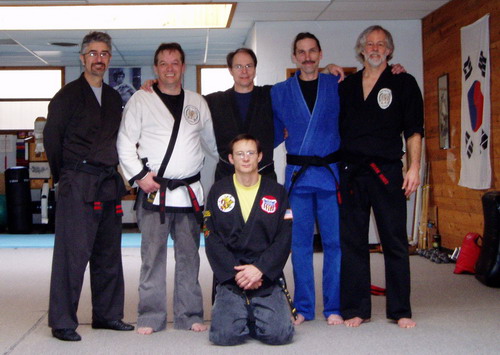
Pacific Martial Arts

I talked about this in a 2004 post where I congratulated my martial arts friend, Dave, on his black belt accomplishment. (I'm in a black gi on the right; Dave is next to me, in blue; Warren Allen, our instructor, is in the middle, in back.)

After almost nine years of traditional Shotokan karate training where everyone had to wear a plain white gi (and only females wore a t-shirt under it, which helps explain my habitual t-shirtless look), I much appreciate Warren’s hang-loose Taoist attitude toward the dojo dress code. Discipline is needed in the martial arts, but dressing exactly alike doesn’t teach anything except rigidity.

It’s interesting that my changeover from the linear, dogmatic, structured Shotokan training to the Pacific Martial Arts circular, eclectic, flowing style has pretty much paralleled a similar change in how I approach meditation and spirituality. I’ve become much less rigid in my philosophical/metaphysical beliefs during the years I’ve been trying to achieve a similar openness in my martial arts training.

My new Church of the Churchless site reflects this creedless creed mentality.

Daniele Bolelli's comparison of contrasting uptight Shotokan and hang-loose Jujitsu classes rang true to me. I trained for nine years in a traditional Shotokan dojo where we practiced the sort of rigid discipline you can read about in the extension to this post.

When I switched to the eclectic Pacific Martial Arts style, the training was just as tough and demanding — more so, in fact — but not as anal. This meshes with Bolelli's description of the Brazilian Jujitsu class he observed, a martial arts style that I learned just enough of to know how much more I had to learn about it.

Anyway, read on for an interesting take on whether sober is better than drunk, and sacred better than profane.

(If you'd rather watch than read, check out Jackie Chan's classic "Drunken Master" on Netflix; it can be watched instantly for free if you have a Netflix account; from about 1:20 to 1:27 is a generally comedy-less look at drunken-style kung fu.)

Lessening thinking is beneficial, but not religious

Every day, in so many ways, our brains produce lots of thoughts. Estimates vary as to the average number. When I asked Google, widely disparate answers popped up. None seemed to be based on solid scientific research. Regardless, most people -- certainly me included -- feel that much, if not most, of the thinking that goes on inside their heads is unproductive, useless, unnecessary, and even unpleasant. Yet the thought-beat goes on... boom, boom, boom, one after the other, much of the time with little rhyme or reason. Often this is called "monkey mind," since left to its own devices…

Corny but inspiring: “Seven Wonders of the World” video

Thanks to Clare, who emailed me a link to this video. Usually I don't have much of a tolerance for super-heartwarming messages (I prefer a dash of cynicism mixed in with sweetness and light), but I enjoyed the concluding mindfulness theme. Here's Clare's accurate take on "Seven Wonders of the World": Hey, this is a bit corny and I'm dubious about the class/kid origin, but nonetheless points to a churchless way of appreciating ourselves and life. Happy New Year. Enjoy. And I'll also say, Happy New Year.

Be a centaur, not a horseman and horse

"The Supreme Doctrine" by Hubert Benoit is a book that I keep re-reading, because every time I pick it up, fresh insights pop out of the pages. I've highlighted so much of it, in several different colors, that now the words mostly are shaded in yellow and green. This morning I re-perused The Horseman and the Horse chapter. The basic notion is that we usually consider that "I" am a horseman (thoughts, will, mind, soul, spirit) who needs to keep control of my horse (body, desires, actions, lower self, emotions). The belief in this biparite composition expresses itself in all…

Dance, and live, like nobody (even God) is watching

Last night my wife and I went dancing. It was a Salem Big Band night at Mission Mill Museum, a beautifully restored woolen mill dating from the late 1800's. When we walked in, about half an hour after the festivities had started, I could tell that my thoroughly intermediate dancing skills were going to be stretched. The piece being played was energetically cool, but I couldn't place it in my stylistic repertoire. Foxtrot? No. Waltz? Definitely no. Latin style? Absolutely not. Swing? Sort of, but not really. Yet couples (and some uninhibited child singles) were dancing away with abandon, clearly…

Get real: give up religious and mystical concepts

Religious believers who make a pilgrimage to this blog often amuse me. They'll say, "Brian, you live in your head; you need to give up your concepts about reality and embrace God's truth." Ha ha ha. What a joke. These guys and gals are deluded. They've got things completely backward. I just rode my Burgman 650 maxi-scooter to a coffeehouse in downtown Salem. It's 45 degrees here in Oregon. I was cold, but comfortably not freezing, thanks to warm gloves/gear and a large cozy windscreen. I didn't think about anything supernatural once on my 25 minute drive. Here and now…

How is it that “I” have a “self”?

I've never met the other person who seemingly inhabits my head along with me. Have you? Yet everyday language, the way we talk to ourselves (there he is again!) and others, appears to point to the existence of someone other than "I" within our psyches. I dragged myself out of bed.I held myself back from hitting him.I was beside myself.You should take a good look at yourself.He's at war with himself over who to marry.Stop being so mean to yourself.I like myself.I need to be a better friend to myself.I was debating with myself whether to leave.I'm disappointed in myself.He's…

Mindfulness is better than “spiritual” meditation

I used to believe that through meditation, I could realize ultimate reality/God. Now, having lowered my unrealistic expectations, I'd be happy if I could go through the rest of my life without losing another glove. A much-beloved glove, insofar as apparel can be loved. LIghtweight, waterproof, comfortable, thin. I'd been wearing it on rainy day dog walks here in Oregon (so I wore them a lot). Headed to the recycling center on a cold, wet, windy afternoon, I decided to take the gloves along. I walked to the car, tossed them on the front seat, and drove into town with…