Taoism isn’t mystical. It is natural.

Life is a mystery. Such, for me, is a given. Don't try to argue me out of it. Hopeless task. For about forty years I believed this meant the cosmos must have mystical underpinnings, some transcendental Absoluteness which, though hidden from everyday experience, held clues -- if not the answer -- to what life, the cosmos, birth and death, heck, everything, was all about. Now, I'm not into that belief very much. In fact, very little. Mysticism has come to strike me as just another way of saying "life is a mystery."  Question is: can the mystery be unraveled, understood,…

I’m loving “Complete Idiot’s Guide to Taoism”

Taoism is a way of life for fools. So when I bought The Complete Idiot's Guide to Taoism, I expected a good match between the usually informatively entertaining Idiot's Guide series, and my favorite philosophical approach. (I'm such a fool, I read the entire book through once, and now am re-reading it with a different colored highlighter in hand.) I was right. Brandon Toporov, writer, and Chad Hansen, Chinese scholar, teamed up to produce an overview of Taoism that is easy to read, inspiring, and practical, while also possessing intellectual rigor. I'm confident of that last assertion, since I searched out…

Taoism wisdom: life is change, so flow with it

Today my Tai Chi instructor talked about change. That's what life -- and Tai Chi -- is all about. When we stop changing, that's called death. The yin/yang symbol beautifully embodies this truth. White (yang) flows into black (yin). There's yang in yin, and yin in yang. To exist, lightness and darkness need each other. Where one ends, the other begins. Taoist philosophy finds a concrete expression in the physical movements of Tai Chi. My instructor likes to emphasize how transitions are central in Tai Chi, as in life. How you move between movements is as important as the movements…

Independence is impossible

So here we are in the United States, celebrating Independence Day this July 4, and my philosophical mind is thinking independence is impossible. And who would want it, anyway? But lest my fellow citizens accuse me of wishing that the colonies had never broken away from Britain (ugh! what a horrible idea; I'd have to watch boring soccer rather than exciting football), I'm talking about a much more cosmic level of reality than political. Religions are big on independence, though the concept almost always is expressed using different terms, such as salvation and liberation. Whether Eastern or Western, dualistic sorts…

I dreamed within a dream. Felt a lot like reality.

Usually I don't pay much attention to my dreams. They seem to be the brain's way of processing waking life events, albeit in a often disconnected and bizarre fashion. But last night I experienced a dream that was coherent enough to be philosophically quite interesting. I suspect some of the content had to do with my going through some old files yesterday, keeping some folders and discarding others. I also drove my Mini Cooper to town and back, taking turns on our rural road the way I usually do: vigorously. My dream started out with me driving on what seemed…

Meditation should be pleasant, not a chore

This morning my pre-meditation reading was a chapter on Wu-Wei (non-action) in Alan Watt's "Tao: The Watercourse Way." The passage below reminded me of how different my meditation period is now that I've become churchless, unreligious, and dogma shunning. In a footnote to a preceding paragraph, Watts says that he is a "deplorable heretic" to those Zen practitioners who favor the "aching legs" brand of Buddhism, since to them long periods of meditation are considered to be key to enlightenment. On the other hand, those who understand the Tao delight, like cats, in just sitting and watching without any goal…

Wisdom from Alan Watts’ “Nature, Man and Woman”

I love Alan Watts. Browsing through the Taoism section of my book collection this morning, I noticed an early edition of his "Nature, Man, and Woman" that I got way back in my college days but hadn't looked at for a long time. During today's pre-meditation reading I made it through the Introduction. Just reading this one chapter reminded me what a creative, insightful writer and thinker Watts was. I don't agree with everything he says, but Watts has a knack for taking familiar subjects and looking at them in a fresh fashion. Here's some quotations that I resonated with:…

Letting go — the essence of Zen

Ah, I love the title of this blog post. It sounds so assured, so confident, so Zen-master'ish. Yet I'm not sure if what I wrote is accurate. No big deal. Because if Zen actually isn't about letting go, we can let go of that notion. And if it is about letting go, then I've hit the Zen nail on the head. As should be obvious, I'm a big admirer of Zen who doesn't want to put in any serious work toward satori, enlightenment, or whatever it is Zen students aspire to. This makes me a Zen dilettante -- proudly so,…

Sober or drunk? Sacred or profane?

I've rarely gotten drunk. But I love the notion of drunkenness. I don't swear a whole lot in public. But profanity springs from my lips much more freely than prayer does.

Reality just seems more, well, real when it is lived on an intoxicated blasphemous edge — whether this be conceptually philosophical or crudely physical. Neat and tidy sobriety isn't congruent with the cosmos' natural wildness, though we humans do our best to smooth rough edges and tame savage beasts.

At the end of this post I've included an excerpt from a chapter in Daniele Bolelli's terrific book, "On the Warrior's Path: Philosophy, Fighting, and Martial Arts Mythology (second edition)."

Now, if you're tempted to stop reading because your interest in martial arts is slim to nonexistent, give this post a chance.What we're talking about here is an issue that goes way beyond martial arts: is the straight and narrow a more productive path than a curving and unrestricted way?

If you read the excerpt from Bolelli's "Sacred and Profane: Combat Sports as Athletic Philosophy" chapter — and I hope that you do — be aware of your reaction to the two contrasting instructional styles he describes in such an entertaining fashion.

This likely will be an indication of what sort of spiritual, religious, moral, mystical, or philosophical teachings and practices you're most attracted to.

Admittedly, Bolelli features some extremes. But few of us are precisely balanced at a mid-point; it's natural to tilt one way or the other (for example, how many people are so perfectly bi-sexual, they're equally attracted to both sexes?).

I bought the second edition of Bolelli's book, even though I'd already read the first edition (and blogged about it in "Bruce Lee's Taoist life lessons") because two new chapters sounded intriguing to me.

I'm glad I did the Amazon deed. Bolelli is much more into martial arts than I ever was, but we share some common experiences and attitudes on both the philosophical and fighting fronts.
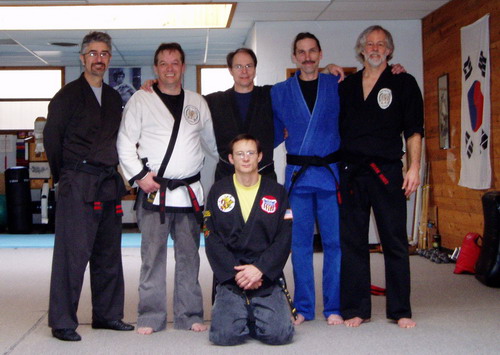
Pacific Martial Arts

I talked about this in a 2004 post where I congratulated my martial arts friend, Dave, on his black belt accomplishment. (I'm in a black gi on the right; Dave is next to me, in blue; Warren Allen, our instructor, is in the middle, in back.)

After almost nine years of traditional Shotokan karate training where everyone had to wear a plain white gi (and only females wore a t-shirt under it, which helps explain my habitual t-shirtless look), I much appreciate Warren’s hang-loose Taoist attitude toward the dojo dress code. Discipline is needed in the martial arts, but dressing exactly alike doesn’t teach anything except rigidity.

It’s interesting that my changeover from the linear, dogmatic, structured Shotokan training to the Pacific Martial Arts circular, eclectic, flowing style has pretty much paralleled a similar change in how I approach meditation and spirituality. I’ve become much less rigid in my philosophical/metaphysical beliefs during the years I’ve been trying to achieve a similar openness in my martial arts training.

My new Church of the Churchless site reflects this creedless creed mentality.

Daniele Bolelli's comparison of contrasting uptight Shotokan and hang-loose Jujitsu classes rang true to me. I trained for nine years in a traditional Shotokan dojo where we practiced the sort of rigid discipline you can read about in the extension to this post.

When I switched to the eclectic Pacific Martial Arts style, the training was just as tough and demanding — more so, in fact — but not as anal. This meshes with Bolelli's description of the Brazilian Jujitsu class he observed, a martial arts style that I learned just enough of to know how much more I had to learn about it.

Anyway, read on for an interesting take on whether sober is better than drunk, and sacred better than profane.

(If you'd rather watch than read, check out Jackie Chan's classic "Drunken Master" on Netflix; it can be watched instantly for free if you have a Netflix account; from about 1:20 to 1:27 is a generally comedy-less look at drunken-style kung fu.)

Are Buddhism and Taoism akin to Sant Mat?

People here in the West often speak of "Eastern religions" as if they were all alike. This shows how little understanding citizens of predominantly Christian nations have of other cultures. Actually, some Eastern faiths have as much, or even more, in common with the Big Monotheistic Three (Christianity, Judaism, Islam) as they do with monistic/atheistic teachings such as Buddhism and Taoism. Case in point: Sant Mat, which means the "path of saints." For about thirty-five years I was an active member of an India-based Sant Mat organization, Radha Soami Satsang Beas, so I know whereof I speak. That's why I…

If there’s no “me,” I don’t have any problems

Following up on "My best guess about God" musings, I wanted to take another crack of getting down to the core of a whole lot of religiosity, spirituality, mysticism, and philosophy.My inspiration is Wei Wu Wei's "Open Secret," which I finished today. Like many books with a Zen, Buddhist, Taoist, Advaita, or non-dual slant, I passed through many stages of literary emotion while reading it.Interest. Irritation. Confusion. Agreement. Contentment. Bewilderment. To name a few.What kept me turning the pages were the glimpses of something intriguingly simple that the author, a.k.a. Terence Gray, was trying to communicate. It isn't an original…

Focus on experiences or the experiencer? The big spiritual divide.

When we get down to the essence of religion, spirituality, and mysticism, it seems to me that the broad divide between various sorts of faiths can be boiled down to this question:Is the focus on experiences, or the experiencer?This isn't an either/or, a crisp choice between one or the other. Still, Zen and Advaita Vedanta are decidedly on the experiencer side. Meaning, what's more important is how the consciousness of a practitioner perceives reality, not what is perceived.Pouring a cup of tea (or for me, sipping a mug of coffee) is as significant, or not, as soaring to the highest…

Taoism and imagination

Reality is what it is. That's difficult, if not impossible, to argue with. And it's a central proposition of Taoism, which is one reason I'm so attracted to this philosophy.We humans like to name things, conceptualize things, analyze things. But what if something isn't really a "thing"? Then how do we relate to it? Like, the universe, the cosmos, the whole shebang. Not a piece of it, which could reasonably be viewed as a thing. Rather, the entire mysterious ungraspable stupendous all-encompassing entirety of everything -- that can't be divided into this thing and that thing.A few days ago I…

Time…the essence of enlightenment?

Einstein showed that we live in spacetime, a continuum comprised of the familiar three dimensions of space and the much more mysterious dimension of time.Nobody knows what time is really all about. Not scientists, not philosophers, not mystics. And certainly not theologians. We have a sense of it passing. But the theory of relativity proves that this sense differs for people in different circumstances.Two events, simultaneous for some observer, may not be simultaneous for another observer if the observers are in relative motion. Moving clocks are measured to tick more slowly than an observer's "stationary" clock.Astronomers look up into the…

A Tai Chi teacher: someone who doesn’t know the way

Here's one of the reasons I enjoy Tai Chi (and it's associated philosophy, Taoism) so much: a Tai Chi teacher isn't looked upon with special reverence, just respect. After having experienced a spiritual path that places the master, or guru, up on a pedestal, it's refreshing to practice Tai Chi -- where the teacher is looked upon quite differently. I like how John Lash, a Tai Chi teacher himself, puts it in his book, "The Spirit of Tai Chi." No one can know with the mind what Tai Chi and the Tao are. These are things that cannot be grasped…

Erotic dream stimulates philosophical thoughts

In the almost-five-year history of this churchless blog, erotic dreams is a subject that hasn't come up for much discussion. Time to make up for the omission.I don't have erotic dreams very often. But last night featured an interesting and pleasurable brief one -- nicely PG rated for open sharing.I was walking down the side of a road. Glancing down, I saw an youngish attractive dark-haired woman lying on her back, arms by her sides, eyes open, completely relaxed. Moment of decision. In a flash my mind chose between (1) continuing on my way, and (2) stopping to kiss her.…

Bruce Lee’s Taoist life lessons

Most people are familiar with Bruce Lee as a famous martial artist. Lee's philosophical accomplishments are less well known. But they are part and parcel of his Jeet Kune Do artistry.This morning I couldn't resist -- I jumped ahead and read the final chapter in Daniele Bolelli's "On the Warrior's Path: Philosophy, Fighting, and Martial Arts Mythology."  It's called "Epistemological Anarchism, The Philosophy of Jeet Kune Do."Bruce Lee's philosophy is rooted in Taoism. The past few days I've been enjoying some spirited discussion about Taoism in comment conversations on posts here and here.I've been arguing that philosophical Taoism (as contrasted…

Tai Chi doesn’t have much to do with “Qi”

George asked some good questions in a comment on this recent post. I responded briefly to the Tai Chi section of his query in a comment of my own, but wanted to reply more fully to these thoughts:Why do even the most churchless on here appear to follow a spiritual practice of some kind? If truly churchless, why not be wholly secular and skeptical, devoid of any and all spiritual belief. If on the other hand such spirituality is indeed practiced and tolerated, why not the same extended to other mystic traditions or religions? Christianity and RS [Radha Soami] have…

Tai Chi vs. Shabd Yoga — I name a winner

I love questions. Especially those I can answer. Here's one that Todd Chambers asked me a few days ago via a comment on a post about giving up Buddhism and Zen.So Brian, on the subject of Tai Chi, I wanted to ask you if you could say which practice has seemed more rewarding for you: Shabda Yoga or Tai Chi? Or do you have a preference?Interesting question. I diligently practiced the Radha Soami Satsang Beas version of Surat Shabd Yoga (a.k.a. Sant Mat) for over thirty years, including a whole lot of daily meditation. And for about five years I've…

Buddhism and Taoism deconstruct religion

Even when I was young, a pre-teen, I was attracted to Taoist and Buddhist imagery. During my first visit to San Francisco's Chinatown at about the age of twelve, I bought a bunch of scrolls and artwork showing sages wandering on misty mountain paths.Where the heck did that immediate attraction for a philosophy I knew nothing about come from? I have no idea. But it was a premonition of things to come.Because now my churchlessness has evolved to the point where Taoist and Buddhist writings are just about the only kind of spiritual literature that my psyche can stomach. And…