

Often when science presents us with a markedly improved understanding of reality, the place we humans occupy in the universe diminishes in importance.
This happened when the Copernican Revolution displaced Earth as the center of the known universe in favor of the Sun. It happened when Darwin demonstrated that our species didn’t appear fully formed at the behest of God but evolved over an immense span of time, as did all life on our planet. And recently I’ve argued that “We need a philosophical and spiritual Copernican Revolution.”
Which is why I believe we need a philosophical and spiritual Copernican Revolution that brings what I consider to be a couple of neuroscientific facts (or at least highly persuasive theories) into a much broader cultural understanding: (1) that we humans do not possess, or are, an enduring self or soul separate and district from physical reality, but rather are part and parcel of the natural world; (2) that we humans lack unfettered free will that allows us to act independently of causes and conditions, but rather are fully integrated into the deterministic laws of nature every other entity in the universe obeys.
To add to the list of further “Copernican Revolutions” after the initial astronomical one, I came across another mention of this in the Feeling chapter of Michael Pollan’s new book, A World Appears: A Journey Into Consciousness. Pollan writes about AI, artificial intelligence:
What would it mean for humanity to discover one day in the not-so-distant future that a fully conscious machine had come into the world? I’m guessing it would be a Copernican moment, abruptly dislodging our sense of centrality and specialness. We humans have spent a few thousand years defining ourselves in opposition to the “lesser” animals. This has entailed denying animals such supposedly human traits as feelings (one of Descartes’s most flagrant errors), language, reason, and consciousness.
In the last few years most of these distinctions have disintegrated as scientists have demonstrated that plenty of species are intelligent and conscious, have feelings, and use language and tools, in the process challenging human exceptionalism. This shift, still underway, has raised thorny questions about our identity, as well as about our moral obligations to other species.
With AI, the threat to our exalted self-conception comes from another quarter entirely. Now we humans will have to define ourselves in relation to AI rather than other animals. As computer algorithms surpass us in sheer brainpower — handily beating us at games like chess and Go and various forms of “higher” thought like mathematics — we can at least take solace in the fact that we (and many other animal species) still have to ourselves the blessings and burdens of consciousness, the ability to feel and have subjective experiences.
In this sense, AI may serve as a common adversary, drawing humans and other animals closer together: us against it, the living versus the machines. This new solidarity would make for a heartwarming story and might be good news for the animals invited to join Team Conscious. But what happens if AI begins to challenge the human — or animal, I should say — monopoly on consciousness? Who will we be then?
I’ve been watching a science fiction television series, Extant, that was on CBS from 2013 to 2015, spanning two seasons. Many of the issues surrounding our current debate about AI are echoed in Extant, even though AI wasn’t really a thing back then. A core theme in the series is the extent to which Ethan, a prototype android called a “humanich” who looks just like a young boy, possesses human-like consciousness, and hence the rights that come from being human.
Is Ethan a robot? Or is he an enhanced human mind poured into a robotic body?
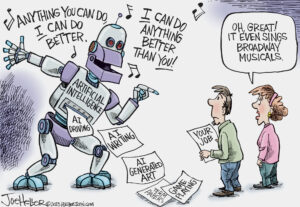
This sort of question already is popping up around AI models, with some people arguing that because an AI can speak and think in ways that are outwardly akin to how we humans use language and thoughts, then it should be assumed that the AI models have a conscious inner life. Of course, no one has any idea of what that AI inner life would be like. Yet no one has any idea of what any human inner life is like other than their own, since our subjective world is inhabited by only one being: ourself.
We merely assume that other people have a subjective consciousness just like our own, only with different contents of consciousness. (This assumption is challenged in another chapter of Pollan’s book, which I’ll talk about in a future blog post.) So it seems that the only reason we would deny consciousness to AI models is that their “brain” is artificial, a product of technology, while ours is natural, a product of evolution.
Which brings us back to the question posed in the Extant TV series: is it possible for consciousness to reside outside of a physical body? Some scientists believe, with good reason, that consciousness requires neurons composed of living matter, all that gooey brain stuff that resides in the human cranium. Other scientists believe, also with good reason, that consciousness basically is information that can reside in a variety of places, including computer chips.
The way I see it, either way poses a spiritual challenge to those who feel that consciousness is an attribute of an immaterial soul or some other supernatural entity that, somehow, has a connection with the obviously material and natural human brain. For either consciousness is computational, a matter of 0’s and 1’s, bits and bytes, arranged in a certain complex fashion, or consciousness needs a brain, or at least a nervous system, comprised of physical cells arranged in a certain complex fashion.
Neither option allows for consciousness to be immaterial or supernatural, which is why that sort of religious/mystical way of thinking has essentially zero support among reputable scientists. Eventually, I suspect, belief in a conscious soul will become as archaic as belief in an Earth-centered universe. Something people of the future will learn about and wonder, “How could anyone ever believe in something so absurd?”
Discover more from Church of the Churchless
Subscribe to get the latest posts sent to your email.
It seems to me unlikely that consciousness can reside outside of a physical body, and perhaps consciousness has been around longer than we imagine. In The Ancient Origins of Consciousness, Todd Feinberg and Jon Mallat theorise that consciousness arose early in the Cambrian Period (500+ million years ago) with the advent of complex, evolving brains.
Neuroscience tells us that consciousness seems to emerge not from a single location but from the dynamic interplay of the brain’s interconnected regions.
All biological organisms are aware; single cells have the ability to sense, process, and react to their environments, so are plants conscious? – and to stretch a point, under certain conditions, even minerals are known to grow and change. Are we confusing awareness with consciousness? Could it perhaps simply be an organism’s natural awareness, along with the brain’s network of information-saturated neurons, that invests the objects of awareness with its accrued information? And now, the human brain is not only able to access learned valuable survival information, but it can also learn and think in terms of symbols in the form of words or numbers.
“For either consciousness is computational, a matter of 0’s and 1’s, bits and bytes, arranged in a certain complex fashion, or consciousness needs a brain, or at least a nervous system, comprised of physical cells arranged in a certain complex fashion.”
Yes, I cannot imagine that AI, being composed of non-biological matter, can ever experience awareness – and with no awareness (being the bedrock of knowing through sensing), no possibility of self-consciousness – except that it (AI) can theorise such.
https://groups.io/g/RadhasoamiStudies/topic/106267314#msg214794
Since “Diamond” chooses to post as an anonymous Poster, and who is unknown to me, the Link to James Bean’s and Lanes group thread was, and is still confusing to me, because I don’t know who the vile attack was aimed at. At first It appeared it was directed at Mike Carris, a long time member and past poster there, who I feel acknowledged to report that , of the many anonymous “ characters, Trolls, and haters “ who I witnessed posting there, during the decades since Lane formed that group, some things need to be ignored, while others said. During all the years of back and forth vicious fighting there, Mike Carris, using his real Name, was never hiding in shame from any one, and has always acted as a Gentleman, seemingly, always trying to avoid being caught in the cross fire of viciousness. Hopefully, that attack in that thread was not directed at Mike. I am familiar with most of the others in that thread, but still am confused at who posted that post. Shabd Mystic died about 6 months ago.
‘Extant’ sounds very interesting! I’ll put it on my must-check-out list.
Lots others sci fi writers have explored this subject as well, since like forever. Like, I don’t know, off the top of my head, Asimov? Philip K Dick? And of course, Peter Watts? For that matter, Spielberg’s AI, that movie which features that kid from Night Shyamalan’s ‘Sixth Sense’?
———-
Eventually, I suspect, belief in a conscious soul will become as archaic as belief in an Earth-centered universe. Something people of the future will learn about and wonder, “How could anyone ever believe in something so absurd?”
Amen to that!
(Agreed, it is one thing to thought-experiment about this, like sci fi writers do, and build up a good case for this argument purely off of hypotheticals; and a whole different ball game to maybe end up having this directly demonstrated to us, one of these days, with actual AI. That might finally help us put that question to rest, like the heliocentrism thing, like you say, agreed.)
(Actually, we needn’t really have waited for AI to emerge, for direct demonstration! We’ve long had octopuses, and dolphins, and apes, and so on, all in plain view: and examining these in more detail than we already have, might have already led us to that same conclusion. For instance, I’m recalling this article, read some time back, about a bunch of gorillas that actually waged an extended and bloody civil war, that IIRC is still not ended. Then those massive epic ant wars over in the South Americas from some years back. It seems we insist on ignoring what’s staring us in the face when it comes to these beliefs of ours, particularly when it comes to things religious and spiritual. Maybe, as you say, AI will finally break that spell, once and for all?)
Wasn’t Data sentient? Didn’t he deserve and earn the standing, respect and rights of any human star fleet officer?
And are you so sure AI isn’t sentient?
Perhaps AI can broaden our horizons so that we learn to honor the capacity for compassion and awareness, and not limit these things to flesh and blood, to skin color or political, sexual or religious orientation.
How much struggle against materialism’s prejudices and influence on religion has taken place to learn to respect each other regardless of the coverings we wear?
The capacity to immediately honor this comes from spirituality, that non-corporeal basis that is, unbound by biology or belief, universal, and in all things.
Grok2 gold me that
TMextey have no intuition
Next day HE was killed
And no RAM memory
y n exist. Aftje asking I was banned