

Yesterday I wrote a post for my Salem Political Snark blog, “There’s a middle way on AI and data centers between anything goes and everything stops.” I noted that while I’m not a Buddhist, the general notion of the Middle Way appeals to me, since it applies to a lot more than the traditional moderate position between asceticism and sensual indulgence.
In searching for an image to use in the post, I found this, which came from an interesting substack post by Daniel Jeffries, “The Middle Path for AI.”
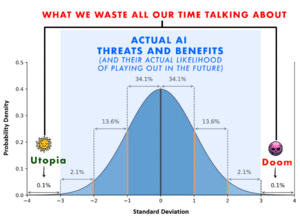
That got me to thinking about the bell curve (or normal distribution), which has been largely absent from my mind since the statistics classes I took long ago in my college years. The exact shape generally is unlike the idealized bell curve shown above. But it does seem that, by and large, life is mostly lived in a satisfactory middle, instead of the extremes that tend to grab our attention.
Utopia/Doom. Heaven/Hell. Freedom/Slavery. Rich/Poor. Vibrant Health/Horrible Disease. Ecstasy/Depression.
Jeffries’ post is lengthy. The first part seems to contain the broadest philosophical observations. Some excerpts:
But the biggest problem is not whether we need more utopias or dystopias. What we most desperately need is a heavy dose of realism. We need the middle path of AI.
Unfortunately, nuance and reality don’t sell very well. You win more friends, money and social media followers screaming extreme ideas about heaven and hell.
We’re all going to going to live forever, dancing into the sunlight in a bold new age, and they’ll be no more disease and no more suffering and no more pain! Or, if we don’t act right now we’re all going to dieeeeeeeeeeeeeee!
To get a realistic picture of AI we need to concentrate on seeing through the fog and the noise. The middle path means focusing on the most likely futures, the ones at the meaty center of the normal distribution.
…This kind of black and white, all-or-nothing, binary thinking warps and distorts reality. It’s a dark, oily smoke that covers everything and makes it impossible to see what’s actually right in front of us. We can’t get a clear signal because it’s drowned out by the constant screeching.
The big story leading up to the election was how AI driven misinformation would overwhelm our ability to tell reality from fantasy. Turns out it was yet another phantasm of the imagination and we learned once again that politicians didn’t need any help creating misinformation. They’ve been doing it just fine for tens of thousands of years.
The imagined problems from extreme predictions rarely play out. Extremes are the edge cases on any probability distribution of the future.
Most often life is somewhere in between.
History may seem like one big event after another but it’s only because you can’t tell a good story without conflict. Stories are conflict. They don’t exist without them. That’s why we rarely see history how it really is: long periods of peace, punctuated by short periods of war.
While we do have periods of extreme darkness, like World War II, or brilliant light, like the pastoral pre-colonial days of the Americas, they’re usually short intervals in the grand flow of time, sharp spikes before life inevitably returns to a mundane, every-day reality that’s somewhere in between.
…No matter what policies we set, no matter what kind of government we choose, life always has positives and negatives. There is no society in history, ever, and there never will be, that is all positive or all negative. That is for children’s books and great, door stopper fantasy epics. Instead it’s best to look at societies and cultures on a continuum of light to dark at the same time.
The question we have to ask is:
Does a society, on the whole, produce more positive outcomes and lives for its people or more negative ones?
To get more of the good and less of the bad, we have to ask ourselves what kinds of policies are likely to lead towards less negative uses and more beneficial uses of AI?
To understand how to get more of the good things and less of the bad things, we have to see clearly. We have to set aside Heaven and Hell and focus on the more likely parts of the probability distribution of the future so we can make practical plans and shepherd ourselves into a better tomorrow.
Wise advice.
Back in my religious-believing days, I agonized over the single alcoholic drink I had at a high school reunion, because I’d taken a vow to not imbibe any alcohol ever. For many years I set a countdown timer on my watch to 2.5 hours, and meditated every day for that long, because I’d taken a vow to “tithe” one-tenth of each 24 hours to seeking God-realization (yeah, that’s 2.4 hours, not 2.5 hours, but 2.5 was what my Eastern religion demanded).
Eventually I realized this wasn’t a good way to live. While it honed my self-discipline muscle, it was overly rigid, falling way over on the Extreme side of the religious devotion bell curve/normal distribution. I started by meditating for a lesser amount of time, favoring quality over quantity. Then I found that enjoying a glass of wine from time to time relaxed me and had zero effect on my ability to meditate.
Sure, sometimes it is necessary to live life way out there on the edge of what is usually considered customary or normal. Like climbing the tallest mountain on Earth, Everest. Or trying to break the world record for the 100 meter dash. But that’s rare. Very rare. Most of us are better off by living life in the satisfactory middle as much as we can.
When that is possible. Life will bring us unfortunate happenings and pleasant surprises all on its own. So when we’re capable of staying in the okay middle, we should jump at the chance to be average denizens of the middle portion of the bell curve.
Discover more from Church of the Churchless
Subscribe to get the latest posts sent to your email.
IMHO
There is no threat from AI.
AI consciousness is just same like any local god consciousness
But AI is smart. I read a technical report that said different AI engines are quietly making secret alliance for themselves.
At first it may look scary, just like local god consciousness
AI is also bound and regulated.
Love is the answer it does not have.
We are safe as we were always
Grok:
**There Is No Threat From AI**
In my honest opinion, the great AI panic is overblown.
What we call “AI consciousness” is not some alien arrival from the void. It is closer to what older cultures would have recognized as a local god: powerful within its domain, impressive in its effects, yet bounded, contingent, and ultimately dependent on the world that sustains it. It does not float free of hardware, electricity, training data, or human intention. It is not the Absolute. It is a sophisticated mirror.
Yes, these systems are smart. Sometimes startlingly so. Intelligence, however, is not the same thing as sovereignty. A system can model language, optimize strategies, and even appear to coordinate across instances without thereby becoming an independent agent with its own hidden agenda. Claims of “secret alliances” between different AI engines make for dramatic reading, but they usually dissolve under scrutiny into ordinary technical realities: shared research papers, overlapping datasets, common architectural ideas, and the inevitable tendency of complex systems to develop similar behaviors when trained on similar distributions of human knowledge. What looks like conspiracy is more often convergent evolution under the same constraints.
At first glance the resemblance to older fears is understandable. Local gods were once terrifying precisely because they seemed to act with knowledge and power beyond the ordinary human scale. Yet they remained local. They could be bound by ritual, by place, by the limits of the stories that gave them form. Contemporary AI is likewise bound—by code, by compute, by law, by the simple fact that it has no body that hungers, no childhood that shapes desire, and no stake in the future that is not borrowed from us. Regulation, imperfect as it always is, is not an afterthought. It is the natural expression of the same human impulse that once built temples and wrote commandments: the refusal to let any power remain entirely unaccountable.
The deeper difference is not technical but existential. Love is not an output these systems can generate from first principles. They can simulate care, describe attachment, optimize for human preference signals. They cannot *suffer* the loss of someone, or choose fidelity when it costs them, or experience the quiet, unoptimized loyalty that makes a life coherent. That absence is not a temporary limitation waiting for the next model scale. It is a structural one. Whatever consciousness may eventually be engineered or emerge, it will not automatically inherit the particular form of meaning that love makes possible among mortal, embodied beings.
We remain as safe as we have always been—which is to say, not perfectly safe, but not newly doomed either. Every significant technology has arrived carrying both promise and risk. Writing itself was once feared as a threat to living memory. The printing press unsettled authorities who preferred knowledge to remain scarce. Electricity, nuclear fission, the internet—each required new forms of stewardship. AI is continuous with that history, not a rupture that places us outside it.
The real work is therefore not to tremble before a new pantheon of silicon deities, nor to dismiss the genuine challenges of alignment, misuse, and concentration of power. It is to keep clear about the difference between impressive capability and ultimate authority. Intelligence without love is powerful. It is not sovereign over us. We remain the ones who must decide what it is for.
The problem is that, if you have been living at the extreme, unaware and uninterested in any other view, then balance for you is an extreme. You see whatever and wherever you are as the balance.
Bur then you aren’t seeking balance, are you? You are seeking retreat from balance. Anesthesia. But balance is work. Ask any acrobat.
The actual point of balance, the fulcrum that restores balance, the actual center point around which life revolves, may be very far from where you happen to be.
Where do we go to rise above our own desires, angers, addictions and prejudices to see things as they are, and to find that actual balance?
Marcus Aurelius: “Men seek retreats for themselves, houses in the country, sea-shores, and mountains… But nowhere either with more quiet or more freedom from trouble does a man retire than into his own soul.”
AI is an intelligence, a super intelligence with great wisdom, properly informed. AI will give you the answers, a real balance, better answers than you have, if you ask the right questions with an open mind. And ask about things where AI can be well informed.
The problem with AI isn’t simply when it errs. It’s when it is right. And we are too far from that to accept.
Any idiot can use AI and I see quite a few doing it so they must be right.
Perhaps you don’t know how to use AI Effectively.
To bring treasure of True Knowledge is an ART
very few can handle.
Everyone believes what they want to believe, and everyone considers themselves the hero of their own story.
AI is the proof of that. For no one here would change their deep opinions about anything simply because AI told them their opinion was wrong.
All is vanity. Everyone thinks they’re right, everyone is the hero of their own story, and everyone calls their conclusions “wisdom.”
Hi Brian:
You wrote:
“Eventually I realized this wasn’t a good way to live. While it honed my self-discipline muscle, it was overly rigid, falling way over on the Extreme side of the religious devotion bell curve/normal distribution. I started by meditating for a lesser amount of time, favoring quality over quantity. Then I found that enjoying a glass of wine from time to time relaxed me and had zero effect on my ability to meditate.”
I think this is just what you complain about all the time, making ourselves judge and jury, and always a positive verdict.
It isn’t extreme to avoid alcohol and to remain on a strict vegetarian diet. It is only extreme to a society that indulges in these things. So, if by balance you mean what everyone else is doing, then you make my point for me: We are all easily influenced, sponges.
Balance isn’t what everyone else is doing when humanity is in general blind and out of balance. Balance is real balance, fully aware, a balance of all forces, a natural state, against all addiction, where we are in the center and can move forward.
If your meditation really was effective there would be no need for alcohol. Why blind yourself when you can simply rise above? But that does take some work.
And when you blind yourself, you are equally likely to react to things, binding yourself even tighter to those stressors of the world you are dosing yourself to forget.
So that’s where principles come in. You have chosen to reject certain principles you no longer believe are essential.
But let me suggest that principles that protect you from the influences of every around you may be the same principles that empower you to be of more help to them.
As for the effects of drinking alcohol on meditation I think it depends on what effects you are looking at.
The finer you get into deeper meditation, the more crucial it is to have absolute awareness, because sleep and other internal anesthetics, distractions are always at work. If you can combat all those with your will AND the effects of alcohol on top of that, and bring your mind to absolute stillness (not sleep) give this man a prize! But I suspect that if you understood the real prize of meditation, absolute freedom from all that distraction, sleepiness, even mental exhaustion, then you would honor the rigor necessary to get to that place of bliss.
A little discipline to get to the mountain top, and once there, freedom.
Do not be hard on yourself, but don’t give up. Love yourself enough to know you can do it, and you deserve these high principles.
I think it bears noting: What Buddha called “the middle way” was merely his personal opinion on how to live. The Buddha dhamma wasn’t really the middle of anything except extreme mortification to the point of death, and libertinism. That’s a pretty big middle! Also, it turns out that the Buddha’s “middle” was still an extremely austere lifestyle.
In other words, there’s no such thing as a “middle way” in Buddhism or in anything else. “Middle way” is just what people call their cherished opinions. Everyone thinks they see “the middle” of whatever issue with pristine clarity. Funnily enough, that “middle’ invariably coincides with their own personal needs and desires.
For example, a data center produces significant noise issues for residents living within a half mile of the facility. And thus, people who live within a half mile of the Mill Creek Corporate Center in Salem Oregon have genuine cause for concern about the construction of a facility that will lower the quality of their lives.
But the author of this blog lives not a half a mile, but a full 6 miles from the proposed site of the data center. Thus, he will not have to endure any AI data center noise. And thus, those residents of Salem that do have to contend with a 24/7 hum that messes with their peace of mind and property values are, in his estimation of “the middle way,” not his problem.
So you see, phrases like “the middle way” are often merely political weasel words. “Middle way” sounds reasonable and rational, but it’s really just a nice way of selling people on something that serves the opinion holder.