

Recently Bill Maher had Ryan Holiday on his Real Time show to talk about his book, The Daily Stoic, and Stoicism in general. Maher said that Stoicism was trendy now, so that made me think the book was recently published.
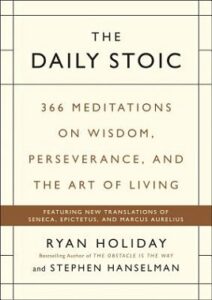
Not so. It was published in 2016. Maybe it is Holiday’s podcast that has generated the current attention. Regardless, I ordered the book and have been reading ten days worth every morning, since there’s no way I want to read a single page for 366 days. (February has 29 pages, to cover leap year.)
I’m fairly familiar with Stoic philosophy, having read Marcus Aurelius and several authors who, like Holiday, have repackaged Stoicism into a form directed at 21st century readers. There’s a lot to like about Stoicism. But I’m unable to buy into the entire philosophy. Nor can I embrace completely any philosophy in my current churchless frame of mind.
For me, the most valuable Stoic teaching was expressed in the initial January 1 entry, “Control and Choice.” I’ll share it in its entirety.
“The chief task in life is simply this: to identify and separate matters so that I can say clearly to myself which are externals not under my control, and which have to do with the choices I actually control. Where then do I look for good and evil? Not to uncontrollable externals, but within myself and to the choices that are my own…”
— Epictetus, Discourses, 2.5.4-5The single most important practice in Stoic philosophy is differentiating between what we can change and what we can’t. What we have influence over and what we do not. A flight is delayed because of weather — no amount of yelling at airline representatives will end a storm. No amount of wishing will make you taller or shorter or born in a different country. No matter how hard you try, you can’t make someone like you. And on top of that, time spent hurling yourself at these immovable objects is time not spent on the things we can change.
The recovery community practices something called the Serenity Prayer: “God, grant me the serenity to accept the things I cannot change, the courage to change the things I can, and the wisdom to know the difference.” Addicts cannot change the abuse suffered in childhood. They cannot undo the choices they have made or the hurt they have caused. But they can change the future — through the power they have in the present moment. As Epictetus said, they can control the choices they make right now.
The same is true for us today. If we can focus on making clear what parts of our day are within our control and which parts are not, we will not only be happier, we will have a distinct advantage over other people who fail to realize they are fighting an unwinnable battle.
Good advice. Though I have some caveats.
Often it isn’t clear whether something is within my control, or beyond my control. That demarcation may be fuzzy, not sharp. Yesterday I wrote a post for my HinesSight blog, “A very strong El Nino means upcoming warmer weather for Oregon and maybe more precipitation.” I can’t control the weather. But along with everybody else on our planet, I do play a (very small) role in determining the climate — since global warming is human-caused.
That’s one reason I leased a Tesla Model Y a few months ago. I was tired of driving a car that used gasoline, a fossil fuel. My Tesla is electric. Currently about 45% of Portland General Electric’s electricity comes from non-carbon sources, and that percentage is steadily rising. So I’m pleased that my Tesla doesn’t emit any carbon pollution directly, and indirectly uses electricity that is almost half carbon-free.
If I didn’t think I had any control over global warming, I wouldn’t have been so eager to get a Tesla. But if I was deluded and thought I had lots of control over global warming, I’d be unnecessarily guilty about our rapidly changing climate.
Then there’s the whole free will thing. I don’t believe in free will. Sure, like everybody else, I make choices. And those choices generally feel like they’re under my control. I just consider that this feeling is an illusion. So I have a problem with this passage from The Daily Stoic.
This morning, remind yourself of what is in your control and what’s not in your control. Remind yourself to focus on the former and not the latter.
Before lunch, remind yourself that the only thing you truly possess is your ability to make choices (and to use reason and judgment when doing so). This is the only thing that can never be taken from you completely.
In the afternoon, remind yourself that aside from the choices you make, your fate is not entirely up to you. The world is spinning and we spin along with it — whichever direction, good or bad.
In the evening, remind yourself again how much is outside of your control and where your choices begin and end.
Well, actually I consider that everything is outside of my control, if by “control” is meant unfettered free will. I believe that all of my choices, without exception, are determined by the same causes and effects that guide everything else in the world. We humans are a part of that complex cause/effect web of interrelationships, not separate from it.
Stoic reason and judgment don’t appear in someone’s mind out of the blue, or via their free will. Reason and judgment are determined by causal factors outside of our control: heredity, education, experience, circumstances, and many other things.
I’m enjoying The Daily Stoic. That enjoyment isn’t a choice. It just happens. Likewise, I don’t view the actions I undertake every day to be choices. They’re just happenings.
Discover more from Church of the Churchless
Subscribe to get the latest posts sent to your email.
Agree. I read the book a few years ago and find the Stoic philosophy (as it’s presented in this book) a bit simplistic. Every decision made is dependent on our previous experiences., so the idea of free will doesn’t hold up. My decision to study for a Masters degree doesn’t arise from nothing, but my previous experience of studying, my thoughts about what study involves, my interest in the subject matter and where the degree will get me (if anywhere). Therefore so much background in any major decision and no doubt small ones too, like making a cup of coffee.
What would you call someone who doesn’t need a philosophy to just live . That’s the pencil pushers who try to put led in my pencil and create isms. It’s way overrated as is rssb. I hardly think about it except when I see a blog about it. And I’m hardly ever online anymore. I decided to die from natural causes.
It is true that buying a Tesla reduces our carbon footprint, and in fact it’s the safest vehicle on the planet (when FDS is used responsibly, otherwise it isn’t), so that covers two sources of personal responsibility. But leasing or buying one places our money directly into the pocket of the man who is causing, as a direct decision he chose to make, the unnecessary deaths of 700,000 children and hundreds of thousands of adults,
Aware of this, what do we do? Empowered with knowledge how do we act? That is the moment where our true character is defined for all to see. Even we can see it, though we are often in denial.
If we have zero control, and if our judgement is hopelessly impaired by our desires, prejudices, adictions and angers, then our efforts to make better decisions are destined to fail and we are doomed to cause more harm than we know by such decisions unless…
Unless we place ourselves under a better, more objective influence. I know for most people they don’t want to rely on anyone else and take it as a personal insult when this is offered: “Death before directions”.
I believe that we must step out of our comfort zone and seek help if we are really serious about moving forward, instead of blindly slipping backwards thinking we are moving forward. Even bragging that we are moving forward, or bragging about how satisfied we are with ourselves. We are biochemical and changing all the time and hardly aware of who and what we really are or are doing.
Any activity that places our actions against a more objective measure is going to show us wanting. That is the basic rule, iMHO, to distinguish honest assessment from denial. If we attend to it.
The only problem with stoicism is that it proudly boasts that we can make good decisions, better choices.
Better decisions do happen, but only in an environment of better influence. We are not human beings each living in their own Island paradise; we are sponges in a polluted ocean.
Those sponges gaze with jealousy and anger at the humans living on that island. The sponges brag proudly as they are tossed about in their own filth that they are people too!
And truly they are, but they haven’t figured it out yet, the one thing that would bring them ashore and free. It is just this. They don’t know who their boss is. The island folk do.
This is why Sardar Bahadur Maharaj Ji limited his satsangs to forty five minutes because he said people generally lack attention for longer than that. But the preceding comments are like diarrhea that went on way too long! ( As usual and makes you wonder where they pick that up from . It’s like they have to defend their daddy from so-called hate speech and there’s no hate in it. It’s just facts and Truth. But often times pencil pushers can’t handle the truth.) I am now following the brevity of Sri Donald.
Ronald, are you saying it took you over 45 minutes to read what I wrote?
Well, that is a big paradigm shift for moi!
Not literacy shaming. Not me buddy.
All is good.
Just learning about you. You are good, you are fine. No problems. If you can read one word, your are doing good. All circuits in order. All meds taken on time, right?
Wait a minute, you wrote you want to die from natural causes? Maybe I should make my essays longer. No, no, why die in torment?
I will keep them brief in future. Sorry.
@ brian,
If what you do is just as it happens than whatever happens in Salem and beast is also j…..just as it happens.
nobody to blame.
Church of the Churchless Secret Decoder Ring: “Whatever I feel is Truth, and whatever I feel benefits me is Truth.”
Back in the days when I was enjoying being one of the chosen people of RSSB and an important satsang leader, RSSB was Truth. Look, I even wrote a bunch of books about this, which are on sale now! –>
But when my satsang objected me to lecturing them on my personal philosophical ideas (which btw are Truth), they told me my high muckamuck RSSB status was revoked. But the experience left me Enlightened. And so I left RSSB and started this blog to carry on my satsang of revealed Truth.
What is that revealed Truth? Basically, that there is no free will, but nevertheless, I enjoy having all kinds of opinions about all kinds of things, including world, national, and local government, and how the people running these organizations should follow my opinions. I no longer believe in karma, but I still strongly believe that I have a perfect understanding of morality and ethics, which, for example, includes slamming people as “misogynists” for questioning hearsay remarks about the guru I once said I’d take a bullet for.
I also revel in shouting the good news that God doesn’t exist, while I tell the world (or the dozen or so people who read this blog) about my never-ending quest to find a substitute spiritual practice to fill the void of leaving RSSB. Including smoking pot and taking LSD.
Some deride my revelations as not quite Truth, and more on the lines of jejune nonsense.
But my writings are Truth. What I want and what I feel is Truth! Why is this so hard for some of you to understand? When will you ever grow up?
Hi Sant64:
I am struck by a fundamental Truth reading your essay. You can substitute any name, yours, mine, any name from your contacts or anyone elses, and this essay would in fact be a truthful description.
We all live in our own world. We all believe whatever we are thinking is right.
We might believe, from experience that we might be wrong. But until we are confronted with that, what else can we believe?
Until then, everyone has an opinion. And so long as mind continues functioning, it’s spewing these out 24/7.
And so we share with each other! It’s a smorgasborg. Pick what appeals to you. Be happy you already know not to mix the pickles with the ice cream….Unless you are pregnant.
Now the misogynist wants to judge pregnant women. Pitiful just pitiful
I find this bit from The Daily Stoic quite funny – in an absurd sort of way: “Before lunch, remind yourself that the only thing you truly possess is your ability to make choices (and to use reason and judgment when doing so). This is the only thing that can never be taken from you completely.”
?? As if there is a ‘we’ that ever had such an ability.
It can be seen that choices are dependent on previous experience – as sm68 states in his/her comment: – “Every decision made is dependent on our previous experiences, so the idea of free will doesn’t hold up.”
There is no you that possesses an ability to make choices – or at least, no separate ‘you’, no ‘self’ that can ever be found. Thoughts arise unbidden, in a continuous stream of consciousness. The illusion of a separate thinker is where attention arrives after the fact to give the impression that someone, some entity, is having a thought.
Thoughts continually arise, giving the impression of ‘me’ thinking. It is probably in the interests of the ego or self-structure to maintain this illusion as it imparts a seemingly solid idea of an autonomous ‘me’ that is above and superior to the natural order of our lives.
When all the self-illusions are dispelled, what is left is a human primate existing in interdependence with the totality of life. The concept of a separate ‘me’, a separate ‘chooser’, can only ever manifest in the realms of belief, fantasy and abstract thought.
For a while I worked as a sous-chef in a kitchen. We were three of us were before 10 were running the kitchen.
It demands besides hard work a lot of concentration, to survive the pressures in peak hours … it reaches the level of trance.
After cleaning up, switching of the lights and driving home, I often had the strange experience of re-finding myself.
In both situations decisions have to be made in order to survive …but the way it happens an is done is totally different
One is present in both situations, fully aware, yet, very very different t