Does “Being” exist?

I suspect that churchless skeptics who are drawn to question traditional belief systems also enjoy the feeling of an elevator suddenly descending, when it seems like the floor has fallen away from under your feet. At least, this is a sensation I frequently have now that I've stopped being a True Believer. It isn't disconcerting, because after an initial jolt of finding that one more unquestioned assumption needs to be closely examined, it feels good to have discarded an additional piece of conceptual junk which doesn't deserve the prominent positioning it used to have in my Philosophical Display Case. For…

Somali pirates kill couple distributing Bibles

It's a tragedy when four Americans on a yacht are killed by Somali pirates. But when I heard about them being taken hostage, I thought, "Who would be crazy enough to sail by themselves into such a dangerous area, given all the other well-publicized hijackings in that part of the Indian Ocean?" Then I learned that one of the couples had been distributing Bibles around the world. My suspicion is that they felt they were under God's protection. Mistaken feeling, obviously. However, I've little doubt that countless Christians are now saying, "It was God's will that they were killed." I…

Finding enlightenment through a colonoscopy (and propofol)

I want to get as much philosophical mileage as possible out of the colonoscopy I had a few days ago. After all, I had to sacrifice eating solid food for almost two days. That isn't exactly a major ascetic accomplishment -- certainly not Gandhi'an -- but since I'm a vegetarian habituated to frequent food browsing, the colonoscopy prep period was a shock to my culinary system. This wasn't the most interesting part of the procedure, though. Just as with the colonoscopy I had two years ago (a benign polyp was found, and the prep wasn't perfect, so the doctor wanted…

The “self” is culturally determined

We in the West (not the wild west, but Western culture) are obsessed with ourselves. "I've got to find my true self," people say. Self-development is a big industry, featuring countless workshops, books, lectures, and such. We're big on autonomy, independence, finding our own way in life, not marching to the beat of someone else's drummer. Other cultures, such as those in East Asia, are quite different. To a much greater degree than self-absorbed Americans and Europeans, they view the self as including family, community, and societal relationships. Such is the message of an interesting Philosophy Talk podcast that I…

Will Kurzweil’s “singularity” let us become immortal?

Shit! Along with a lot of other baby boomers, I bet, that was my instant reaction to the TIME magazine cover that shouted out "2045 The Year Man Becomes Immortal" at me when I opened the mailbox a few days ago. Those of us who were born a few years after the end of World War II would be pushing 100 by the time immortality could be ours. Even before I read the cover story, I figured that (1) almost certainly I'll be dead by 2045, and (2) even if I wasn't, living forever in a worn out body/brain wouldn't…

A religious or spiritual path is a metaphor — not reality

Metaphors are fun to play around with. Over on my other blog, I recently called the Oregon city where I live "a blandburger sandwiched between spicy Portland and Eugene." But Salem isn't really food. It's what it is: people, places, buildings, roads, parks, culture (and the lack thereof), plus so much else immediately cognizable stuff. Metaphors are a big step removed from the sort of reality that doesn't depend upon mentally connecting this, such as Salem, with that, such as the innards of a sandwich. I'm plugging away on reading a big thick book, "Philosophy in the Flesh," that I've…

How “Nothing” is the key to a meaningful life

I've never watched an episode of Seinfeld, but the theme of the show -- "nothing" -- appeals to me. In one way or another, this is what attracted me to my Wu Project, which is still bubbling along in its nothing-much fashion. Here's the thing, though: "nothing" still is something, when this notion is viewed as something special, something to be attained, something waiting around a meaning-of-life corner. Zen folks have a lot to say, via words or silently, on this subject. But I don't think there's any unique understanding of "nothing" here either, since Zen (and Buddhism in general)…

Near-death experiences are physical, as is meditation

I've finished reading Kevin Nelson's intriguing book, "The Spiritual Doorway in the Brain: A Neurologist's Search for the God Experience." His focus is on near-death experiences. (I've previously blogged about the book here, here, and here.) The bottom line is that Nelson cites lots of research, which he combines with his extensive knowledge of how the brain works, to come up with a compelling explanation for the seemingly spiritual nature of what often happens to people on the edge of death. It's all physical. Natural. Brain-based. As is meditation. As is everything, so long as we are alive in a…

“Jesus Potter, Harry Christ” relates Hogwarts and Heaven

Who comes to mind when you think...? Magic father, human motherMiraculous birth, foretold by prophecyThreatened by an evil ruler, had to go into hiding as a babyPower over animals, time, and matterSymbolized by a lion, enemy symbolized by a snakeDescended into the underworldBroke seven magical sealsWent willingly to his deathSuffered and died (or appeared to die) willingly, was mournedCame back to lifeDefeated his enemy in a glorious final battle I'm no Biblical scholar. And I've never read the Harry Potter series. But I believe Derek Murphy when he says, early on in his book "Jesus Potter, Harry Christ," that there…

Religion is the biggest joke — but with no punchline

What if you spent quite a bit of time doing something that was very serious and important to you? And then you came to understand it was a joke and useless. How would that make you feel? Probably, disturbed that you'd wasted so much effort on something so laughable. Yet also happy that you reached your realization before frittering away more of your life on a big bit of nothing. This is how I see religions now. As jokes, but without a punchline. Often a joke isn't funny until the very end. That's when we see the humor in the…

“All Things Shining” is a luminous philosophical read

If you're looking for a book that (1) discusses Western classics like Moby Dick and the Odyssey in a fresh and creative fashion, (2) points the way to a philosophy of life that navigates between the danger zones of religiosity and nihilism, and (3) was featured on a recent episode of The Colbert Report, there's only one choice: "All Things Shining," by Hubert Dreyfus and Sean Dorrance Kelly, two heavy-duty philosophers (Kelly is Chair of the Department of Philosophy at Harvard, but looks too young and clean-cut for this; where's the beard and pipe?) I'm not literary enough to be…

No, Randi Rhodes, I can’t tolerate blind faith

This afternoon, all it took was a few minutes of listening to Randi Rhodes on Portland's progressive talk station (KPOJ) to get irritated by what she was saying. Usually it takes a bit longer, but eventually I always find Rhodes to be almost as difficult for me to listen to as Glenn Beck, Sean Hannity, Rush Limbaugh, and Michael Savage -- her ideological opposites. (See here, here, and here for my previous anti-Randi rants.) Today I tuned into her show as she was talking with an atheist caller. He said that he couldn't believe in any religion, or God, because…

Be selflessly selfish (as if you had a choice)

A few nights ago my wife traumatized me. She shook the foundation of my existence, which in no small part rests on a weekly filling up of our bathtub with steaming hot water, pouring a glass of red wine, and having a pleasant soak while reading the latest issue of People magazine. (How else am I going to keep up on celebrity weddings?) "Where's the People magazine?" I asked Laurel, wine in hand. "I left it at the athletic club," she told me. "I thought you'd read it." Instantly the bottom dropped out of my envisioned future. I couldn't believe…

Reality isn’t what we imagine, or remember

Most forms of religion, mysticism, spirituality, and philosophizing have a big drawback: they're wildly out of touch with reality. Of course, for those who don't care about living a truthful life, imagining an illusory world where Jesus saves, a guru enlightens, karma bites you in the butt during your next incarnation, or whatever, can be appealing -- since a believer can substitute warm and fuzzy concepts for whatever hard realities he or she wishes to deny. Those of us who are committed to experiencing life as honestly as possible have our own sources of solace, though. Since I'm a long-time…

“Story of Suzie” shows absurdity of Jesus

Thanks to one of my favorite blasphemous blogs, Pharyngula, I got to watch the new version of the Story of Suzie. I found it especially enjoyable because Christians are upset that the video depicts them as delusional. Well, to me Suzie accurately reflects the craziness of Christianity. Have a look and see if you agree.

Zen says the door is wide open (while we cling to bars)

As noted before, I keep re-reading Hubert Benoit's brilliant book about Zen, "The Supreme Doctrine." No matter how many times I ponder a page, a fresh understanding (or productive non-understanding) almost always pops into my psyche upon another perusal. This morning I re-read Benoit's chapter on The Immediate Presence of Satori. In the first few paragraphs he accurately captures the psychology of both spiritual seekers and humanity at large. My primordial demand to be a distinct being conditions all my desires and, by my desires, my hopes and my beliefs. Bearing this claim, I am the bearer of an aspiration,…

“Selfless Insight” — intriguing, yet disappointing, Zen book

I didn't enjoy neurologist James Austin's book about Zen and neuroscience as much as I thought I would. My reading of "Selfless Insight: Zen and the Meditative Transformations of Consciousness" may show, of course, that I'm neither selfless nor imbued with enlightened (or kensho'ened) insight -- both of which I plead guilty to. Regardless, I expected that Austin would provide a clearer and simpler analysis of how Zen meditation and brain science relate. He's written two other books on this subject, this being the most recent, so perhaps "Selfless Insight" is more complicated than his earlier works. I was left…

Sober or drunk? Sacred or profane?

I've rarely gotten drunk. But I love the notion of drunkenness. I don't swear a whole lot in public. But profanity springs from my lips much more freely than prayer does.

Reality just seems more, well, real when it is lived on an intoxicated blasphemous edge — whether this be conceptually philosophical or crudely physical. Neat and tidy sobriety isn't congruent with the cosmos' natural wildness, though we humans do our best to smooth rough edges and tame savage beasts.

At the end of this post I've included an excerpt from a chapter in Daniele Bolelli's terrific book, "On the Warrior's Path: Philosophy, Fighting, and Martial Arts Mythology (second edition)."

Now, if you're tempted to stop reading because your interest in martial arts is slim to nonexistent, give this post a chance.What we're talking about here is an issue that goes way beyond martial arts: is the straight and narrow a more productive path than a curving and unrestricted way?

If you read the excerpt from Bolelli's "Sacred and Profane: Combat Sports as Athletic Philosophy" chapter — and I hope that you do — be aware of your reaction to the two contrasting instructional styles he describes in such an entertaining fashion.

This likely will be an indication of what sort of spiritual, religious, moral, mystical, or philosophical teachings and practices you're most attracted to.

Admittedly, Bolelli features some extremes. But few of us are precisely balanced at a mid-point; it's natural to tilt one way or the other (for example, how many people are so perfectly bi-sexual, they're equally attracted to both sexes?).

I bought the second edition of Bolelli's book, even though I'd already read the first edition (and blogged about it in "Bruce Lee's Taoist life lessons") because two new chapters sounded intriguing to me.

I'm glad I did the Amazon deed. Bolelli is much more into martial arts than I ever was, but we share some common experiences and attitudes on both the philosophical and fighting fronts.
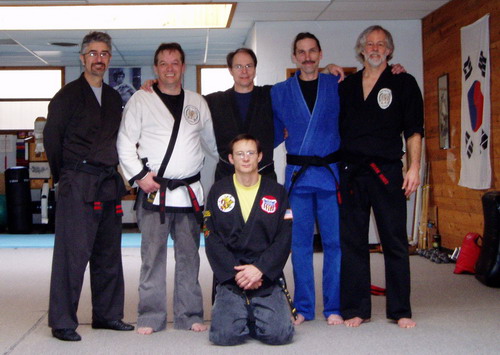
Pacific Martial Arts

I talked about this in a 2004 post where I congratulated my martial arts friend, Dave, on his black belt accomplishment. (I'm in a black gi on the right; Dave is next to me, in blue; Warren Allen, our instructor, is in the middle, in back.)

After almost nine years of traditional Shotokan karate training where everyone had to wear a plain white gi (and only females wore a t-shirt under it, which helps explain my habitual t-shirtless look), I much appreciate Warren’s hang-loose Taoist attitude toward the dojo dress code. Discipline is needed in the martial arts, but dressing exactly alike doesn’t teach anything except rigidity.

It’s interesting that my changeover from the linear, dogmatic, structured Shotokan training to the Pacific Martial Arts circular, eclectic, flowing style has pretty much paralleled a similar change in how I approach meditation and spirituality. I’ve become much less rigid in my philosophical/metaphysical beliefs during the years I’ve been trying to achieve a similar openness in my martial arts training.

My new Church of the Churchless site reflects this creedless creed mentality.

Daniele Bolelli's comparison of contrasting uptight Shotokan and hang-loose Jujitsu classes rang true to me. I trained for nine years in a traditional Shotokan dojo where we practiced the sort of rigid discipline you can read about in the extension to this post.

When I switched to the eclectic Pacific Martial Arts style, the training was just as tough and demanding — more so, in fact — but not as anal. This meshes with Bolelli's description of the Brazilian Jujitsu class he observed, a martial arts style that I learned just enough of to know how much more I had to learn about it.

Anyway, read on for an interesting take on whether sober is better than drunk, and sacred better than profane.

(If you'd rather watch than read, check out Jackie Chan's classic "Drunken Master" on Netflix; it can be watched instantly for free if you have a Netflix account; from about 1:20 to 1:27 is a generally comedy-less look at drunken-style kung fu.)

If the Bible permits it, why can’t I own a Canadian?

Here's a classic (all the way from 2002) expose of the ridiculousness of some entities that deserve to be ridiculed: the Old Testament and Dr. Laura Schlessinger. Dear Dr. Laura:Thank you for doing so much to educate people regarding God's Law. I have learned a great deal from your show, and try to share that knowledge with as many people as I can. When someone tries to defend the homosexual lifestyle, for example, I simply remind them that Leviticus 18:22 clearly states it to be an abomination. End of debate. I do need some advice from you, however, regarding some…