

Creation is a perennial hot topic in both science and religion. In the Bible, God created the heavens and the earth. Other holy books have different explanations for how the world came to be. But they all suffer from a fatal flaw: they’re unbelievable. Or so lacking in evidence they are the closest thing to unbelievable.
Science does a lot better.
Big bang cosmology provides a satisfying, albeit incomplete, answer to the creation question. Some 14 billion years ago our universe burst into existence in a unimaginable explosion of sorts, expanding from the size of a subatomic particle to the vastness of hundreds of billions of galaxies, ,each containing on average hundreds of billions of stars.
I readily admit that the scientific explanation is as mind-blowing as the religious explanations.
It’s extremely hard to fathom how everything in our universe once was compressed to a size much smaller than a grain of sand. Science can’t comprehend this either, since equations point to infinity at the moment of the big bang, and infinity isn’t something that we can get our human heads around, assuming it even exists in reality in addition to mathematics.
And of course, neither science nor religion can explain the ultimate origin of creation. If God has always existed, that isn’t an explanation but a cop-out, since nothing created God. Science can play the same game, saying that the laws of nature that powered the big bang always have existed, so no creator there either.
I deeply doubt that science is going to come up with an ultimate origin explanation for our universe any time soon. For sure religion isn’t going to do this. So I find a more practical question to be What is the scientific source of everything in the world? By “everything” I don’t mean what came into being at the big bang; I mean the stuff that comprises the everyday world right here, right now.
In other words, the wellspring of reality as we know it. Pondering this, I’m reminded of my favorite one sentence metaphysical statement.
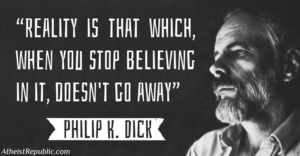
Now, there are problems with this adage. I’m not going to defend it in this blog post, because I’m aiming at a more defensible argument about reality. However, I like the simplicity and intuitive appeal of what Philip K. Dick said. It grabs my attention and makes me think, both good things.
Currently I’m reading two books about reality that aren’t nearly so simple or intuitive: The Blind Spot by Adam Frank, Marcelo Gleiser, and Evan Thompson, and Physics Fixes All the Facts by Liam Graham. The Blind Spot argues that direct experience is what makes science possible, so deserves more attention and respect from scientists. Physics Fixes All the Facts argues that quantum physics is the cause of everything in reality, even “emergent” phenomena like consciousness.
Both books are aimed at academic types, or at least sophisticated general readers with a high tolerance for complicated arguments. Which describes me, though I struggle at times to comprehend each of these books. Here’s a simple way of describing what has struck me about both books based on my reading of some early chapters.
I have no problem accepting the central thesis of The Blind Spot. I don’t suffer from that inability to recognize the importance of direct experience malady. Nor do I know anybody who does. The authors appear to be aiming their book at scientists so enamored with the lure of objectivity and the so-called God’s Eye view of the world, that they forget the inherent subjectivity of direct experience that makes science and every other endeavor possible.
Every experiment, every observation, every reading of a test result, every communication of a finding — all of that and so much more relies on human direct experience. A space telescope can gather reams of data about the universe, but until a human mind becomes aware of that data, it is useless. This seems obvious.
This also seems obvious to me, though I suspect it is more controversial among some of those who read this blog post: it does seem true that as the book’s title says, physics fixes all the facts. Graham, the author of the book, engages in some intricate arguments to persuade the reader of this. And I’ve got most of the book left to read.
Here’s how I make Graham’s argument in a much less complex way.
It seems clear that direct experience requires consciousness. Few, if any, would debate that. More people would disagree with this statement, even though it strikes me as almost equally undebatable: the brain produces consciousness. Sure, neuroscience doesn’t know exactly how it does this, but the evidence for consciousness requiring a properly functioning brain is very strong.
Anesthesia. Being hit on the head with a baseball bat. Brain damage. Comas. Change the brain, and you change consciousness. Psychedelic drugs testify to that, as does alcohol, caffeine, amphetamines, and such.
Let’s dig deeper. The brain is composed of cells, including many billions of neurons interacting via trillions of connections. Without those cells and maybe other brain entities (I’m no expert on the details of brain physiology), there’s no consciousness. But each cell is composed of molecules, and each molecule is composed of atoms, and each atom is composed of subatomic particles, and those particles are governed by quantum physics.
So where along the line of reality that leads from quantum physics to consciousness is it possible to omit something and still be left with reality as we know it? No brain cells, no consciousness. No molecules, no brain cells. No atoms, no molecules. No subatomic particles, no atoms. No quantum physics, no subatomic particles. (Meaning, really, no quantum fields, since quantum physics is the study of quantum fields.)
It may sound crazy to say physics fixes all the facts. But I disagree, based on my current understanding of science. To me it is sort of like a multistory building resting on a foundation. Without the foundation, the building collapses, no matter how many intriguing things are going on in the stories above ground level. Ditto with reality.
The source of everything in the world is the quantum realm. From that, everything is constructed. Subatomic particles, atoms, molecules, cells, organs, living beings, brains, plants, animals, rocks, air, water, everything. It is absolutely true that more is different, the basis of complex emergent phenomena arising from simpler phenomena, like consciousness arising from brain cells.
But I can’t fathom how either simple or complex phenomena aren’t dependent on the laws of nature known to physics. Which is the central tenet of the Physics Fixes All the Facts book.
Discover more from Church of the Churchless
Subscribe to get the latest posts sent to your email.
Sounds like you’re just having a horrible time and if I were you I would get half cocaine half heroin put it in a syringe find the juggler. And end it all.
Let’s go back to Philip K Dick. In his stories, when consciousness changes, so does reality!
If you dream it differently so, in his stories, your waking life is different. Your reality is different. And you may never even know of any change, since you, your identity and consciousness, changed with that dream. To you it is exactly as it always was.
Dick pointed out that the moment people discuss reality they inadvertently, or purposely, manipulate it, so that all discussion can only be about false realities, manufactured realities.
Brian, your reality is the one you want it to be, even if you don’t like it much, and so it is the reality you see, always proving itself to you, for your pleasure.
The reality that never changes may be entirely unknown to any of us, because we are changing all the time, recreating ourselves moment by moment. What we, being manufactured by our own mind, think is real is most certainly not.
If I’m reading this post right, then the main issue is: “The brain is composed of cells, including many billions of neurons interacting via trillions of connections. Without those cells and maybe other brain entities (I’m no expert on the details of brain physiology), there’s no consciousness. But each cell is composed of molecules, and each molecule is composed of atoms, and each atom is composed of sub-atomic particles, and those particles are governed by quantum physics.”
I can only refer to my own experience. Yes, the world does present itself to my senses as real and solid, and I accept the physicist’s view that this world is essentially composed of subatomic particles. Perhaps the compromise would be that instead of saying that ‘physics fixes all the facts’, it would be better to say that physics is the basis of all the facts, facts that accord with the laws of nature.
I appreciate how Robert Saltzman puts part of this issue: – “Naturalism says awareness is emergent—something that arises under certain complex conditions, like a human brain. In this view, awareness doesn’t precede the cosmos. It arose within it. No one can prove this beyond doubt, but as a working stance, it fits ordinary observation.”
‘Fits ordinary observation.’ That’s perhaps that’s all we ever say-if we’re honest. Same goes for creation and all the myths of religion and hypotheses of science that surround it. I’m of the mind that we will never know. That is not defeatist; there are many things that we may continue to discover, but when it comes to the origins of the universe, of everything, then I can envisage that search, much like the universe, as receding further away as we approach it – much like the rainbow.
Back to reality. All we can ever truly know is that which presents itself to us in the moment. All else, being injected into the moment through thought, overlays the reality on now – but, there again, that thought is what’s happening now – then it’s gone.
“Call it Shabd, call it Tao, call it Logos, or even Energy. It is the creative life force …”