Values end up being justified by nothing

Having finished Todd May's book, "A Significant Life: Human Meaning in a Silent Universe," I left an Amazon reader review titled Best "Meaning of Life" book I've ever read.  That's high praise, since I've read a lot of them. Philosophical, spiritual, psychological, mystical, religious, scientific, political, environmental.  May's book has resonated with me more than any other. Maybe it is because "A Significant Life" is the most recent one I've read. But I don't think that's the reason. Rather, May delves into issues that have always fascinated me, explicating them in a fresh and appealing manner. For example... Whether we're speaking…

What do we want? Happiness, experiences, or meaning?

About all it took for me to order Todd May's book was the title: "A Significant Life: Human Meaning in a Silent Universe."  How could I resist? Hey, I want a significant life. Filled with meaning. And I totally agree we live in a silent universe. That is, one which doesn't have a God or some other cosmic entity whispering in our ears, Here is what makes life meaningful... I've got a few chapters left to read. Ordinarily getting this far into a philosophical book would make me confident that I know what the final conclusions will be. But May,…

“A God That Could Be Real” doesn’t seem very real

After spending half an hour or so perusing articles about, and reviews of, a book called "A God That Could Be Real: Spirituality, Science, and the Future of Our Planet," I've pretty much concluded that... This God doesn't strike me as potentially real enough to buy what Nancy Abrams wrote. But I'll give her credit for this: creativity, thought-provoking'ness, poetic prose, and a semi-gallant attempt to explain a God that is compatible with modern science. Since I don't understand how her God is any different from the collective imagination of humanity, I don't feel like I can explain Abrams' conception…

A question about “God’s creation” for religious believers

I have a question for religious people: most religions believe that God or some other divine being created the universe. Which, naturally, includes Earth. I read a lot of science books. I'm not expert in the details of cosmology and evolution, but I'm familiar with the broad outlines of these fields. I know how much solid evidence supports certain basic facts. Such as... The universe started off in a big bang some 13.8 billion years ago. Stars and galaxies eventually came into being, along with our sun and the solar system.  Chance, in the form of countless unpredictable chaotic deterministic…

Religious ridiculousness: men refusing to sit next to women on planes

Rather than the so-called Religious Freedom Restoration Act, legislatures in the United States should get busy passing Freedom from Religion bills. After all, to me (and many others) religiosity is a relationship between an individual and his/her imagined divinity. It's a matter of personal belief, which I have no problem with. Believe whatever you want, so long as you don't interfere with the right of other people to believe as they want.  Unfortunately, all too often religion becomes a matter of outward action, rather than inner belief. And not private actions, but public ones that affect other people. Case in…

Religion is just one of many stories humans have imagined

Often religious people will say, "Science is just another sort of religion." This is wrong. Science is science. Religion is religion.  Yet that saying also is right in a way. Neither science nor religion exists in the same fashion as stars, rocks, water, and flowers do.  Those things existed before modern humans, Homo sapiens, came along. They also exist now. And if we humans disappear from Earth, almost certainly all of those things will remain. As Yuval Noah Harari, a historian, says in his fascinating book, "Sapiens: A Brief History of Humankind," certain entities exist only in the minds of…

“Spiritual” and “Science” — two words that belong together

Carl Sagan didn't see any conflict between spirituality and science. Neither do I. They get along very nicely, so long as we remember that "spirit" has nothing to do with God, divinity, or the supernatural. It's just a word that points to how we look upon reality, rather than focusing on the what of existence. As in, for example, "With what sort of spirit are you going to view the situation?" Over on my other blog, HinesSight, I put up a post yesterday -- A secular Easter thought: "spiritual" isn't supernatural or religious. Give it a read. The post is…

Neil deGrasse Tyson on religion vs. objective truth

The headline on this Daily Beast piece is a bit misleading: "Neil deGrasse Tyson Defends Scientology -- and the Bush Administration's Science Record."  Sure, both statements are true. But only in a certain context. Here's some of what astrophysicist Tyson says about Scientology. So, you have people who are certain that a man in a robe transforms a cracker into the literal body of Jesus saying that what goes on in Scientology is crazy? ...But why aren’t they a religion? What is it that makes them a religion and others are religions? If you attend a Seder, there’s an empty…

Let’s add a new L-word to “Who is the guru?” possibilities

Back in 2006 I pondered the question, Who is the guru?

By “guru,” I meant someone who is (1) alive today, and (2) considered by his/her devotees to be, if not actually God in human form, darn close to this exalted level of divinity.
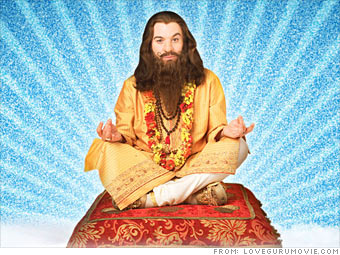
Guru

This is, obviously, a different sort of religious personage than, say, a Christian minister. Or even the Pope. It is easy to visualize them sincerely believing that they are God’s representatives on Earth, while recognizing that they are entirely human.

In some Eastern religions, though, the distinction between God and guru is minimal. Even nonexistent.

The Indian guru I was initiated by in 1971, Charan Singh, was considered to have attained a state of God-realization by his followers.

No longer believing this, my “Who is the guru?” post was an attempt to make sense of the fact that Charan Singh, along with his successor Gurinder Singh, could sit on a podium in front of tens of thousands of adoring disciples who looked upon them as not only godly, but as God.

I’ve been thinking about the four options concerning who Jesus was, according to biblical scholar Bart Ehrman: a liar, a lunatic, the Lord, or a legend. When it comes to a long-dead historical figure like Jesus, these options make sense. But what about a modern-day guru who is similarly proclaimed to be God in human form?

I was initiated by such a guru, Charan Singh Grewal. I sat at his feet, literally. I had two personal interviews with him. I heard him speak many times. I saw him worshipped by tens of thousands of devotees as a divine incarnation.

And yet, I still don’t know what to make of him. Or his successor, Gurinder Singh Dhillon. Who is the guru? A philosophically-inclined friend of mine likes to say, “There’s only one question to ask a guru who is supposedly God in human form: Are you who people claim you are?”

But given Ehrman’s four options, the answer wouldn’t be all that revealing. If the guru was a liar, you couldn’t believe what he said. Ditto if he was a lunatic. And even if he truly was the Lord, and said as much, what reason would there be to believe him? Plus, one could argue that a God-man would be so humble, you’d never hear a claim to divinity pass his lips.

With living gurus the legend option doesn’t come into play. They’re alive and kicking, not legendary. Quite a few men (and a few women) of recent vintage are considered by the faithful to be manifestations of God. For example, Meher BabaRamakrishna, and Lokenath.

So I muse over my recollections of Charan Singh and Gurinder Singh, trying to decide whether they’re best described as liars, lunatics, or the Lord.

I ended up preferring a fourth option, loyalist.

Is there another L-word that better fills the bill? One springs to mind: loyalist. Perhaps when a successor is appointed to fill the shoes of a highly-regarded guru, loyalty both to his predecessor and to the surrounding organization prevents the newcomer from crying out, “Hey, I’m not God! I’m just a man filling the role of a guru.”

This theory got support in a video David Lane made about Charan Singh, as described in a 2013 post, “Charan Singh was a loyal guru.”

But a essay by Michael Shermer in his Scientific American “Skeptic” column suggests another possibility. In “Lies We Tell Ourselves: How Deception Leads to Self-Deception,” Shermer says:

Trivers’s theory adds an evolutionary explanation to my own operant conditioning model to explain why psychics, mediums, cult leaders, and the like probably start off aware that a modicum of deception is involved in their craft (justified in the name of a higher cause). But as their followers positively reinforce their message, they come to believe their shtick (“maybe I really can read minds, tell the future, save humanity”).

Click on the link above to read the full piece by Shermer. I’ll also include it as a continuation to this post.

Desperate to find an L-word to add to the liar, lunatic, Lord, or loyalist possibilities, the best I could come up with after a brief look at some online thesauruses was to substitute “legerdemain” for self-deception.

It seems to fit, as rarely used as the word is.

1. sleight of hand.
2. trickery; deception.
3. any artful trick.

So let’s add a likely option that answers the question, “Who is the guru?” Legerdemainist. Which actually is a word.

The guru tricks himself into believing that he (or she) is God. Or God in human form, after being viewed as divine by fawning followers. This act of self-deception further bolsters his standing among devotees, as Shermer explains.

As Abraham Lincoln well advised, “You can fool some of the people all of the time and all of the people some of the time, but you cannot fool all of the people all of the time.” Unless self-deception is involved. If you believe the lie, you are less likely to give off the normal cues of lying that others might perceive: deception and deception detection create self-deception.

Interesting. Read on to peruse Shermer’s entire essay.

“No preachiness” reminder for commenters

Ah, how soon they forget. Some preachy-prone commenters on this blog have been asking, "Dude, where's my comment?" Unpublished, guy or gal. Guess you've forgotten my post of a few months ago about a new commenting policy. Starting today, I'm going to be less accepting of publishing comments that include a lot of preachy religious dogma. Some people have been using comments on my "churchless" posts as an opportunity to share their irrelevant (to the post) religious beliefs.  They might make a passing brief reference to something I said in the post, then launch into a lengthy description of how…

Even God can’t explain the mystery of existence

Re-reading the first chapter of Luther Askeland's "Ways in Mystery" this morning (one of my favorite meaning-of-life books), I liked how Askeland addressed The Seemingly Really Big Question of Existence. The Way of Unknowing chapter starts off with a Wittgenstein quote: Not how the world is, is the mystical, but that it is. Now, I've come to doubt that this that mystery is really as mystically mysterious as it appears to be. Maybe the classic question "Why is there something rather than nothing?" simply should be rephrased as a statement: "There is something rather than nothing." Offering support to  this…

Thoughts on “Let’s find out” in science, religion, and everyday life

One of the perks of my utterly unpaid blogging "career" is being able to interact with intelligent, thoughtful, well-spoken people who are interested in exploring the same subjects I care about.A commenter on this blog who goes by Appreciative Reader is one such person. Whenever I read something from him, I'm much impressed by the quality of the ideas being expressed.  Below is a message that was emailed to me by Appreciative Reader. As you'll read, he felt it was lengthy enough to be unsuitable as a blog comment. I, though, felt it was perfect for a blog post. Since,…

Indiana legalizes religious discrimination. Glad I live in Oregon.

Indiana has passed a Freedom to Discriminate bill. That's the name Matthew Tully, an Indianapolis Star columnist, prefers over the Religious Freedom Restoration Act. Here's some excerpts from his "Statehouse Republicans embarrass Indiana. Again." Let's call it what it is. It's discrimination wrapped up in a legislative bow. It's divisiveness painted as something holy. It's tired and cynical politics weakly masked as a principled stand. Sure, it is cleverly labeled with a market-tested name (the Religious Freedom bill), but please don't be fooled: This is nothing more than a government endorsement of discrimination. Yes, in this land of liberty, our…

This Idea Must Die — great idea for both science and religion

Browsing through Portland's amazing bookstore, Powell's, I came across "This Idea Must Die: Scientific Theories That Are Blocking Progress" in the new non-fiction area. Couldn't resist it. The back cover said: Few truly great ideas are developed without first abandoning old ones. In the past, discoveries often had to wait for the rise of the next generation to see questions in a new light and let go of old truisms. Today, in a world that is defined by a rapid rate of change, staying on the cutting edge has as much to do with shedding outdated notions as adopting new…

Science says, “Sorry, no such thing as soul”

Delving into a bag of books and magazines yesterday, I pulled out a 2013 issue of Skeptic. Thumbing through it, I found a highlighted article that must have been the reason I saved the magazine.

Good title: "What Science Really Says About the Soul," by Stephen Cave. Being fairly short, I'll include the piece in its entirety at the end of this post, after sharing some selected quotes.

Soul

His arguments against the existence of some sort of non-material bubble of divine consciousness are pretty darn good. I've made most of them myself in my own highly-persusive blog posts during the past 10+ years. 

They're difficult to refute. 

One is what I like to call the Baseball Bat Argument. If an eternal non-physical conscious soul is our genuine essence, why doesn't some sign of it manifest when the brain is injured, like after the head is hit with a baseball bat?

Cave says:

The evidence of science, when brought together with an ancient argument, provides a very powerful case against the existence of a soul that can carry forward your essence once your body fails.

…every part of the mind can now be seen to fail when some part of the brain fails.

…But if we each have a soul that enables us to see, think and feel after the total destruction of the body, why, in the cases of dysfunction documented by neuroscientists, do these souls not enable us to see, think and feel when only a small portion of the brain is destroyed?

…But if the soul can see when the entire brain and body have stopped working, why, in the case of people with damaged optic nerves, can’t it see when only part of the brain and body have stopped working? In other words, if blind people have a soul that can see, why are they blind?

…In fact, evidence now shows that everything the soul is supposed to be able to do—think, remember, love—fails when some relevant part of the brain fails. Even consciousness itself—otherwise there would be no general anesthetics.

Cave goes on to present an oft-heard explanation for why damage to the brain results in malfunctioning consciousness: soul consciousness is like electromagnetic waves, and the brain is like a television. The waves are separate from the television, but can't be received/perceived without a TV as long as we are alive.

Not a good argument, as Cave demonstrates.

Most believers expect their soul to be able to carry forward their mental life with or without the body; this is like saying that the TV signal sometimes needs a TV set to transform it into the picture, but once the set is kaput, can make the picture all by itself. But if it can make the picture all by itself, why does it sometimes act through an unreliable set?

…Second, changes to our bodies impact on our minds in ways not at all analogous to how damage to a TV set changes its output, even if we take into account damage to the camera too. The TV analogy claims there is something that remains untouched by such damage, some independent broadcaster preserving the real program even if it is distorted by bad reception. But this is precisely what the evidence of neuroscience undermines.

…Which suggests we are nothing like a television; but much more like, for example, a music box: the music is not coming from elsewhere, but from the workings within the box itself. When the box is damaged, the music is impaired; and if the box is entirely destroyed, then the music stops for good.

Not good news. But reality isn't set up to deliver what humans prefer. Reality is what it is. Understanding that "it is" is the goal of science, whereas religion specializes in "what we'd like to be."

For many years, 35 or so, I managed to be semi-scientifically-minded while still holding to a belief in soul and spirit. Why? Because it felt good to do this.

I didn't like the idea of dying and being gone forever (still don't, for that matter).

So I embraced the feel-good stories told by a mystical Indian teaching and rejected the evidence of science in this regard. Now, though, I resonate with Cave's final paragraph.

There is much about consciousness that we still do not understand. We are only beginning to decipher its mysteries, and may never fully succeed. But all the evidence we have suggests that the wonders of the mind—even near-death and out of body experiences—are the effect of neurons firing. Contrary to the beliefs of the vast majority of people on Earth, from Hindus to New Age spiritualists, consciousness depends upon the brain and shares its fate to the end.

The full Cave article can be found in a continuation to this post.

Hurting children in the name of religion — unacceptable

I dislike faith-based religious belief for lots of reasons. A big one is that innocent people often are hurt by irrational, science-denying dogmas. Like, the crazy notion that vaccines somehow are ungodly. Or even that all sorts of medical care are.  Driving around yesterday, I was channel-surfing on satellite radio and came across an interview with pediatrician Paul Offit on Radio Times. He's written a book called "Bad Faith: When Religious Belief Undermines Modern Medicine."  What he said pushed the child-protecting buttons in me. I'm OK with people endangering their own health (physical and mental) in the name of religion.…

Best statement about reality, in just thirteen words

Back in 2006, I called my post about it "The best one-sentence metaphysics ever written." I still feel that way. But if anyone has another contender for this honor, share it in a comment. Dick's adage came to mind today when I gave some thought to another quotation by Gregory Bateson that I see mentioned fairly often in science books. Information is a difference which makes a difference. So let's ponder the notion of "God" a bit from the perspectives of what Dick and Bateson said. Or, if you like, of supernatural religiosity in general. What difference does the divinity so…

Leaving religion can be like dogs facing imaginary doors

Recently I came across a couple of videos that reminded me of (1) how hard and scary it can be to leave religious beliefs behind, and (2) how easy and joyful it can be. There is nothing preventing you from walking through the empty door of freedom from dogma, blind faith, and moralistic confinement. You just need to take a step or two. Be confident that the only thing holding you back is a false belief that something is. Then, rejoice in your newfound freedom. See how these videos strike you..    

Consciousness is a fundamental property of matter

After attending a talk in Portland, Oregon by neuroscientist Christof Koch (see here), I've been re-reading his book, "'Consciousness: Confessions of a Romantic Reductionist." In his talk, as in my blog post about it, Koch emphasized his search for the neural correlates of consciousness. That is, the specific goings-on in the brain that produce a specific "percept," like seeing the color red. A few commenters have correctly noted that this doesn't answer the Hard Problem question: how and why we have phenomenal awareness in general, leaving aside the question of how and why this particular bit of awareness comes to…

Christof Koch’s brain talk points to the material nature of consciousness

Last night my wife and I, along with two neighbor friends, attended a talk in Portland, Oregon by neuroscientist Christof Koch. Title: "The Quest for Consciousness." What is consciousness? What is hiding in our unconscious mind? And how can you harness both for a more fulfilling life? Consciousness is like an orchestra, and our brain is its conductor. Stemming in part from a long-standing collaboration with the late Nobel Laureate Francis Crick, Christof Koch, Ph.D., will be exploring how the flickering of nerve cells in the brain leads to information processing and the unforgettable experiences that make us who we…