You Tube works in mysterious ways. After I started listening on my iPhone to a video of Robert Sapolsky talking with an interviewer about how the brain constructs emotions, I noticed that an Alan Watts talk had popped up in a list of supposedly related videos. Okay, I thought, I like Alan Watts, and the title sounds intriguing, "Alan Watts: Live Without Worry or Fear." Wow, all I have to do is spend 53 minutes listening to an Alan Watts talk, and I'll be worry and fear free. Of course, that didn't happen, unless there's a delayed reaction after hearing…
Whew. I did it. Finished all 495 pages of Paul Breer's second book, Beyond Self-Realization: A Non-Sectarian Path to Enlightenment. It was interesting reading, though it repeated some of the themes in his first book, The Spontaneous Self: Viable Alternatives to Free Will. I admire authors like Breer who put a lot of time and effort into writing about a subject that, given its nature, isn't going to land their book(s) on best seller lists. It's a labor of love, not of money. I speak as someone who has put a lot of time and effort into writing books of…
As noted before, one reason, among many, why I enjoy Paul Breer's books about the illusion of free will and of independent selfhood is that in addition to persuasively arguing why we humans lack free will or an enduring Self he talks about how these illusions can be markedly reduced, if not outright eliminated. His second book, Beyond Self-Realization: A Sectarian Path to Enlightenment, has the greatest focus on "how to." I'm only about a quarter of the way through it, but I've come across some tips that make sense to me. Breer was a student of Zen Buddhism for five…
Here's more pearls of wisdom from Paul Breer that I'm harvesting from his book, The Spontaneous Self: Viable Alternatives to Free Will, that I've been blogging about recently. I'm finding Breer to be a clear thinker who is one of the few people writing about free will, or rather the lack thereof, who is out to show not only that free will is an illusion, but how that illusion can be dispelled. The difficulty of letting go of the false notion that we humans possess free will, while the rest of the world doesn't, is that as discussed in my…
Message to those who visit this blog who aren't into Sartre's Being and Nothingness as much as I am (which includes almost everybody, I'm pretty sure): Today I reached a point in my re-reading of the book where it dawned on me what my central problem with Sartre's existentialist philosophy is -- freedom. It's a big enough problem that I likely will put Being and Nothingness back on the shelf where I picked it up recently. I enjoy trying to encapsulate complex philosophies and world views in a few words, as crazy as this would seem to an expert in…
This is why I love Twitter. Oops, X, the name Elon Musk has given to a reincarnated Twitter, though I'll persist in calling X Twitter, and what you post on Twitter tweets rather than Xs.
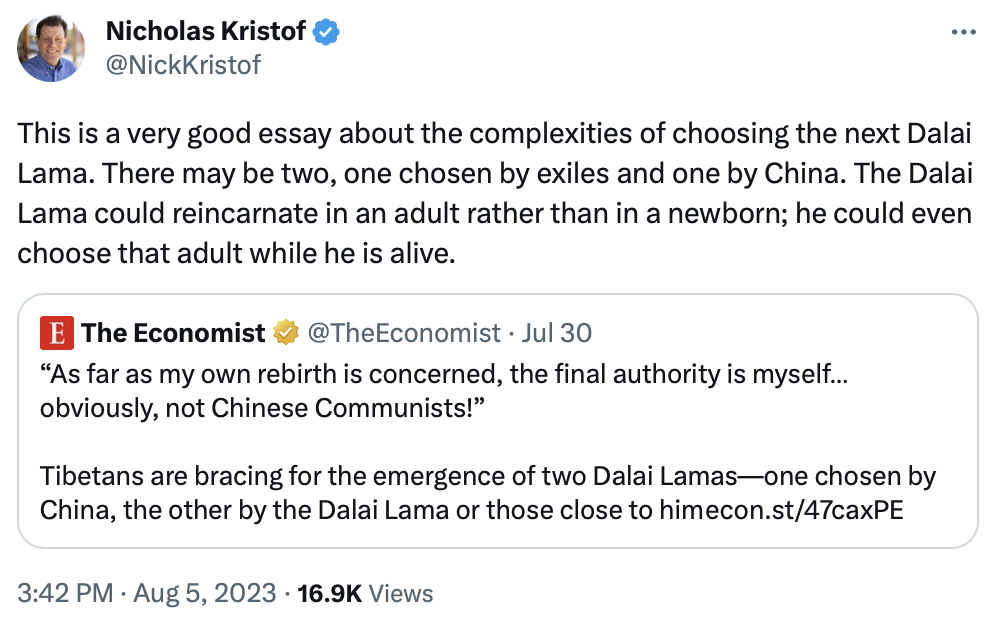
Today I came across this tweet by Nicholas Kristof, the New York Times columnist who ran for the governor of Oregon, the state where I live, until a court ruled that he didn't meet the residency requirement for that office.
Fascinating. Even though I don't believe in reincarnation, or rebirth, this notion is central to the mystique surrounding the Dalai Lama, since all of the leaders of Tibetan Buddhism supposedly are part of an unbroken string of incarnations of previous leaders.
Though I don't subscribe to The Economist, I'd registered with this publication, which entitles me to read three articles a month. Below I've copied in the lengthy article cited in Kristof's tweet. It's about 5,000 words, so I've boldfaced the parts that struck me as most interesting to Church of the Churchless readers.
Click on the continuation link to read the entire article. I wasn't aware of the intense struggle surrounding the choice of a successor to the current Dalai Lama between Chinese authorities and the Tibetan Buddhist community. The article does a good job of explaining this.
——————————————————–
China wants to choose the next Dalai Lama. He has other plans
As rival candidates are lined up to succeed the Tibetan spiritual leader, Brook Larmer unpicks the politics of reincarnation
The boy’s existence had been little more than a rumour. When he appeared during a ceremony in March on a small throne below the Dalai Lama, the ageing leader of Tibetan Buddhism, the monks and nuns in the audience didn’t seem to recognise him. The boy, about eight years old with short black hair, wore a copper-tinted robe with oversized cuffs covering his hands and – as if to add to the mystery – a white mask over his face.
Midway through the ceremony, held in Dharamsala, the north Indian refuge for Tibetan exiles, the Dalai Lama paused and gestured nonchalantly toward the boy: “We have the reincarnation of Khalkha Jetsun Dhampa Rinpoché of Mongolia with us today.” This was, in the world of Tibetan Buddhism, a mic-drop moment. The last Jetsun Dhampa – one of the religion’s most important figures – died in 2012. But the significance of the announcement was not only religious. The Dalai Lama had managed to outmanoeuvre China in the geopolitical chess game of reincarnation.
Seven years ago, the Dalai Lama told a press conference in Mongolia that he was convinced Jetsun Dhampa’s reincarnation had been born in the country. “However, the boy is very young right now,” he said, “so there is no need for haste in making an announcement.” The Chinese government, which claims sole authority over all Tibetan Buddhist reincarnations, was incensed. It closed its main border crossing with Mongolia and delayed loan negotiations with the cash-strapped country.
Then there was silence. Under Chinese pressure, Mongolia, which along with Tibet is a centre of Tibetan Buddhism, banned the Dalai Lama from future visits. To stiffen the Mongolians’ resolve – and embolden the boy’s reluctant parents – the Dalai Lama sent in one of his most influential spiritual advisers: a monk named Thubten Ngodup. Thubten is the medium of the state oracle of Tibet, whose visions have guided the decisions of the Dalai Lama and his predecessors since the 16th century. He met in secret with the boy and his parents, offering reassurances and counselling patience. “The family was a little nervous, uncomfortable, but slowly, slowly, they came to accept their fate,” Thubten told me. “We still had to keep it secret because we didn’t want China coming up with their own fake Jetsun Dhampa.”
When the Dalai Lama introduced the boy in March, Tibetan Buddhists were thrilled at the audacity: not only had the Dalai Lama found the reincarnate lama beyond China’s grasp, he had managed to pull it off in secret. What’s more, the boy had been born in Florida, giving him the added protection of a passport from a government that has staunchly defended Tibet’s right to choose its spiritual leaders. With a single revelation, the Dalai Lama had created a possible template for an even more important reincarnation to come: his own.
Reincarnation might seem like an esoteric subject for 21st century geopolitics, especially for a secular state like the People’s Republic of China. But the Communist Party’s efforts to manage the transmigration of Buddhist souls are part of a contentious, decades-long campaign to absorb Tibet into China and control Tibetan Buddhism. In this existential contest, the reincarnations of the senior monks known as lamas have become a battleground for the future of Tibet. And no reincarnation is more consequential or volatile than that of the Dalai Lama himself.
At 88 years old, the Dalai Lama is frail enough that three monks assist him – one on each arm, one girding his waist – as he shuffles across the grounds of his monastery in Dharamsala. For more than six decades, ever since he escaped across the Himalayas from invading Chinese forces in 1959, the Dalai Lama has sustained and unified his people, elevating their struggle into a global cause. China claims sovereignty over Tibet, and insists that its forces liberated Tibetans from poverty and slavery. In response, the Dalai Lama has single-handedly spread a counter-narrative of his homeland as non-violent, noble and unjustly oppressed. It is almost impossible for Tibetans – and the world – to imagine a Tibet without him.
But the Dalai Lama is approaching his final years at a time when China has never seemed stronger – or Tibet more vulnerable. The 6m-7m Tibetans still inside Tibet live under increasingly harsh Chinese rule. Billions of dollars in Chinese investment have been accompanied by a systematic weakening of Tibetan religion and culture, along with tight restrictions on movement and communication. An estimated million Tibetan schoolchildren are now compelled to attend Chinese-language boarding schools away from their homes, raising fears that their own language will soon disappear. Meanwhile, the estimated 150,000 Tibetans in exile, scattered across the globe, are at risk of losing their identity and unity as another generation comes of age with no memory of their homeland. “Tibet is dying a slow death,” Penpa Tsering, the president of the government-in-exile in Dharamsala, told me. “China is slowly, slowly constricting us like a python.”
Many Tibetans have tethered their hopes to the Dalai Lama. He is the 14th human incarnation of the first Dalai Lama, who was born in 1391 and considered the reincarnation of one of the most enlightened beings in Tibetan Buddhism, Avalokitesvara, the bodhisattva of compassion. He has led his people through 15 American presidents and all 74 years of the People’s Republic. Through his reincarnated lineage, he connects Tibetans to the bedrock of their history.
But what will happen when the Dalai Lama leaves this world? As a spiritual adept who wishes to continue helping others achieve enlightenment, the Dalai Lama is believed by Tibetan Buddhists to have the ability to choose the body into which his soul transmigrates. The Chinese government, however, has other ideas. Tibetans are now bracing for the emergence of two Dalai Lamas – one chosen by China, the other by the Dalai Lama or Tibetans close to him. Faced with this bizarre scenario, the Dalai Lama has been playful and elusive about his intentions. He has suggested, at various times, that the next Dalai Lama could be a girl, an adult or nobody at all. He might opt for an “emanation” – choosing someone while he is still alive – rather than a “reincarnation” after his death. The only certainties the Dalai Lama offers are that his successor will be born in a “free” country – not Tibet – and that he alone has the power to decide. “This is a religious matter,” he says. “As far as my own rebirth is concerned, the final authority is myself…obviously, not Chinese Communists!”
Today I read a talk in Pema Chödrön's book, The Wisdom of No Escape, where she explained to her Buddhist retreat students what the practice of tonglen is all about -- something I'd never heard about before. I found a web page where Chödrön describes tonglen in the same way as she did in her book. Check out "How to Practice Tonglen." Here's an excerpt. Tonglen practice, also known as “taking and sending,” reverses our usual logic of avoiding suffering and seeking pleasure. In tonglen practice, we visualize taking in the pain of others with every in-breath and sending out…
Pema Chödrön is one of my favorite writers about Buddhism. She's an American Buddhist nun and one of the foremost students of Chogyam Trungpa, a renowned meditation master. Here's some excerpts from a wonderful little book by Chödrön, The Wisdom of No Escape. I love how she describes meditation as simply attending to who we are right now, with no intent of improving ourselves. The book is a collection of talks she gave during a one-month practice period in 1989, which explains some repetition in what I've shared below, which come from the first eight of eighteen talks in the…
I feel a duty to report on how the subject I've been writing about recently, Rob Burbea's book about Buddhist teachings, Seeing That Frees: Meditations on Emptiness and Dependent Arising, ends. There wasn't a big surprise in the final pages. Burbea had been steadily building a case for emptiness being the foundation of both inner and outer reality, so it wasn't a shock when the final chapter concluded, in a thoroughly Buddhist fashion, that the world as it seems (distinct separate objects) and the world as it really is (empty of inherent existence) amount to the same thing. Burbea writes: We…
I'm pleased to present another comment from "Appreciative Reader," a regular commenter on this blog, that I liked a lot. (Not coincidentally, I agree with with what he says.) Appreciative Reader makes a point that, while it appears obvious now that I've read the comment, I hadn't thought of before. Or at least, not as clearly as he expressed it. Namely, that some religions, mystical practices, and other forms of spirituality can function just fine without supernaturalism, while others require supernaturalism in order for their teachings to be coherent. By coherent, I don't mean that the religion or whatever makes…
As noted before, what I both like and dislike about Rob Burbea's book about Buddhist teachings, Seeing That Frees: Meditations on Emptiness and Dependent Arising, is how marvelously detailed and deep Burbea dives into his subject. In no way is this a popular Buddhist book, using "popular" to mean a book aimed at people who want to know more about Buddhism but aren't into the farthest reaches of classic Buddhist writings and practices. It's more like a manual for attaining both a full conceptual knowledge and intuitive experience of what Burbea considers the core of Buddhism: emptiness, along with the closely…
I've continued to make my way through Rob Burbea's excellent book about Buddhist teachings, Seeing That Frees: Meditations on Emptiness and Dependent Arising. As noted before, Burbea goes into considerable detail about his subject, sometimes more than I'm capable of appreciating -- since I'm a fan of Buddhism but don't consider myself a Buddhist. Then I come across some passages that truly do resonate with me. Here's a sampling. This discussion of concepts impressed me because it fits so well with the modern neuroscientific theory of predictive processing by the brain. Basically this says that the brain is constantly making…
I'm personifying Buddhism in the title of this blog post. But really I'm talking about how Rob Burbea viewed the Buddhist approach to dualities in his book, Seeing That Frees: Meditations on Emptiness and Dependent Arising. As noted in recent posts about the book, I like the way Burbea explains his subject, though sometimes he can be too Buddhist-geeky for my less-committed-to-Buddhism taste. However, today my yellow highlighter kept making question marks in the margin as I read two chapters about "The Dependent Arising of Dualities" and "The Fading of Perception." I found much to like in the chapters, but…
Buddhism, like all "ism's", can be irritating. But that's the case with everything in life, really. Too much of a good thing can be a bad thing. I resonate with Buddhist teachings. However, as I make my way through Rob Burbea's in-depth examination of the Buddhist notions of emptiness, dependent arising, suffering, and such, some chapters in Seeing That Frees are too Buddhist-geeky for my taste. Burbea, like some practitioners who are really into Buddhist teachings, strikes me as being akin to a car enthusiast who wants to fine-tune every aspect of a vehicle's operation. So his book goes into…
It's a fitting day to be writing about reactivity, given that at the moment the fate of five people in a submersible craft that was on its way to view the wreck of the Titanic, some two and a half miles down in the ocean, is unaccounted for. Meaning, the craft hasn't been located after it lost communication with the mother ship about an hour and a half into its descent. By this time, it's estimated that if the five people are still alive, they're about to run out of air. That's a truly horrendous situation. It'd be extremely easy…
I'm continuing to enjoy the book by Rob Burbea, Seeing That Frees: Meditations on Emptiness and Dependent Arising. (First post about it is here.) It's clear that Burbea knows a lot about meditation, Buddhist variety, and is skilled at communicating his knowledge both to his students in person and to the world at large through his book. There's so much of interest in the six chapters (out of 31) that I've read so far, I find it difficult to decide what to share in my blog posts about the book. So I'll focus on some of what got special highlighting…
Shamil Chandaria's talk on the Bayesian Brain and Meditation that I wrote about recently is a gift that keeps on giving. For on one of his slides there was a small image of a book by Rob Burbea, Seeing That Frees: Meditations on Emptiness and Dependent Arising. I recall that Chandaria mentioned it briefly, but he certainly didn't dwell on the book. I figured, correctly as it turns out, that the book was in line with the ideas about the brain that Chandaria was talking about, so I decided to order a copy from Amazon. It took a while to…
In my experience, the most difficult part of writing is the first sentence and the last sentence. With one, there's nothing that comes before. With the other, there's nothing that comes after. So those sentences are unique. I struggled with the first sentence in my book, Return to the One. Until finally, a sentence popped into my head that seemed just right to me. If something has been lost and you're not sure where to look for it, there's good reason to start searching right where you are rather than far afield. Then I spoke about the familiar situation (familiar…
One of the things that I like about the Buddhist notion of emptiness, where change is omnipresent because nothing possesses an inherent existence, is how much money it saves me on books. For I've found that rather than buying a new book to get some fresh ideas, I can look over the books I already own and reread them. This gives me fresh ideas because I've changed from the last time I read the book, so much of it will seem new to me. Case in point: a few days ago I was looking at the mindfulness section in my…
Back in my religious-believing days, I would have viewed this as a sign from God. Now, I just see it as an interesting coincidence. But who knows? Maybe it is a sign from God! Last week I'd scribbled on a large post-it note some of what Sam Harris had said in a guided meditation of his Waking Up app, then stuck the note next to books that I read every morning before meditating. It quoted Harris as saying: The goal of meditation is to realize that consciousness as it is, is good enough. Not waiting for something to happen. I…

 11
11