

Usually I put new issues of New Scientist and Scientific American at the bottom of a pile of science magazines that I try to read in order, oldest first. But when the October 2026 issue of Scientific American came with a provocative cover story that pushed my philosophical button, I had to read several of the Impossible Questions right away.
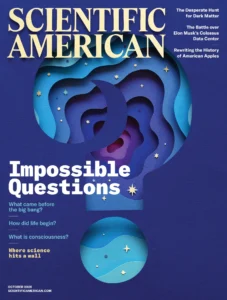
I started with “What Is Consciousness, Really?” by Tim Bayne. It was disappointing, though. The main point of the article was that there’s no general agreement about what the word consciousness refers to. So the title of the article referred to the meaning of consciousness instead of the thing itself. Excerpt:
Consciousness researchers have never agreed on what we mean when we use that word. In some disciplines, “consciousness” means “sentience”; in others, “awareness.” Still others use it interchangeably with “experience” or “qualia.” The muddy terminology makes it hard to tell whether the different areas of consciousness even have a common subject matter.
So I moved on to “What Came Before the Big Bang?” by Sarah Scoles. Much better. Here’s a PDF file: What came before the big bang? | Scientific American
The question obviously is devilishly difficult to come to grips with. Scoles writes:
It’s unclear whether science as a discipline, and scientists as people, will ever be able to answer some questions definitively. After all, no one can “see” what happened before the big bang, and no one will ever be able to, at least not directly. But the current and future universe, researchers are learning, may contain clues about the distant past, ways to test theories about the before before. “I’m happy to listen to any framework, but I only start taking it seriously when it produces a clean observational target that a real instrument can go after,” says Brian Keating, a cosmologist at the University of California, San Diego. “If there isn’t a discriminant you can measure, you’re doing metaphysics with equations.”
Here are three ideas that he and other scientists take seriously about the cosmos’s ultimate origins:
The No-Boundary Proposal
…That infinite regression, however, didn’t make sense to physicists Stephen Hawking and James Hartle, who worked on the question together in the 1980s. They decided to eliminate the universe’s ultimate input—its “beginning.” Instead they formed a model of the universe called the no-boundary proposal. They suggested that time and space form a closed, rounded surface: a four-dimensional hemisphere of spacetime.
Imagine the universe like the globe of Earth. The big bang is the North Pole. There is no “before” it, just as there is no north of north. “Before” becomes irrelevant as a concept. “It’s almost like a Zen idea,” Lehners says. And it’s one he’s toying with in calculations to see if he can re-create the universe we see today from a round place with no north of north.
Cyclic Cosmos
…So he came up with a cyclic universe: one that balloons significantly in size, as ours seems to be doing now, then shrinks a little and then starts expanding all over again. “When people think about contracting universes, they’re usually thinking about things coming to a crunch,” Steinhardt says—the cosmos collapsing back down into an infinitesimally small point. That’s not what Steinhardt is talking about: he thinks the universe perhaps contracts slowly, to a smaller fraction of its size but not to nothing.
…Steinhardt adds that what looks like a big bang is actually not. The universe expands, then slowly contracts and then quickly goes back to expanding. The fast transition between contraction and expansion is not a bang but a “big bounce.”
Mirror Universe
…Like the big bounce concept, Boyle’s favored proposal is pretty simple conceptually, and it also avoids inflation. “There’s the universe after the big bang and the universe before the big bang,” he says, “and they’re kind of mirror copies of each other.”
Picture this, Boyle says, like the points of two ice cream cones touching each other, with their contact representing the big bang. “Time marches away from the big bang in both directions,” he says. On our side, it goes forward; on the mirror side, it goes backward. What happened before the big bang is the reflected opposite of what happened after. And that doesn’t just include time: here there is matter; there there is antimatter. Here left is left; there left is right.
Scoles says near the end of her story:
Each of these scientists is attached to their own idea. But Lehners isn’t confident any of them will stand the test of time—whatever time is. “I think it’s completely preposterous that, in the year 2025, we should understand the beginning of the universe,” he says. In the grand scheme of things, in other words, we’re still at the beginning of our journey of understanding. “Why not in the year 2,000,025 or whatever?”
Or, never. Because it seems to me that the effort to determine what, if anything, came before the big bang runs head on into the biggest question of all: Why Is There Something Rather Than Nothing?
I’ve been fascinated by this question for many years. Decades, really. It points to the mystery of existence, how it is that anything exists at all. (Put “mystery of existence” into the Search box in the right sidebar and you’ll find most of the posts I’ve written on this subject.) Existence simply seems to be a given. What I said in a 2011 blog post, Mystery of existence eludes both religion and science, still resonates with me now. Here’s the post in its entirety.
“Why is there something rather than nothing?” This is the ultimate question. So ultimate’y, it shouldn’t be viewed as a question, because questions imply answers.
I prefer, “There is something rather than nothing.”
Leave out the “why.” Embrace the stark, unarguable reality of existence. Forget God. Something must exist or God couldn’t exist. So my awe is directed toward existence, not God.
Existence is everlasting, eternal, omnipresent, unfathomable. Wild! If I want to feel a tingle up my psyche’s spine before I fall into sleep, I ponder there is something rather than nothing as I doze off.
(Some reflections of my ponderings are here, here, here, here, and here.)
Last week a fresh New Scientist issue arrived in the mail. Glancing at the cover I was excited to read:
The Existential Issue
The staggering mysteries of being
(and how to cope with them)Appropriately, the first mystery tackled in the existential issue was “Why is there something rather than nothing?” After all, without something, there’d be no other mysteries.
I liked the mixture of science and philosophy in the article by Amanda Gefter. In less than three minutes you can get the gist of how modern cosmology looks upon this question in the following New Scientist video. [sorry, it’s missing]
(My favorite part: “something and nothing may well be the same thing.” The universe is just a form of nothing. Ooh! So Zen!
Still, this doesn’t really answer the question of why anything exists at all. Gefter acknowledges the untouched mystery of existence in her final paragraph.
“None of this really gets us off the hook, however. Our understanding of creation relies on the validity of the laws of physics, particularly quantum uncertainty. But that implies that the laws of physics were somehow encoded into the fabric of our universe before it existed. How can physical laws exist outside of space and time and without a cause of their own? Or, to put it another way, why is there something rather than nothing?”
Religious believers will seize upon this admission of science’s inability to peek behind the curtain of why existence exists and exclaim, “God is the only answer!” To which I reply, “Wrong!”
God, whether viewed as a personal or impersonal power, fills precisely the same role in theology as do the laws of physics in science.
That is, a given. Something for which no cause is offered. A brute fact, without which no other facts are possible.
OK. To me, it’s a tie. Both religion and science are clueless about the ultimate question: why is there something rather than nothing? Each offers up an answer that doesn’t satisfy.
“God created the universe.” Fine. So tell me, what created God?
“The universe was created by a quantum fluctuation.” Fine. So tell me, what created the quantum fluctuation?
What is simply is. There is something rather than nothing. I find this eminently satisfying. More than that, actually, much more. It’s awesome. Mindblowing. Astoundingly meaningful.
Why? Like existence itself, there’s no why.
Discover more from Church of the Churchless
Subscribe to get the latest posts sent to your email.
There is Mauj of Radhasoami Dayal
Before Big Bang
A event recorded outside time(kaal)
Creation comes
I believe big bang is yet to happen
What would it look like
That’s mystery
One has to work on
For it leads to Truth
https://youtu.be/nSrBC2mClyw?is=mX0WfnTEsGiBFzbL
soundtrack of the cosmic crowbar prying your soul from its home during the Big Bang and the ten percent who played slide and didn’t want to leave ( the 2 percenters who played correctly) . Paul McCartney is just a fun name to say like Angelina Jolie. It just goes together and rolls off the tongue like poetry in motion.
The squeaky wheel gets the grease
American proverb
Rather Blueprint comes without consciousness
Kaal makes that blueprint
But it is not alive
For One comes down to be conscious of kaal design
Creation comes
In science
Time exists as an just one dimension before big bang
But there is no one to experience time… no reference point
so blueprint before big bang is not alive
once creator releases dimensions
Time come into existence
with big bang
Whatever may be objectively proven about the universe — Creator or no Creator, beginning or no beginning — suffering is the central issue for all of us.
“Once Bodhicitta arises in us it will take care of everything.” — The Dalai Lama
Which came first the chicken or the egg. It doesn’t matter if you’re vegetarian. For consciousness you just need to be vegetarian and a good person and I’m working on the second part thanks to my wonderful critic.
It’s about time that you man up and tell everyone Daddio
“I’m happy to listen to any framework, but I only start taking it seriously when it produces a clean observational target that a real instrument can go after,” says Brian Keating, a cosmologist at the University of California, San Diego. “If there isn’t a discriminant you can measure, you’re doing metaphysics with equations.”
A solid guideline for where we should put our time.
When you ask the question “what came before” it is a parochial question, not a physics question.
Time is fluid. And where there is matter the rate of time is inversely proportional. Where there is expansion time can move, relatively, backwards.
Whenever you look through a telescope you are looking backwards in time.
When there was only matter, if you extrapolate backwards, you get to the point where time is zero.
What can happen or exist then? When there is zero time and only matter?
Calculus gives us the hint. The passage of time is the summation of an infinite series of points that have zero time. How can something moving emerge from from an infinity that is motionless?
That is not a philosophical question. It is a physics question. And we already have a mathematical answer. And so much science relies upon it, upon calculus, for navigating this tiny slice of reality.
I quite like this point of view: –
“Why is there something rather than nothing?” This is the ultimate question. So ultimately, it shouldn’t be viewed as a question, because questions imply answers.
I prefer, “There is something rather than nothing.”
Leave out the “why.” Embrace the stark, unarguable reality of existence. Forget God. Something must exist, or God couldn’t exist. So, my awe is directed toward existence, not God.
______
One ‘really’ hypothetical view of the universe is to imagine not just one universe but countless universes, all existing in an endless sea of nothingness with vast distances between them and at different stages of development. Some are just a tiny, hot, and dense space, yet to become their ‘big bang’; others are in various states of expansion or contraction. All existing in absolute nothingness.
Well, as we are talking about stuff we do not know – and may never know – whether we invoke physics or God, any hypothesis goes – take your pick. I don’t think that we – somewhat advanced human primates – are equipped to know such things. All ideas about the creation of the universe – and us – are merely just that, ideas.
All we can honestly know is that each of us is here now. In this moment, existing in a world of impermanence – as much as we would like to make it permanent, certain and to have meaning. Basically, we are really not atheists or deists, but ‘don’t know’ists.
What an eye opener. I was given false information by someone strung out on drugs and saying anything they had to for a fix. Admit your mistake Babaji, that’s the first step. These people know now. You can be known as the first guru that took 12 steps instead of ten. But to a normal size man it would be 10. For every step we take towards the guru he takes 10 but in your case 12. I don’t think you can call it a grudge when a narcissist or anyone does you wrong and owes you a simple apology and maybe some other things. Only another narcissist would think that a grudge wasn’t warranted. But back to the Big Bang. All she wants to do is dance , and make romance.
False information from a junkie who just wanted another fix had stared me in the face for so long I didn’t even recognize it. If Babaji was a snake he would have bit me. Why me Lord ? Is it your will Lord. Willard . In the end Babaji learned more from me than I learned from him but where he’s going they already have rock and roll
Maybe he got Jasdeep so he could have someone to quit using with. That’s typical.
I make fun of it but his big time white turban crime and marching over women womaning doesn’t bother me like him lying to me might. But he was on drugs. He admitted it but he said that the echo of the big bang could cut through anything. .( The Shabd) Now that’s real ! He just needs to make amends. What a flash I just found out yesterday . His apology would end the grudge and I think I can speak for everyone. And still not have to be master.
Just give Jaz 8 steps mister. Eight steps towards the door and we won’t see him no more.
https://www.indiatoday.in/world/story/indian-origin-pharma-tycoon-tonmoy-sharma-arrested-in-us-for-healthcare-fraud-2735798-2025-06-04
Every scale of measurement in physical reality is a ratio scale. That means it has a zero point. Without zero, two is not necessarily twice the value of one.
With a zero, equal intervals can be established and measurement is possible.
But it is only possible because zero must exist. For distance and speed, size and time to exist zero must exist. Even though, by definition, zero cannot exist. Yet it fits perfectly into a relativistic universe. This object exists here, but there is zero of it over there.
To exist at all that last statement must be true.
And that brings us back to Newton, and Calculus. For time to proceed, zero time, zero movement and zero mass must also exist, even though by that sane definition they do not exist.
These are not contradictions in reality at all. They are necessary conditions of this creation. Where there is existence, it can only be measured in contrast to its absence, whether time, space, matter, energy… All things that exist also requires the presence of their non-existence
But they are contradictions using human logic of human reasoning. The very reasoning that brings to us every measurement has built into it the requirement of zero.
Why does anything exist anywhere? Don’t worry, it must also not exist somewhere at the same time.